

City logistics hubs are becoming critical to improving distribution efficiency across high-density urban markets, where congestion, rising order volumes, and faster delivery expectations challenge traditional networks. A strong city logistics hub development strategy helps businesses assess hub locations, delivery density, warehousing needs, last-mile connectivity, carrier access, regulatory constraints, and cost-to-serve dynamics.
Within Market Entry Strategy Service Offerings, city hub analysis supports market prioritization, distribution network design, partner selection, route optimization, and scalable urban logistics planning for efficient, resilient, and customer-focused market entry.
The positive impact is clear as urban consolidation and logistics hub models can reduce freight vehicle trips by 15% to 30% in dense city areas. This improves distribution efficiency, lowers congestion, supports faster deliveries, and strengthens scalable urban market entry.
Market Entry Strategy Services for Urban Logistics Hub Planning
Urban logistics hub planning strengthens market entry by aligning hub location, fulfillment capability, distribution efficiency, regulatory readiness, and scalable city logistics execution. Key focus areas of the plan are:
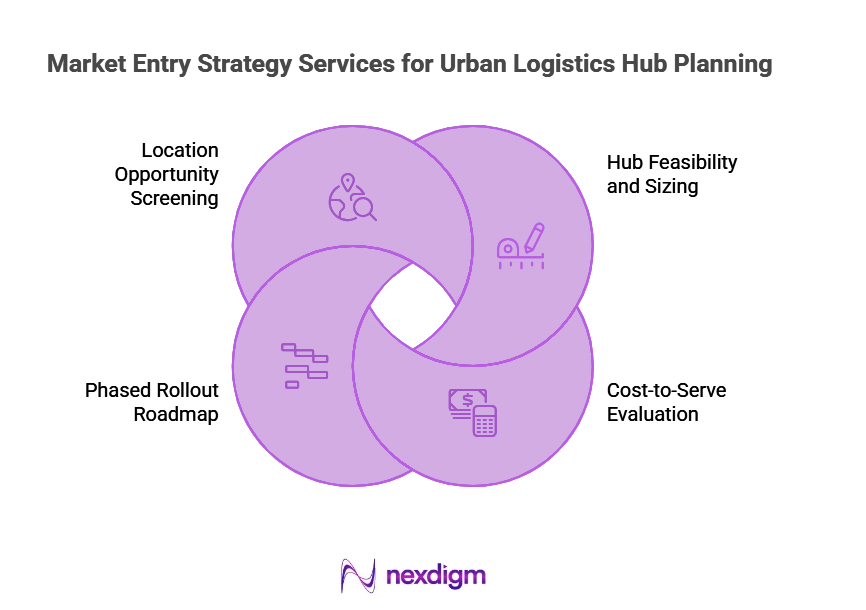
- Hub Feasibility and Sizing: Determination of hub size, inventory capacity, dispatch needs, facility type, and location suitability for planned market coverage.
- Cost-to-Serve Evaluation: Analyzing facility costs, delivery expenses, handling charges, route productivity, and utilization to assess commercial viability.
- Phased Rollout Roadmap: Defining pilot locations, launch sequencing, performance metrics, risk controls, and expansion milestones for scalable market entry.
- Location Opportunity Screening: Shortlisting potential hub locations based on demand access, real estate suitability, transport links, and service coverage potential.
Nexdigm’s Role in Strengthening Hub-Based Urban Market Entry Models
Nexdigm enables businesses to build hub-based urban market entry models through city logistics hub development strategy, Market Entry Strategy Services, distribution network planning, demand cluster analysis, logistics partner assessment, and last-mile delivery optimization. Its advisory support helps companies improve market access, reduce operating complexity, enhance delivery efficiency, and create scalable urban logistics models.
Nexdigm’s Go-to-Market Approach for Hub-Based Urban Expansion
Nexdigm’s approach strengthens hub-based market entry by integrating demand assessment, logistics infrastructure planning, partner mapping, risk review, and scalable operations. The key focus areas here are:
- Demand and Serviceability Analysis: Reviewing customer density, serviceable zones, order volumes, delivery promises, and fulfillment requirements across target urban clusters.
- Infrastructure and Facility Planning: Assessing warehouse space, micro-hub needs, loading access, dispatch readiness, and facility scalability for urban logistics operations.
- Distribution Efficiency Review: Measuring route density, delivery speed, trip utilization, congestion exposure, and operating productivity across hub-based models.
- Governance and Scale Framework: Defining KPIs, partner controls, service standards, risk mitigation actions, and scale-up milestones for long-term execution.
- Hub-and-Spoke Network Design: Defining central hubs, micro-hubs, spoke points, delivery zones, and fulfillment routes for efficient urban distribution.
Nexdigm’s Case
Nexdigm assisted a retail company to assess urban logistics hub planning for market entry. The study analyzed 22 customer clusters, benchmarked hub-and-spoke models, and shortlisted partner options, improving projected delivery reach by 35%, and reducing route overlap by 26%.
To take the next step, simply visit our Request a Consultation page and share your requirements with us.
Harsh Mittal
+91-8422857704