

Claims technology has become a critical part of insurance operations because it affects both financial outcomes and policyholder experience. Insurers need systems that can register claims, collect documents, coordinate assessments, identify suspicious activity and track settlements. The technology market includes broad claims management platforms as well as specialist providers focused on fraud analytics, document automation and customer communication.
Identifying market leaders requires more than comparing software features. Providers operate at different points in the claims lifecycle, and their value depends on the insurance segment, claim complexity and existing operating environment.
Claims Administration Platforms: Managing the End-to-End Workflow
Claims management systems coordinate activities from first notification of loss through assessment, approval, payment and closure. They may include case allocation, workflow rules, document repositories, communication tools and management dashboards.
Some platforms are designed for broad insurance operations, while others focus on specific segments such as health, motor or property claims. A general insurer may need configurable workflows across several product lines, whereas a health insurer may require integrations with hospitals, third-party administrators and medical document systems.
Vendor analysis should examine workflow configurability, case tracking, document handling, integration with policy records and support for different claim types. The platform should also provide visibility into pending cases, processing stages and unresolved exceptions.
Efficiency: Measuring Automation and Processing Quality
Claims automation can reduce repetitive work, improve information availability and help route cases to the appropriate teams. Technologies may include optical character recognition, document classification, automated data extraction, rules-based decision support and workflow orchestration.
However, automation rates alone do not establish operational efficiency. A platform may automate document intake while leaving verification, assessment and settlement dependent on manual processes.
Buyers should examine the complete workflow and identify where technology reduces processing effort. Useful indicators include time from notification to initial review, document completion rates, manual intervention, exception volumes and processing time by claim category.
The comparison should also distinguish routine claims from complex cases. A system that performs well on standardised claims may require substantial human review when documentation is incomplete or the claim involves multiple parties.
Fraud Detection: Combining Data and Investigation Workflows
Claims fraud technology can support anomaly detection, identity checks, duplicate identification, network analysis and risk-based case prioritisation. Some providers offer specialised analytics, while broader claims platforms incorporate fraud indicators into existing workflows.
The quality of these tools depends on data coverage, model design, explainability and the ability to connect alerts with investigation processes. High alert volumes can overwhelm claims teams if the system does not distinguish meaningful risks from routine variations.
Vendor assessment should consider the types of fraud signals supported, data sources used, model monitoring, alert prioritisation, audit trails and integration with case management systems. Buyers should also understand how false positives are handled and whether investigators can review the basis for a flagged claim.
Technology can help identify patterns and prioritise cases, but it should not replace appropriate investigation or professional judgement.
Customer Experience: Keeping Policyholders Informed
The claims journey is often the most consequential interaction a customer has with an insurer. Delays, repeated document requests and unclear communication can damage trust even when the final decision is appropriate.
Customer-facing claims technology may include digital claim submission, document upload, status tracking, notifications, chat support and self-service portals. The best fit depends on the insurer’s customer base and the complexity of its claims.
Evaluation should examine ease of use, mobile accessibility, communication preferences, language support and the consistency of information across digital and assisted channels. Integration with internal claims records is particularly important. A customer portal that does not reflect current case status can create more enquiries rather than reduce them.
Market Landscape and Provider Differentiation
The claims technology market includes enterprise software providers, specialist insurtech companies and firms offering focused automation or fraud analytics. Some platforms provide broad claims administration, while others address a specific step such as document intelligence, damage assessment or fraud detection.
India’s insurance sector paid claims worth approximately ₹8.36 lakh crore during FY2024-25, reflecting the scale of the activity supported by insurer operations. The volume and complexity of claims create opportunities for technology providers, but comparisons must account for differences between life, health and general insurance workflows.
Market leadership should therefore be assessed by segment and capability. A specialist fraud analytics provider should not be ranked directly against a full claims administration platform without accounting for their different roles.
Nexdigm’s Claims Management System Vendor Landscape Framework
Navigating the claims management system vendor landscape requires a structured evaluation of administrative platforms, automation tools, and fraud analytics to match technology capabilities with specific operational requirements.
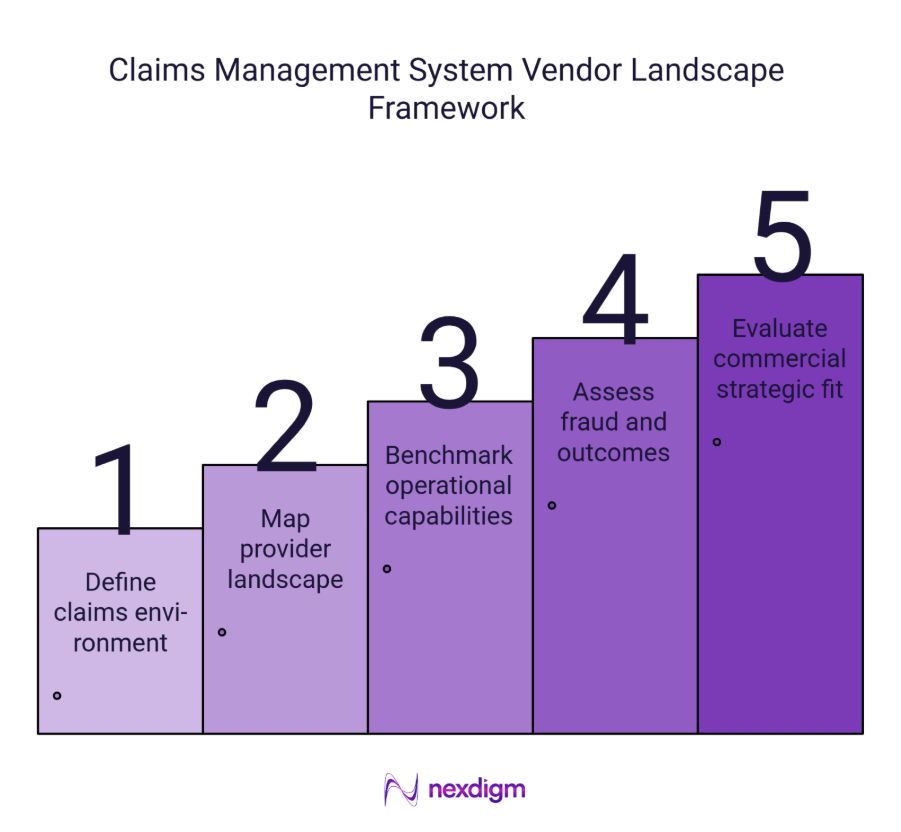
- Define the claims environment: Identify insurance lines, claim volumes, case complexity, operating channels and current processing challenges.
- Map the provider landscape: Classify vendors into end-to-end claims platforms, automation specialists, fraud analytics providers and customer experience solutions.
- Benchmark operational capabilities: Compare workflow management, document processing, automation, integration and case visibility.
- Assess fraud and customer outcomes: Examine detection capabilities, alert quality, investigation support, communication tools and policyholder access.
- Evaluate commercial and strategic fit: Compare licensing, implementation, data dependencies, scalability and integration costs before creating a segment-specific shortlist.
Case Study: Claims Technology Vendor Landscape
An insurance provider reviewing claims operations needed to compare enterprise platforms with specialist fraud and automation solutions. Nexdigm mapped 22 vendors across claims administration, analytics and customer-facing technology, identifying differences in product scope and integration models. The assessment produced a shortlist of seven providers for further review.
To take the next step, simply visit our Request a Consultation page and share your requirements with us.
Harsh Mittal
+91-8422857704