

Climate-smart agriculture is moving from a sustainability objective toward a measurable business opportunity as farmers, agribusinesses, investors, and policymakers seek practices that improve productivity while strengthening resilience and reducing emissions. Solutions include improved seeds, precision irrigation, soil management, crop diversification, digital advisory, and efficient input application.
Recent statistics demonstrate the opportunity. The World Bank reports that 75% of its current agriculture portfolio projects improve productivity, while 31% build climate resilience, demonstrating increasing integration of climate-smart objectives into agricultural investment.
These trends create opportunities for organizations assessing scalable practices, farmer adoption, technology models, financing mechanisms, and commercially viable climate-resilient agricultural solutions.
Evaluating Climate-Smart Agriculture for Scalable Impact
While the range of climate-smart agricultural solutions continues to expand, not all practices deliver the same combination of economic viability, resilience benefits, and farmer adoption potential.
For stakeholders seeking scalable opportunities, the key challenge is identifying interventions that can generate measurable productivity gains, withstand climate-related risks, and achieve widespread adoption without excessive dependence on subsidies or external support.
Assessing scalability requires a multidimensional lens. Successful climate-smart practices typically demonstrate:
- Productivity impact: Ability to improve yields, input-use efficiency, or farm profitability.
- Climate resilience: Capacity to help farmers manage droughts, heat stress, water scarcity, pest pressures, and other climate-related risks.
- Economic feasibility: Clear return on investment for farmers, agribusinesses, and investors.
Understanding how different practices perform across these dimensions is essential for prioritizing investments and designing programs that can deliver both environmental and commercial outcomes. The following analysis examines leading climate-smart practices, evaluating their resilience benefits, productivity impacts, economic attractiveness, and likelihood of adoption at scale.
The Climate-Smart Practices with the Strongest Scaling Potential
A select group of climate-smart agricultural practices stands out for its ability to improve productivity, strengthen resilience, and deliver economic value at scale. These include climate-resilient seeds, precision irrigation, soil health management, crop diversification, optimized input use, and digital advisory solutions. However, scalability depends on factors such as local conditions, affordability, infrastructure, and farmer readiness.
From a Nexdigm perspective, the most promising solutions are those that combine measurable farm-level benefits with strong adoption potential and sustainable commercial returns. Understanding their performance across these dimensions is critical to identifying scalable climate-smart agriculture opportunities.
Nexdigm’s Insights on Climate Smart Agriculture Market Assessment
As climate-smart agriculture transitions from a sustainability priority to a commercial growth opportunity, stakeholders require a structured approach to evaluate which practices can scale effectively.
Through a Climate Smart Agriculture Market Assessment, Nexdigm examines solutions based on their ability to enhance resilience, improve productivity, drive farmer adoption, and generate sustainable economic returns.
This market-led perspective helps identify high-potential opportunities for agribusinesses, investors, technology providers, and policymakers seeking scalable and commercially viable climate-smart agriculture solutions.
Nexdigm’s Assessment of Leading Climate-Smart Practices
To identify practices with the highest scaling potential, Nexdigm evaluates climate-smart agriculture solutions that helps stakeholders prioritize interventions that deliver measurable farm-level benefits. The structured steps followed during the assessment are:
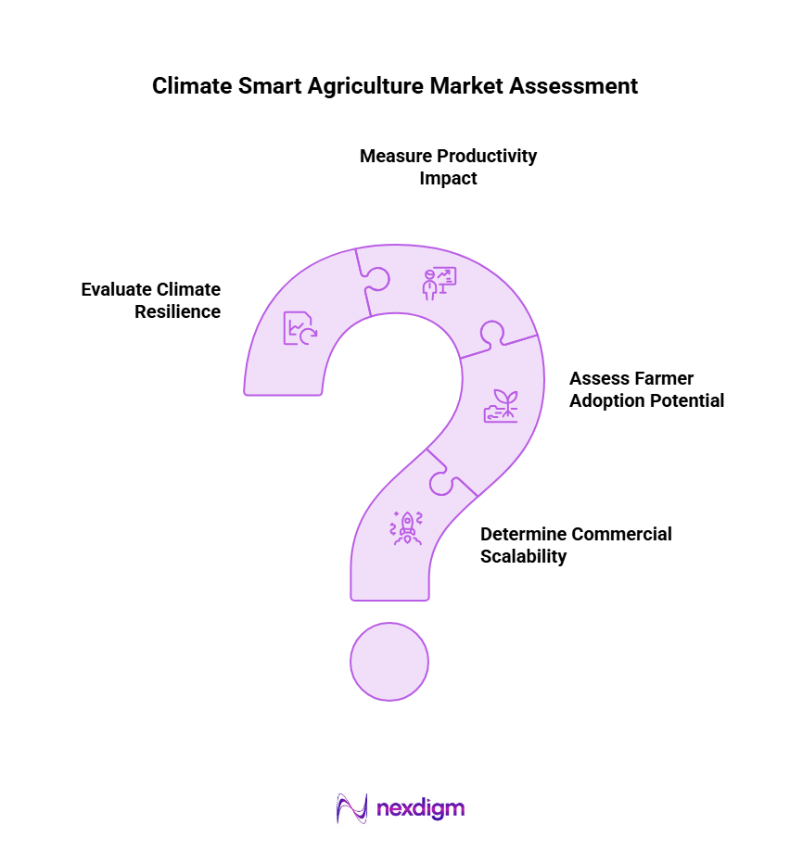
- Evaluate Climate Resilience: Assess the ability of a practice to help farmers manage climate-related risks such as drought, heat stress, water scarcity, and changing weather patterns. Practices that strengthen adaptive capacity are more likely to remain effective under future climate uncertainties.
- Measure Productivity Impact: Examine the extent to which the practice improves yields, optimizes resource use, reduces losses, or enhances farm profitability. Strong productivity outcomes are critical for driving farmer interest and ensuring long-term economic sustainability.
- Assess Farmer Adoption Potential: Analyze factors influencing adoption, including ease of implementation, affordability, awareness, required behavioral changes, and access to supporting infrastructure. Solutions with lower barriers to adoption typically achieve greater scale.
- Determine Commercial Scalability: Evaluate whether the solution can be replicated across regions, crops, and farming systems while generating sustainable value for farmers, agribusinesses, investors, and other ecosystem participants.
By applying this framework, Nexdigm helps stakeholders identify climate-smart agriculture solutions capable of delivering both measurable sustainability outcomes and long-term commercial value.
Nexdigm’s Climate-Smart Assessment Promoting Sustainable and Commercial Value
Climate-smart agriculture creates value when sustainability outcomes align with economic performance. Through its assessment framework, Nexdigm helps stakeholders identify solutions by focusing on the following areas:
- Prioritizing High-Impact Opportunities: Assessment findings help identify practices that offer the strongest combination of resilience, productivity improvements, and adoption potential, enabling stakeholders to focus resources on high-value interventions.
- Aligning Sustainability with Business Objectives: Climate-smart solutions are most effective when environmental benefits are accompanied by measurable economic gains, including higher yields, improved resource efficiency, and stronger farm profitability.
- Supporting Scalable Growth Models: By evaluating implementation feasibility, financing requirements, and ecosystem readiness, organizations can develop business models that support long-term adoption and market expansion.
- Driving Stakeholder Value Creation: Farmers, agribusinesses, investors, and policymakers can leverage assessment insights to strengthen decision-making, reduce risks, and unlock new growth opportunities within the agricultural sector.
These insights enable stakeholders to move beyond sustainability goals and focus on scalable solutions that deliver measurable environmental impact, economic returns, and long-term value creation.
Nexdigm’s Case
A global agribusiness company engaged Nexdigm to evaluate climate-smart agriculture opportunities across resilient seeds, precision irrigation, soil management, and digital advisory. The study identified 14 scalable practice areas, and improved investment prioritization by 28%, supporting farmer adoption strategies, sustainable productivity, and climate-resilient growth initiatives.
To take the next step, simply visit our Request a Consultation page and share your requirements with us.
Harsh Mittal
+91-8422857704