

Climate variability and resource constraints are reshaping agricultural production, making procurement planning increasingly important to business continuity. India’s exposure is significant: nearly 60% of its net sown area is rainfed, contributing around 40% of total food production.
Government data also records 2,996 climate-resilient crop varieties released between 2014 and 2025. Globally, agrifood systems generated 18.5 billion tonnes of CO₂-equivalent emissions in 2024, representing 35% of total emissions.
These developments highlight the need to consider climate exposure, resource consumption, and input efficiency when evaluating agricultural sourcing decisions. A climate smart agriculture procurement strategy helps businesses connect procurement priorities with long-term resilience and responsible resource use.
Why Climate Resilience Must Influence Procurement Planning
Agricultural procurement is exposed to changing rainfall patterns, water availability, soil conditions, and temperature fluctuations. These pressures can affect input requirements, production costs, supplier availability, and delivery schedules. Businesses therefore need to consider how sourcing regions, input choices, and supplier capabilities respond to environmental stress. Procurement decisions that account for these factors can help reduce resource-related vulnerabilities and support more consistent agricultural operations.
Procurement Priorities for Climate-Smart Agriculture
A climate-focused procurement approach should balance operational requirements with the efficient use of natural resources. Three priorities can guide this alignment:
- Resource-Efficient Input Selection: Evaluate seeds, fertilizers, irrigation solutions, and crop protection inputs based on their potential to improve resource efficiency and suit local growing conditions.
- Climate-Resilient Supplier Networks: Assess suppliers across sourcing regions, production capabilities, and distribution networks to understand their exposure to climate-related disruptions.
- Sustainable Technology and Practices: Consider precision agriculture, water-efficient irrigation, soil management solutions, and other technologies that support more efficient agricultural operations.
Integrating these priorities into procurement planning helps businesses connect input selection with resource conservation, operational continuity, and changing agricultural conditions.
How Nexdigm Connects Procurement Research With Climate Priorities
Our climate smart agriculture procurement strategy combines agricultural market research, supplier intelligence, and commercial assessment to help businesses evaluate sourcing opportunities through a climate and resource-efficiency lens. Our research can examine:
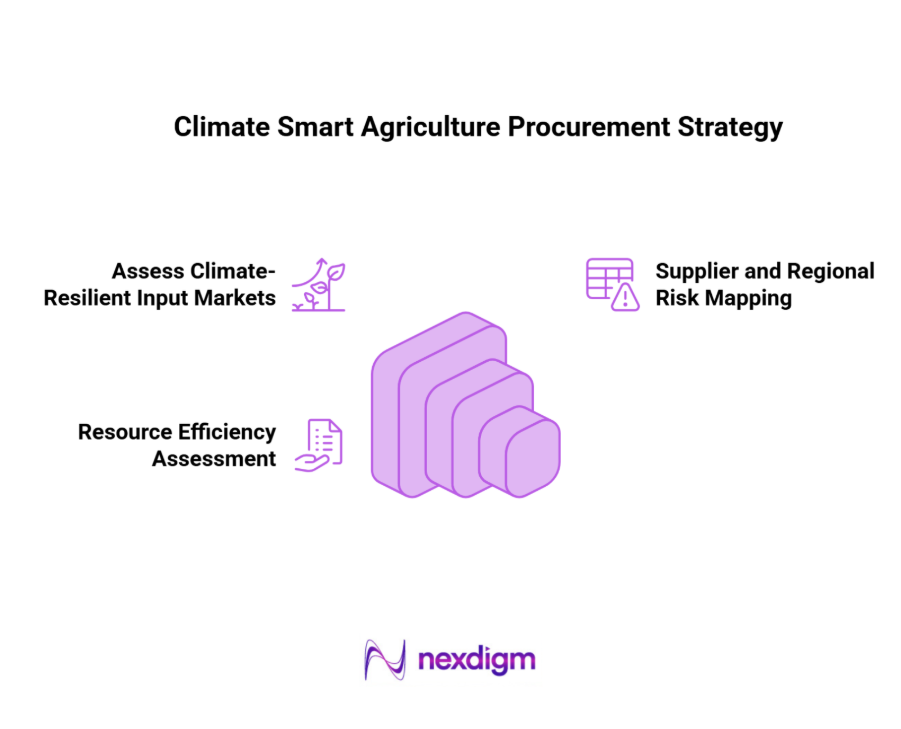
- Climate-Resilient Input Markets: Identify suppliers and solutions across drought-tolerant seeds, efficient irrigation systems, biological inputs, and other climate-adaptive agricultural categories.
- Resource Efficiency Assessment: Examine product capabilities and available information relating to water use, energy consumption, soil health, and input efficiency.
- Supplier and Regional Risk Mapping: Evaluate sourcing locations, supplier networks, production capabilities, and distribution dependencies to identify potential climate-related vulnerabilities.
Together, these research areas help agribusinesses identify sourcing options that address climate-related challenges while considering operational and commercial requirements.
A Glimpse into Nexdigm’s Climate-Smart Agriculture Procurement Strategy
Our climate smart agriculture procurement strategy brings together agricultural market intelligence, supplier research, and commercial evaluation to help businesses assess climate-aligned sourcing opportunities. Our approach examines climate-resilient input categories, resource-efficient technologies, supplier capabilities, and regional sourcing risks. By connecting these insights, we help agribusinesses identify relevant alternatives, evaluate procurement feasibility, and prioritize sourcing options that support resource efficiency and long-term operational resilience.
How Nexdigm Converts Climate Priorities into Procurement Opportunities
Our agriculture procurement strategy helps agribusinesses move from understanding climate-related sourcing challenges to identifying practical procurement opportunities. By evaluating supplier capabilities, input availability and resource-efficiency considerations, our experts help businesses compare potential sourcing alternatives and identify areas requiring further assessment. This approach supports more structured procurement planning, helping organizations balance climate resilience, commercial feasibility, and operational requirements.
Nexdigm’s Case
An agricultural enterprise engaged Nexdigm to evaluate climate-resilient input suppliers and resource-efficient procurement options across three sourcing regions. The assessment covered 25 suppliers and found that 28% offered limited information on water and energy efficiency, while 24% had restricted distribution coverage in climate-sensitive areas. Based on the findings, the enterprise shortlisted 8 suppliers for further technical and commercial evaluation.
To take the next step, simply visit our Request a Consultation page and share your requirements with us.
Harsh Mittal
+91-8422857704