
Climate exposure is creating a growing need for technologies that can protect agricultural productivity, but need alone does not create a market. For companies developing climate-smart farming solutions, the commercial challenge is identifying where farmers face sufficiently material risks, have an economic reason to respond, and can access a practical route to adoption.
India’s climate-risk assessment provides a substantial potential addressable base. ICAR has assessed 651 predominantly agricultural districts, identifying 310 as vulnerable, including 109 very highly vulnerable and 201 highly vulnerable districts.
The scale of exposure is significant. The harder question is where that exposure can translate into sustained commercial adoption.
Where Climate Exposure Creates a Commercial Opening
Drought, heat stress, flooding and water scarcity do not affect every crop or farmer in the same way. The economic consequences depend on production systems, irrigation access, farm size and the ability to absorb losses.
ICAR’s National Innovations in Climate Resilient Agriculture programme has demonstrated climate-resilient technologies in 448 Climate Resilient Villages across 151 vulnerable districts in 28 States and Union Territories.
These interventions show that adaptation is already being tested across vulnerable agricultural systems. For companies entering the market, however, the presence of a climate problem is only the first filter.
A commercially relevant opportunity exists where the problem is sufficiently costly, the proposed solution addresses it effectively, and the customer has a practical means of adopting it.
The Economics Start With the Farm
The value proposition for a climate-smart solution can take several forms. It may reduce water consumption, protect yields, lower input requirements or reduce exposure to production volatility.
Rainfed agriculture illustrates the scale of the challenge. It accounts for nearly 60% of India’s net sown area and approximately 40% of total food production.
Yet the opportunity created by that exposure will vary considerably across crops and regions. A water-efficiency solution may have a strong economic proposition in a water-stressed crop system while offering limited incremental value where irrigation is already reliable.
Farm structure adds another consideration. India’s average operational holding was 1.08 hectares in the 2015–16 Agriculture Census. For smaller farms, upfront technology costs, equipment access, financing and the complexity of implementation can all influence adoption.
The addressable customer base therefore needs to be segmented beyond geography alone.
Avoided Loss Can Be Part of the Value Proposition
Climate-smart technologies do not necessarily have to increase the selling price of agricultural output to generate value. Protecting expected yields or reducing production costs can be equally important.
ICAR modelling indicates that, without adaptation, rainfed rice yields could decline by 20% by 2050 and 47% by 2080, while wheat yields could decline by 19.3% by 2050 and 40% by 2080.
Such projections indicate the potential scale of future exposure, but commercial adoption depends on the economics of addressing that exposure today.
A farmer evaluating a new technology is likely to consider the cost of adoption against the loss it can reasonably prevent or the savings it can generate. That calculation will differ according to crop, farm size, production conditions and the reliability of the solution.
Getting the Solution to the Farmer
The route to market can be just as important as the product itself. Climate-smart solutions may reach farmers through input dealers, farmer-producer organisations, cooperatives, financial institutions, government programmes or direct commercial models.
The appropriate channel depends on the nature of the intervention. A technology requiring installation, training and ongoing support may need a different distribution model from a climate-resilient seed or agricultural input.
This makes customer access part of the market opportunity itself. For companies evaluating climate-smart farming market entry services, understanding where adoption is economically feasible and how those customers can be reached can help narrow the market before commercial resources are deployed.
From Climate Risk to Market Priorities
A useful assessment needs to connect climate exposure with customer economics rather than treating them as separate datasets. Nexdigm can bring these dimensions together to identify the crop, geographic and customer segments where a climate-smart solution has the strongest commercial potential.
Nexdigm’s Climate-Smart Opportunity Framework
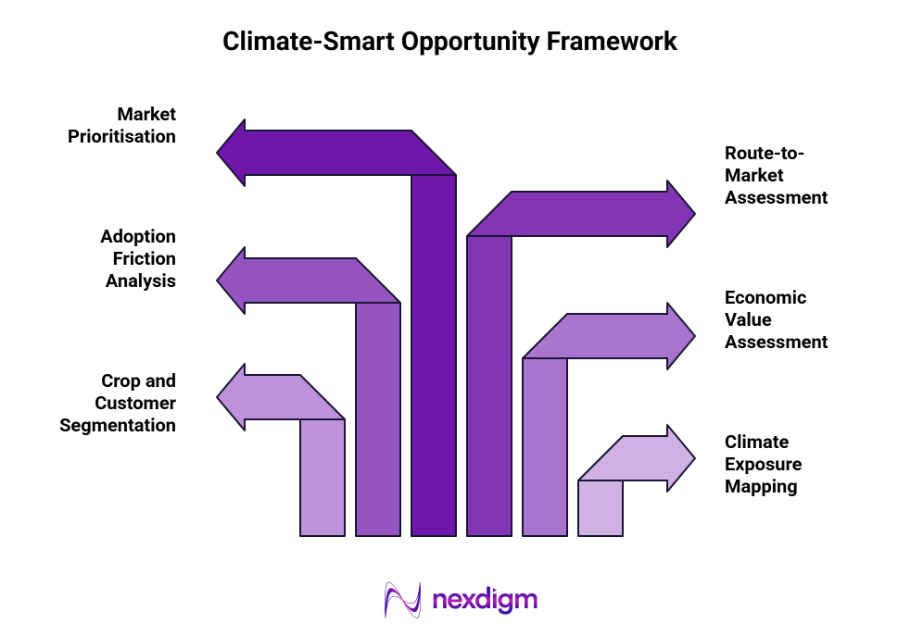
- Climate Exposure Mapping
Identify regions and crop systems facing material exposure to drought, heat, flooding, water stress and other climate-related risks. This establishes where the underlying need is most significant. - Crop and Customer Segmentation
Assess farm size, crop type, irrigation access, production economics and technology readiness. This helps distinguish broad climate exposure from addressable customer segments. - Economic Value Assessment
Evaluate the potential impact of the solution through yield protection, input savings, water efficiency or reduced production volatility. The focus is on measurable economic value rather than technical capability alone. - Adoption Friction Analysis
Examine upfront costs, financing, technical complexity, awareness, training requirements and perceived risk. These factors can determine whether a technically relevant solution can achieve meaningful adoption. - Route-to-Market Assessment
Evaluate dealers, FPOs, institutional channels, government programmes and direct sales models. The objective is to identify how priority customer segments can be reached efficiently. - Market Prioritisation
Combine climate exposure, customer economics, adoption conditions and channel readiness to identify the markets where commercial entry should be evaluated first.
Nexdigm’s Role in Translating Climate Need into Commercial Opportunity
An agritech company assessing expansion into climate-vulnerable agricultural markets could evaluate 86 districts across 12 states, combining climate exposure, crop economics, farmer adoption and channel readiness. The analysis could then narrow the opportunity to 24 priority districts and three target crop segments for phased market entry.
To take the next step, simply visit our Request a Consultation page and share your requirements with us.
Harsh Mittal
+91-8422857704