

Cloud infrastructure has become a significant part of enterprise technology investment, with organizations increasingly distributing workloads across multiple providers. Flexera’s 2026 State of the Cloud Report found that 83% of respondents run some or significant workloads on Amazon Web Services (AWS), compared with 79% on Microsoft Azure. The report also indicates that 76% of large enterprises spend more than US$5 million monthly on public cloud services.
These findings highlight the scale of cloud adoption and the importance of selecting suitable infrastructure partners. Through structured cloud infrastructure vendor analysis, enterprises can compare provider capabilities, assess resilience, understand commercial differences, and identify vendors aligned with their performance and business requirements.
What Makes Cloud Infrastructure Provider Selection Challenging?
Cloud providers differ in infrastructure architecture, geographic coverage, workload specialization, pricing structures, and service commitments. A provider suited to general-purpose computing may not offer the same advantages for AI workloads, high-performance databases, or business-critical applications. Enterprises must therefore assess how infrastructure capabilities align with workload demands, integration requirements, security expectations, and operational priorities before selecting a provider.
Factors Enterprises Should Consider When Assessing Cloud Providers
Selecting a cloud infrastructure partner requires a balanced assessment of performance, continuity, and commercial suitability. Three areas deserve particular attention:
- Infrastructure Performance: Examine computing capacity, storage performance, network capabilities, scalability, and workload compatibility to determine whether providers meet technical requirements.
- Resilience and Security: Evaluate availability commitments, disaster recovery, redundancy, cybersecurity controls, data protection, and compliance capabilities to understand operational reliability.
Considering these factors together helps enterprises identify providers that can support both immediate infrastructure requirements and longer-term operational objectives.
Why Comparing Cloud Infrastructure Providers Requires a Structured Approach
Although cloud providers may offer similar core services, their capabilities can differ considerably in performance consistency, resilience architecture, geographic reach, support models, and pricing structures. Comparing them through isolated specifications may overlook important differences in workload suitability and long-term value. Nexdigm can help enterprises assess these variations through structured provider research, examining technical capabilities, service commitments, commercial models, and market positioning. This approach helps organizations identify meaningful differences and long-term priorities.
What Should Enterprises Evaluate Beyond Core Cloud Infrastructure Capabilities?
A meaningful provider comparison requires enterprises to look beyond basic computing and storage specifications. Nexdigm’s research can help organizations examine additional factors that influence provider suitability and long-term value, including:
- Workload Specialization: Assess providers’ capabilities across AI, analytics, high-performance computing, and business-critical applications to understand their technical fit.
- Geographic and Industry Coverage: Examine data center locations, regional availability, industry experience, and compliance capabilities to identify potential limitations.
- Service Ecosystem and Support: Compare managed services, integration options, technical assistance, and partner networks to understand the broader value each provider offers.
Evaluating these dimensions can help enterprises develop a more complete view of provider strengths and identify suitable infrastructure partners.
Nexdigm’s Approach to Cloud Infrastructure Vendor Analysis
Nexdigm’s cloud infrastructure vendor analysis provides enterprises with a comparative view of the provider landscape, covering hyperscale platforms, regional cloud providers, and specialist infrastructure vendors. Our research examines service portfolios, technical capabilities, geographic presence, market positioning, and innovation priorities to identify differences across competing providers. By developing structured provider profiles and comparative assessments, Nexdigm can help organizations understand supplier strengths, identify capability gaps, and long-term business priorities.
Why Enterprises Partner with Nexdigm for Cloud Infrastructure Vendor Analysis
Choosing a cloud infrastructure provider requires visibility into both vendor capabilities and the wider market landscape. Nexdigm combines market intelligence with structured supplier research to help enterprises make informed comparisons. Our approach can support organizations through:
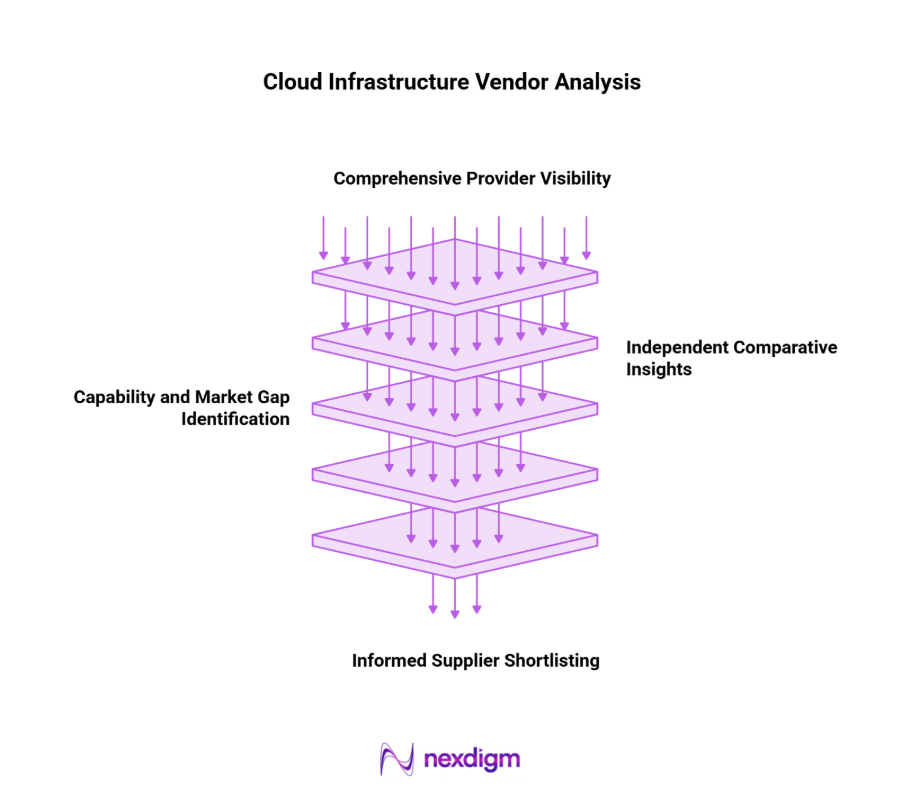
- Comprehensive Provider Visibility: Identify established hyperscalers, regional providers, and specialist vendors to broaden the supplier landscape.
- Independent Comparative Insights: Assess provider capabilities, service portfolios, market positioning, and commercial models through a consistent research framework.
- Capability and Market Gap Identification: Highlight differences in infrastructure offerings, geographic coverage, and service specialization that may influence provider suitability.
- Informed Supplier Shortlisting: Translate research findings into comparative profiles and actionable insights aligned with enterprise infrastructure and sourcing priorities.
This combination of market understanding and provider-level assessment can help enterprises strengthen evaluation processes and make more informed cloud infrastructure sourcing decisions
Nexdigm’s Case
A large enterprise sought to evaluate cloud infrastructure providers across performance, resilience, geographic reach, and commercial suitability. In this illustrative scenario, Nexdigm conducted a comparative assessment of 12 providers, identified capability gaps or service limitations among and shortlisted 4 vendors for detailed evaluation. The assessment provided greater visibility into provider strengths and limitations, helping the enterprise refine its infrastructure sourcing priorities.
To take the next step, simply visit our Request a Consultation page and share your requirements with us.
Harsh Mittal
+91-8422857704