

Cloud migration has moved beyond the question of whether enterprises should leave the data center. The more consequential question is where each workload should run, how deeply it should be modernized, and whether the resulting architecture improves economics and operational performance.
Worldwide public cloud spending crossed $723 billion in 2025, while 94% of enterprises use public cloud infrastructure and 60% of corporate data resides in cloud environments. Yet migration strategies are becoming more selective as organizations confront technical debt, unpredictable cloud costs, regulatory requirements, and application dependencies.
The Migration Model Is Changing
The first wave of cloud adoption relied heavily on rehosting, moving existing workloads to cloud infrastructure with limited architectural change. Rehosting accounted for 38.3% of historic migrations but relocating an application does not remove the constraints embedded in its underlying architecture.
Replatforming and refactoring are consequently gaining importance. Application refactoring is expanding at approximately 22.35% annually, with refactoring accounting for around 34% of migration expenditure. Enterprises are decomposing monolithic applications, adopting containers and managed databases, and redesigning workloads around cloud-native architectures.
This shift also explains the growth of hybrid and multi-cloud environments. Around 82% of enterprises operate workloads across multiple cloud providers, while 73% maintain hybrid configurations. Cloud migration is increasingly becoming an exercise in workload placement rather than a one-time infrastructure relocation.
Why Some Workloads Are Moving Back
Cloud adoption has also created a countertrend: selective workload repatriation. Between 83% and 86% of enterprise CIOs report plans to move certain workloads back to private infrastructure, on-premise environments, or colocation facilities. Only around 8% intend to leave public cloud environments completely.
The economics are workload specific. Predictable, high-utilization workloads can become expensive when cloud compute and data-transfer charges accumulate continuously. Applications with intensive data movement can also incur significant egress costs, while legacy software licensing may create additional recurring expenses after migration.
Public cloud remains better suited to workloads requiring rapid scaling, variable capacity, distributed access, and flexible infrastructure. The result is a more deliberate architecture combining public cloud, private infrastructure, and colocation according to workload characteristics.
The Cost of Migrating Without Readiness
Migration programs can become expensive when application dependencies are poorly understood. Historical data indicates that approximately 38% of enterprise cloud migrations experience delays exceeding one fiscal quarter, while projects exceed initial budgets by an average of 14%.
Technical debt is a major contributor. Legacy applications often contain undocumented database dependencies, synchronous application calls, tightly coupled services, and network assumptions built around low-latency internal infrastructure.
FinOps adds another layer. Network egress can account for approximately 6%–12% of cloud operating costs in data-intensive environments. Organizations therefore need to evaluate the full lifecycle economics of each workload rather than comparing infrastructure prices alone.
A cloud migration market assessment can support this process by examining migration demand, workload suitability, modernization requirements, cloud economics, and the technology and services ecosystem supporting enterprise migration.
Five Signals That Should Determine Workload Placement
Rather than applying one migration strategy across an entire application estate, enterprises can assess workloads against several variables:
- Application architecture: Measure database coupling, API dependencies, technical debt, and refactoring complexity.
- Data gravity: Quantify data volumes, movement patterns, and potential egress exposure.
- Regulatory requirements: Map data residency, industry regulations, and sovereignty requirements against available cloud regions.
- Cost predictability: Compare variable cloud consumption with steady-state private or colocation infrastructure economics.
- Modernization value: Determine whether refactoring can materially improve scalability, release velocity, resilience, or integration with emerging technologies.
These dimensions can separate applications that should be rehosted quickly from those that warrant replatforming, refactoring, replacement, or selective repatriation.
Nexdigm Cloud Migration Decision Framework
Nexdigm’s cloud migration decision framework can structure cloud migration decisions around the economics and complexity of individual workloads:
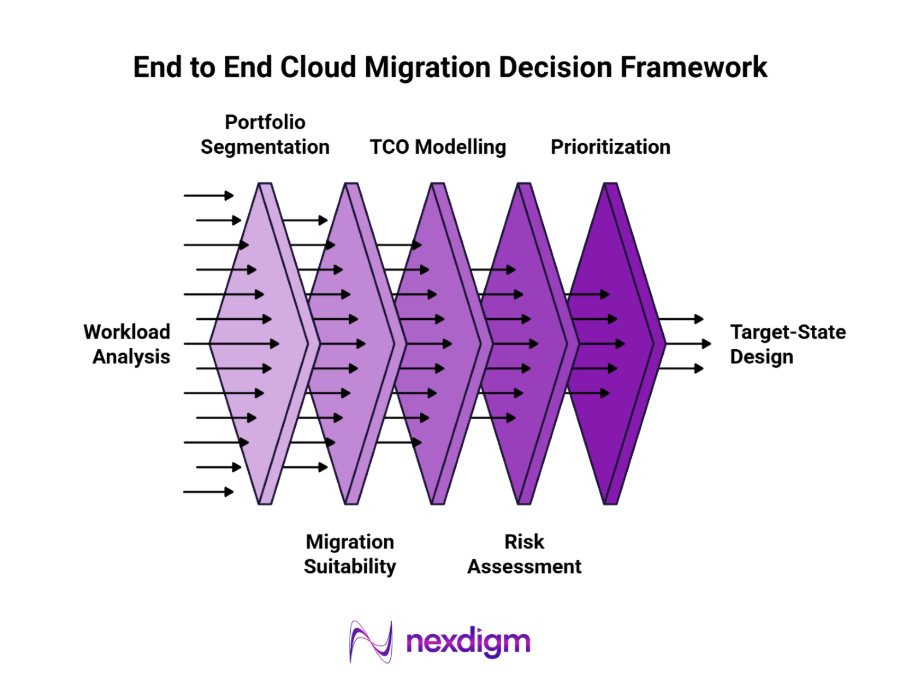
- Portfolio segmentation: Classify applications by business criticality, architecture, dependencies, and lifecycle.
- Migration suitability: Determine the appropriate path across rehost, replatform, refactor, replace, or retain.
- TCO modelling: Compare infrastructure, licensing, network, migration, support, and modernization costs.
- Risk assessment: Identify security, compliance, resilience, dependency, and operational risks before migration.
- Prioritization: Sequence workloads according to business value, technical readiness, migration complexity, and expected financial impact.
- Target-state design: Define the appropriate mix of public cloud, private infrastructure, colocation, and hybrid architectures.
This approach allows migration programs to be sequenced around measurable business and technology outcomes rather than data-center exit targets alone.
Nexdigm Case: Application Modernization for a Financial Institution
Nexdigm assessed 420 core banking workloads for a multinational financial institution, mapping application dependencies and modernization requirements. The engagement identified opportunities to reduce infrastructure costs by 34%, eliminate $2.1 million in redundant licensing, and increase release velocity by 65% through targeted application modernization and workload restructuring.
To take the next step, simply visit our Request a Consultation page and share your requirements with us.
Harsh Mittal
+91-8422857704