

Cloud markets are expanding rapidly as enterprises accelerate digital transformation, adopt hybrid infrastructure, and invest in scalable computing environments. For cloud providers and technology companies entering new markets, strategic partnerships with hyperscalers, system integrators, managed service providers, and channel partners can improve market access, customer acquisition, and delivery capabilities.
Recent market indicators highlight strong cloud growth. According to Gartner, worldwide public cloud spending is expected to exceed $700 billion in 2025 as enterprises increase investments in cloud infrastructure, platforms, and services.
As competition grows, organizations must identify the right partnership models, ecosystem relationships, and go-to-market strategies to build sustainable cloud market positions.
For cloud providers, software companies, system integrators, technology vendors, investors, private-equity firms, and enterprise strategy teams, cloud partnership entry consulting services help evaluate partner ecosystems, market opportunities, channel strategies, commercial models, and expansion potential.
Understanding the Cloud Partnership Opportunity
As cloud adoption accelerates, organizations must identify the partnerships that can provide the greatest advantage in market entry, customer acquisition, solution delivery, and long-term growth. Evaluating the cloud ecosystem helps businesses build:
- Hyperscaler Partnerships: Collaboration with leading cloud platforms enables access to established customer bases, technical resources, co-selling programs, and market credibility.
- System Integrator Alliances: System integrators provide implementation expertise, industry knowledge, and enterprise relationships that accelerate solution deployment and adoption.
- Managed Service Provider (MSP) Networks: MSPs help extend service delivery capabilities, provide ongoing support, and enhance customer retention through managed cloud services.
- Channel and Reseller Ecosystems: Channel partners expand market reach, generate qualified leads, and facilitate local customer engagement across target regions and industries.
By understanding the cloud partnership landscape, organizations can prioritize high-impact relationships, strengthen market positioning, and accelerate successful cloud market entry and expansion.
How Nexdigm Supports Cloud Partnership and Market Entry Strategy
Entering a new cloud market requires more than identifying potential partners. Organizations must assess ecosystem fit, commercial viability, channel effectiveness, and long-term growth potential. Nexdigm helps businesses develop partnership strategies that align with their market entry and expansion objectives by conducting:
- Ecosystem Mapping: Identification of relevant hyperscalers, system integrators, MSPs, distributors, and channel partners across target markets and customer segments.
- Partner Evaluation: Assessment of partner capabilities, market reach, technical expertise, customer relationships, and alignment with strategic business goals.
- Go-to-Market Strategy Development: Defining partnership-led routes to market, co-selling opportunities, channel structures, and customer acquisition approaches.
- Commercial Model Assessment: Evaluation of partner incentives, revenue-sharing models, investment requirements, and profitability considerations to support sustainable growth.
Through a structured cloud partnership assessment, Nexdigm helps organizations build the right ecosystem relationships, reduce market entry risks, and accelerate sustainable growth in competitive cloud markets.
Nexdigm’s Cloud Partnership Entry Assessment Framework
Nexdigm’s cloud partnership entry consulting services provide a structured framework to identify, evaluate, and prioritize partnerships that can accelerate cloud market entry, strengthen channel capabilities, and support sustainable growth. The framework involves structured steps to be followed, they are:
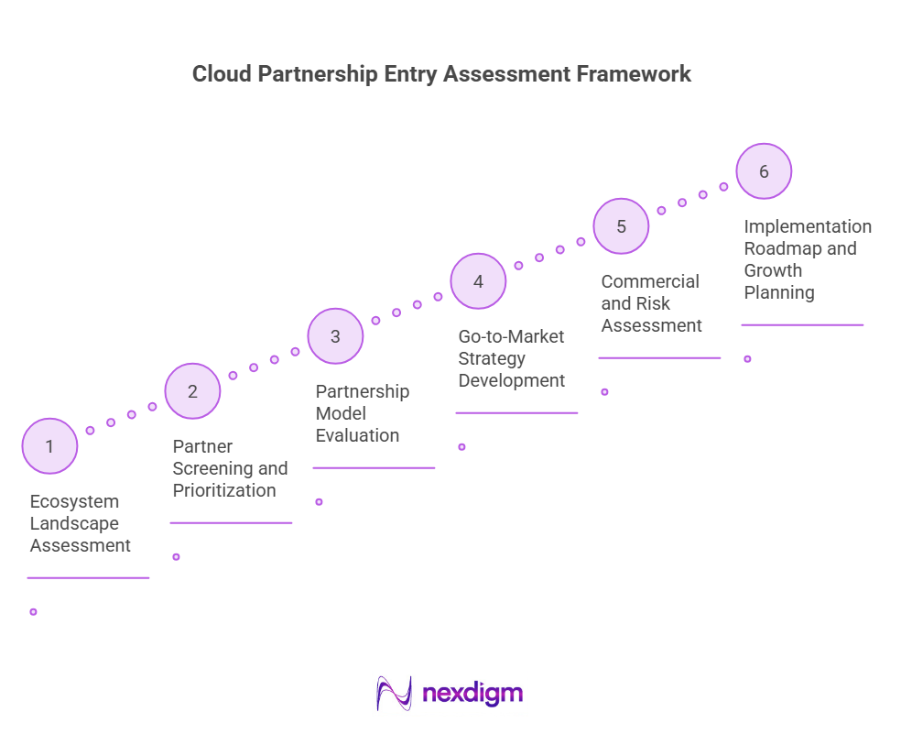
- Step 1: Ecosystem Landscape Assessment: Map the cloud ecosystem, including hyperscalers, system integrators, managed service providers (MSPs), distributors, and channel partners across target markets.
- Step 2: Partner Screening and Prioritization: Assess potential partners based on market reach, customer access, technical expertise, industry presence, and strategic fit.
- Step 3: Partnership Model Evaluation: Evaluate alliance structures, co-selling opportunities, reseller arrangements, referral models, and managed service partnerships to determine the most effective engagement approach.
- Step 4: Go-to-Market Strategy Development: Define route-to-market frameworks, partner enablement plans, sales motions, and customer acquisition strategies to maximize market penetration.
- Step 5: Commercial and Risk Assessment: Analyze partnership economics, investment requirements, incentive structures, scalability potential, and associated business risks.
- Step 6: Implementation Roadmap and Growth Planning: Develop a phased roadmap outlining partner onboarding, capability development, performance metrics, and expansion opportunities.
Through this structured framework, Nexdigm helps organizations move from partner identification to execution, enabling faster market access, stronger ecosystem relationships, and long-term competitive advantage.
Strengthening Ecosystem Relationships with Nexdigm’s Framework
Building a successful cloud ecosystem requires more than identifying partners. It requires establishing relationships that align strategic objectives, enhance market reach, and create long-term value.
Through its cloud partnership entry consulting services, Nexdigm helps organizations develop a structured partnership framework that fosters:
- Partner Alignment: Ensures partnerships are aligned with business goals, target customer segments, technical capabilities, and market expansion objectives.
- Collaboration Enablement: Develops governance models, communication frameworks, and joint planning mechanisms that strengthen coordination across ecosystem participants.
- Co-Innovation Opportunities: Identifies opportunities for joint solution development, service integration, and technology collaboration to enhance customer value.
- Channel Performance Optimization: Establishes performance metrics, partner enablement programs, and incentive structures that drive mutual growth and accountability.
- Long-Term Ecosystem Development: Creates scalable partnership strategies that support market expansion, customer retention, and sustained competitive advantage.
This helps organizations transform individual partnerships into high-performing ecosystems that strengthen market presence, accelerate growth, and deliver lasting business value.
Nexdigm’s Case
A global cloud solutions provider engaged Nexdigm to evaluate partnership opportunities with hyperscalers, system integrators, and channel partners for market expansion. The assessment analyzed 45+ ecosystem factors and improved market-entry strategy effectiveness by 28%, supporting alliance planning, customer acquisition, and scalable cloud growth initiatives.
To take the next step, simply visit our Request a Consultation page and share your requirements with us.
Harsh Mittal
+91-8422857704