

Enterprise demand for cloud platforms is becoming more sophisticated. Organizations are no longer evaluating cloud simply as a destination for applications; they increasingly require integrated capabilities across compute, data, AI, application development, security, analytics, and infrastructure management.
AI is adding another layer of demand. Gartner forecasts worldwide AI spending of approximately $2.6 trillion in 2026, while AI infrastructure represents the largest spending category.
AI-optimized cloud infrastructure is expanding rapidly. For cloud providers, hyperscalers, enterprise technology companies, investors, data-center operators and digital infrastructure providers, a Cloud platform market demand assessment can help them to evaluate enterprise requirements across compute, storage, networking, data platforms, AI infrastructure and platform economics and also to identify where cloud-platform opportunities are emerging.
Understanding the Drivers of Enterprise Cloud Demand
Enterprise cloud demand is expanding beyond infrastructure to encompass AI, data, application development, and security capabilities. Understanding these demand drivers is essential for evaluating cloud market opportunities and evolving customer requirements. These drivers are:
- Compute Infrastructure: Enterprise workloads continue to require scalable compute resources, with demand varying by industry, application type, performance needs, and utilization patterns.
- AI-Driven Compute Demand: AI training, inference, and agent-based applications require specialized processors, advanced storage architectures, high-speed networking, and significantly higher computing capacity.
- Data Platform Requirements: Organizations increasingly seek platforms that support data collection, storage, governance, analytics, and processing to manage growing enterprise data volumes.
- Cloud-Native Application Development: Managed services, containers, APIs, serverless computing, and orchestration platforms are enabling faster application development, deployment, and integration.
Enterprise cloud demand is becoming increasingly multi-layered, with compute, AI, data, application development, and security capabilities shaping platform selection and infrastructure investment decisions.
How Nexdigm Evaluates Enterprise Cloud Platform Demand
As enterprise cloud requirements become increasingly complex, Nexdigm helps organizations assess where demand is emerging across compute, AI, data, application development, and security layers. Through its cloud platform market assessment approach, Nexdigm evaluates demand drivers through:
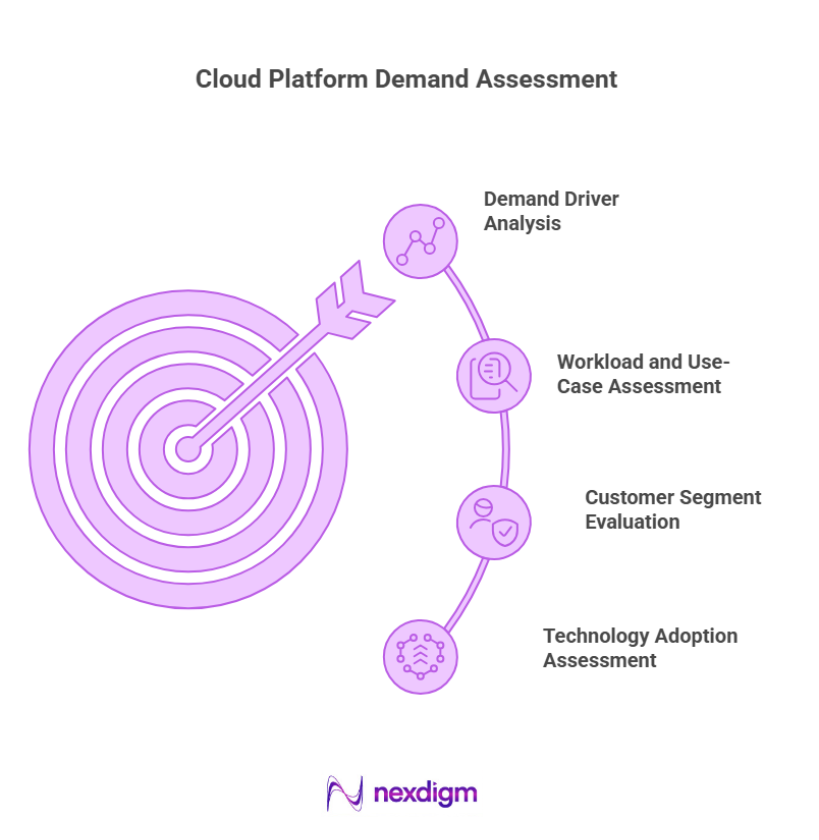
- Demand Driver Analysis: Assess enterprise requirements across infrastructure, data, AI, applications, and security to understand evolving cloud consumption patterns.
- Workload and Use-Case Assessment: Evaluate workloads driving cloud adoption, including business applications, analytics, AI models, and cloud-native development initiatives.
- Customer Segment Evaluation: Analyze adoption trends by industry, enterprise size, geography, and technology maturity to identify priority customer segments.
- Technology Adoption Assessment: Examine the uptake of cloud-native services, AI platforms, data solutions, and security capabilities across enterprise environments.
By understanding these demand drivers, Nexdigm helps organizations understand how enterprise cloud requirements are evolving and where the most attractive infrastructure and platform growth opportunities are emerging.
Nexdigm Identifies Attractive Infrastructure Opportunities
As enterprise cloud demand evolves across compute, AI, data, application development, and security layers, Nexdigm helps organizations identify infrastructure segments with the strongest commercial potential. By evaluating the following areas:
- High-Growth Infrastructure Segments: Identify cloud, AI, edge, and data infrastructure opportunities supported by strong enterprise demand and investment momentum.
- Emerging Technology Opportunities: Assess evolving requirements across AI computing, cloud-native platforms, data ecosystems, and security solutions.
- Customer Demand Alignment: Evaluate infrastructure opportunities against enterprise priorities, workload requirements, and technology adoption trends.
- Investment Prioritization: Focus resources on market segments that offer attractive growth prospects, scalability, and long-term commercial viability.
By connecting enterprise demand and assessing these areas, Nexdigm helps organizations identify attractive market opportunities and make informed growth, expansion, and investment decisions across the cloud computing ecosystem.
How Nexdigm Helps Convert Infrastructure Opportunities into Strategies
Understanding infrastructure trends is valuable only when those insights can be converted into actionable business plans. Nexdigm helps organizations assess how developments in cloud computing, AI infrastructure, data platforms, edge computing, and enterprise technology adoption are creating new market opportunities.
By evaluating customer demand, technology shifts, competitive dynamics, and investment activity, Nexdigm enables businesses to identify high-potential growth areas, prioritize strategic investments, refine market-entry plans, and align expansion strategies with the future direction of enterprise computing.
Benefits of Nexdigm’s Strategic Approach to Infrastructure Opportunity Assessment
As cloud, AI, and distributed computing continue to reshape enterprise technology landscapes, organizations need a clear understanding of how infrastructure trends translate into business opportunities.
Nexdigm helps bridge this gap by connecting market developments with strategic growth and investment decisions. This helps organizations with:
- Clearer Growth Prioritization: Helps organizations identify infrastructure segments where enterprise demand, technology adoption, and market potential are most strongly aligned.
- Better Investment Decisions: Enables businesses to focus investments on opportunities supported by favorable growth trends, customer demand, and long-term scalability.
- Stronger Market Positioning: Provides insights into evolving customer needs and competitive dynamics, helping organizations refine their market and solution strategies.
- Improved Expansion Planning: Helps assess market readiness, commercial attractiveness, and ecosystem dynamics before pursuing growth or market-entry initiatives.
Through these benefits, organizations get to identify emerging infrastructure opportunities, prioritize investments, and develop growth strategies aligned with evolving enterprise computing trends with Nexdigm’s expertise.
Nexdigm’s Case
A technology client engaged with Nexdigm to assess enterprise demand across cloud compute, data, AI, and application development. The study identified four high-potential segments and 10 priority opportunities, supporting a 16% improvement in projected market potential and enabling more targeted expansion, product prioritization, and investment decisions.
To take the next step, simply visit our Request a Consultation page and share your requirements with us.
Harsh Mittal
+91-8422857704