

Cloud procurement has changed the way organisations purchase computing infrastructure. Instead of making large upfront investments in hardware, businesses can access storage, processing power, databases and application services through consumption-based or subscription models. This flexibility supports faster deployment, but it also makes technology expenditure more dependent on usage patterns, pricing structures and contract management.
A cloud pricing intelligence research exercise helps organisations understand how cloud providers structure their commercial offerings and where differences in pricing create opportunities for procurement optimisation. It examines more than published service rates, considering discounts, commitment structures, regional pricing, data transfer charges and the operational conditions that influence total expenditure.
Why Cloud Pricing Requires Continuous Attention
Cloud costs can change as workloads expand, applications move between regions and organisations adopt additional services. A workload that appears inexpensive during initial deployment may become significantly more costly when data transfer, storage growth, backup requirements and monitoring services are included.
Cloud adoption is also widespread enough to make cost governance a procurement priority. Eurostat reported that 52.7% of EU enterprises used paid cloud computing services in 2025, up 7.4 percentage points from 2023. Among large enterprises, adoption reached approximately 85%. As organisations increase their reliance on cloud infrastructure and software, the ability to understand and manage pricing becomes increasingly important.
The commercial challenge is that cloud providers do not always use comparable pricing structures. Computing instances may be priced by the hour or second, storage by capacity and performance tier, and data transfer through separate charges. Even when two providers offer services with similar technical specifications, their total costs may differ because of network architecture, discounts or service dependencies.
Understanding the Main Cloud Pricing Models
On-demand pricing
On-demand models allow organisations to access resources without long-term commitments. They provide flexibility for variable workloads, development environments and projects with uncertain demand.
The trade-off is that standard consumption rates may be higher than rates available through committed-use arrangements. Procurement teams should assess whether flexibility justifies the premium, particularly for workloads with predictable baseline demand.
Reserved and committed-use discounts
Cloud providers may offer reduced rates in exchange for commitments to use specified resources or spend a minimum amount over a defined period.
These arrangements can improve cost predictability, but they require accurate forecasting. Overcommitting can result in expenditure on unused capacity, while undercommitting may leave organisations paying higher on-demand rates for additional usage.
Spot and interruptible capacity
Some providers offer discounted infrastructure capacity that can be reclaimed when demand changes. This can be useful for fault-tolerant workloads, batch processing and non-critical development activities.
However, interruption risk and availability constraints must be considered before relying on these resources for business-critical applications.
Enterprise agreements and negotiated discounts
Large organisations may negotiate commercial arrangements based on annual expenditure, service scope or broader strategic relationships. These agreements can include discounts, credits, technical support and migration incentives.
The evaluation should examine the conditions attached to these benefits. Credits may expire, discounts may apply only to selected services, and minimum spending commitments may limit future flexibility.
Comparing Cloud Providers on a Consistent Basis
A meaningful cloud pricing comparison requires standardised workload assumptions. Procurement teams should define the expected computing capacity, memory, storage performance, operating system, region, availability requirements and usage duration before comparing providers.
The assessment should also include less visible cost components. Data egress charges, inter-region transfers, backup storage, security tools, monitoring, support subscriptions and managed services can materially influence the total cost.
Organisations operating hybrid or multi-cloud environments should consider the cost of moving workloads and data between platforms. A lower compute rate may not produce savings if data transfer and integration costs are significantly higher.
Pricing intelligence should therefore examine both unit economics and workload-level expenditure. Comparing the price of an individual virtual machine is useful, but understanding the cost of running a complete business application provides a more practical basis for procurement decisions.
Commercial Levers for Better Cloud Economics
Cloud procurement teams can improve cost efficiency through several approaches. These include negotiating committed-use discounts for stable workloads, aligning storage tiers with access requirements, reviewing data transfer patterns and consolidating purchasing across business units.
FinOps practices can strengthen this process by connecting cloud consumption with financial accountability. The FinOps Foundation’s 2025 State of FinOps survey, covering 861 respondents representing approximately $69 billion in public cloud spending, identified workload optimisation and waste reduction as the leading current priority among practitioners. The survey also found that FinOps responsibilities were expanding beyond public cloud into SaaS, licensing and data centre expenditure.
This broader approach matters because cloud costs are rarely controlled by procurement alone. Engineering teams influence resource consumption, finance teams manage budgets and forecasts, while procurement negotiates supplier terms. Effective cost intelligence brings these perspectives together.
How Nexdigm Supports Cloud Pricing Research
Nexdigm provides market research, supplier intelligence, commercial benchmarking and procurement analysis to support cloud sourcing decisions. Its research can help organisations compare provider pricing, assess discount structures, evaluate contractual commitments and identify opportunities to improve cloud expenditure across infrastructure and platform services.
Cloud Pricing Intelligence Framework
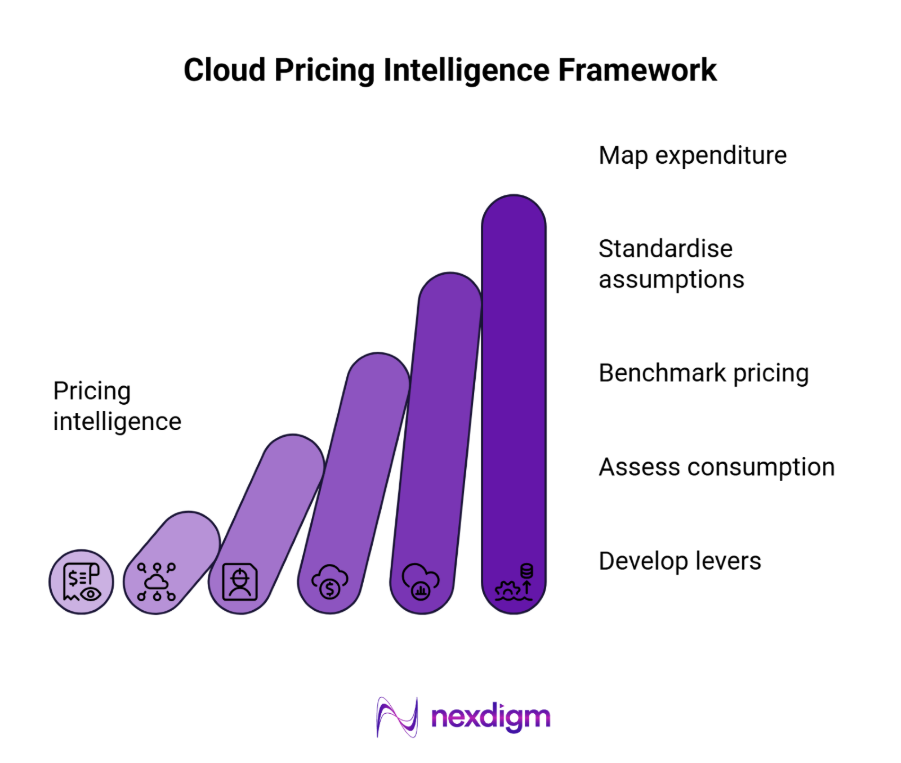
- Map cloud expenditure: Identify providers, services, regions, workloads and current contractual commitments.
- Standardise workload assumptions: Define comparable computing, storage, networking and availability requirements.
- Benchmark pricing structures: Compare on-demand rates, committed-use discounts, enterprise agreements and additional charges.
- Assess consumption and risk: Review utilisation, forecasting accuracy, transfer costs and commitment exposure.
- Develop procurement levers: Identify opportunities for negotiation, workload optimisation, commitment restructuring and supplier consolidation.
Nexdigm’s Case Study: Identifying Cloud Procurement Opportunities
Nexdigm compared pricing across three cloud providers for 22 workload configurations, reviewed 12 discount and commitment structures and identified six procurement opportunities. The analysis supported a revised sourcing strategy focused on cost visibility and workload-level economics.
To take the next step, simply visit our Request a Consultation page and share your requirements with us.
Harsh Mittal
+91-8422857704