

Cloud adoption is changing the economics of enterprise security. As workloads move across public cloud, private infrastructure, SaaS platforms, containers, APIs, and increasingly AI-enabled environments, security teams are managing a distributed attack surface rather than a defined corporate perimeter. Gartner forecasts global end-user information security spending at $244 billion in 2026, while public cloud spending continues to expand as enterprises modernize applications and infrastructure.
The shift is particularly visible in India, where information security spending is projected to reach $3.4 billion in 2026, up 11.7% from 2025. Security software is expected to grow 12.4%, with cloud security increasingly extending into AI-specific configurations and runtime protection.
Cloud Expansion Is Increasing Security Complexity
The security challenge is no longer limited to protecting infrastructure. Enterprises must continuously evaluate identities, workloads, APIs, configurations, software dependencies, data flows, and permissions across multiple environments.
This creates a fragmented control problem. A vulnerability may exist in a container, become exploitable because of an excessive cloud permission, and ultimately expose an internet-facing application. Reviewing each issue separately can obscure the relationship between them.
Gartner’s current CNAPP research reflects this shift. Its 2026 guidance identifies Cloud Security Posture Management (CSPM), Cloud Workload Protection Platforms (CWPP), Kubernetes Security Posture Management (KSPM), and Cloud Infrastructure Entitlement Management (CIEM) as core capabilities for addressing cloud vulnerabilities across infrastructure, workloads, and identity permissions.
CNAPP Is Becoming a Platform Decision
The market is moving toward platforms that connect security controls across the development and runtime lifecycle. Gartner projects the CNAPP market to reach $41 billion by 2030, representing a 35% CAGR, driven by multicloud complexity and the need to secure AI-enabled applications and workloads.
This changes how enterprises should evaluate security investments. A standalone CSPM product may identify a misconfigured storage bucket, while a CIEM platform may identify excessive permissions. A converged platform can potentially correlate those signals with workload exposure, vulnerabilities, runtime activity, and business criticality.
For technology buyers, the relevant question is therefore how effectively a platform reduces the distance between detection and remediation. Tool consolidation only creates value when it improves prioritization, reduces duplicated telemetry, and gives security teams enough context to act.
AI Workloads Are Expanding the Attack Surface
Generative AI introduces additional cloud security requirements. AI applications depend on APIs, model infrastructure, vector databases, data pipelines, third-party services, and rapidly changing workloads. Each component introduces identities and permissions that must be governed.
The result is a security architecture that increasingly has to operate across development and production simultaneously. Infrastructure-as-code needs to be evaluated before deployment; identities require continuous monitoring; runtime environments require behavioural visibility; and APIs need controls that account for both authentication and abnormal usage.
This also increases the importance of cloud security market assessment across technology categories rather than evaluating products in isolation. Spending decisions increasingly need to account for workload coverage, identity integration, deployment models, compliance requirements, staffing implications, and the cost of operating multiple security platforms.
What Should Enterprises Measure Before Consolidating?
A practical assessment should examine five dimensions:
- Risk correlation: Whether the platform can connect vulnerabilities, exposed assets, identities, permissions, and runtime behaviour into a meaningful risk priority.
- Lifecycle coverage: The extent to which security controls operate from infrastructure-as-code and development through deployment and runtime.
- Identity visibility: Coverage across workforce identities, service accounts, privileged access, cloud roles, and machine identities.
- Telemetry efficiency: The balance between agentless discovery and deeper runtime visibility without creating excessive infrastructure overhead.
- Economic impact: Licensing costs, integration effort, operational headcount, alert reduction, remediation efficiency, and compliance workload.
Nexdigm Cloud Security Market Assessment Framework
Nexdigm can evaluate cloud security opportunities through a structured assessment covering:
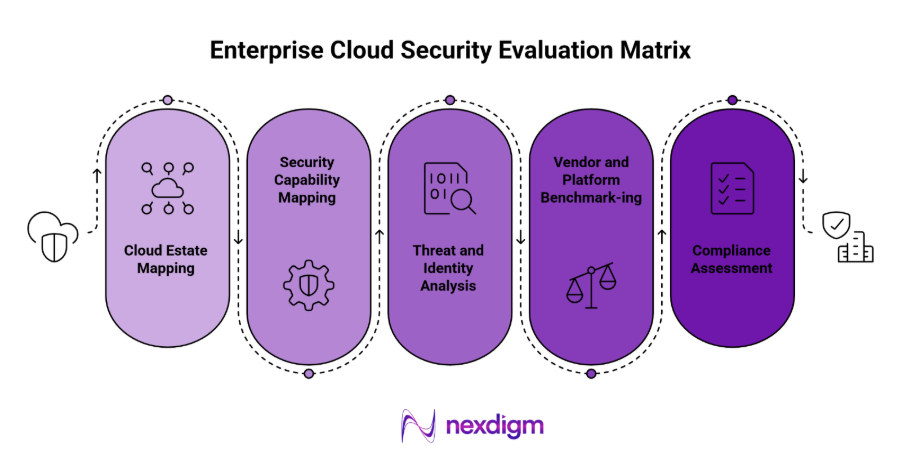
- Cloud estate mapping: Segment workloads across public, private, hybrid, multicloud, SaaS, containers, and AI environments.
- Security capability mapping: Benchmark CSPM, CWPP, CIEM, KSPM, CDR, API security, and adjacent capabilities against enterprise requirements.
- Threat and identity analysis: Identify high-risk combinations involving exposed assets, vulnerabilities, excessive privileges, and unmanaged identities.
- Vendor and platform benchmarking: Compare functionality, deployment architecture, integrations, pricing models, scalability, and consolidation potential.
- Compliance assessment: Map security controls against applicable requirements and identify gaps across jurisdictions and industry frameworks.
- Investment prioritization: Quantify the potential value of consolidation, remediation, automation, and managed security models before technology investments are made.
Nexdigm Case: Cybersecurity for a Global Digital Trade Finance Platform
Nexdigm supported a global digital trade finance platform through a Virtual CISO engagement covering authentication, API governance, Entra ID policies, vulnerability mitigation, endpoint security, and continuous security checks. The engagement delivered a 70% annual cost saving while strengthening security controls and improving operational efficiency.
To take the next step, simply visit our Request a Consultation page and share your requirements with us.
Harsh Mittal
+91-8422857704