

As enterprises distribute workloads across public cloud platforms, private infrastructure, and on-premises systems, securing these environments has become increasingly complex. According to the 2026 SANS Cloud Security Survey, 93% of surveyed organizations run production workloads in the cloud, while 65% use more than one cloud provider. However, only 40% consider their cloud security strategy advanced or optimized.
The 2026 Fortinet Cloud Security Report also found that 88% of organizations operate across hybrid or multi-cloud environments, highlighting how widely distributed cloud architectures have become. These developments increase the importance of evaluating providers beyond individual security features. Through cloud security technology supplier analysis, organizations can help enterprises examine vendor capabilities, market positioning, and technology suitability across complex cloud environments.
Why Multi-Cloud Security Requires a Different Evaluation Approach
Security controls designed for a single cloud environment may not provide consistent protection across multiple platforms. Differences in architecture, configurations, identity policies, and monitoring capabilities can create visibility gaps. Enterprises therefore need to understand how security vendors address fragmented environments, protect workloads and data, and coordinate controls across cloud providers and existing infrastructure.
The Capabilities That Matter When Comparing Cloud Security Vendors
A meaningful comparison should examine how vendors address three connected areas of cloud protection:
- Cloud Security Posture Management: Assess configuration monitoring, compliance checks, risk prioritization, and the identification of misconfigured cloud resources.
- Workload and Application Protection: Examine runtime threat detection, container security, vulnerability management, and protection for applications across cloud environments.
- Identity and Data Security: Evaluate access governance, privileged permissions, encryption, data discovery, and controls against unauthorized access or exposure.
Together, these capabilities provide a foundation for understanding how vendors address cloud-specific risks and enterprise security requirements.
Managing Security Consistency Across Distributed Cloud Environments
Even with the right security capabilities, enterprises may struggle to maintain consistent protection across multiple cloud platforms. Nexdigm can help organizations examine how differences in provider-native tools, security policies, access controls, and monitoring processes affect centralized oversight. Through supplier research, our experts can identify how vendors address these challenges and support enterprises in evaluating approaches that strengthen risk visibility, incident coordination, and compliance management across evolving cloud architectures.
How Nexdigm Balances Cloud Security Requirements
Understanding security challenges is only the starting point; enterprises also need to identify which suppliers can address their priorities. Our experts can support this process by examining three important dimensions:
- Technology Alignment: Map vendor capabilities against requirements for workload protection, cloud configuration, identity security, and data governance.
- Supplier Differentiation: Compare product portfolios, specialization, deployment models, and integration capabilities to identify meaningful differences.
- Market and Commercial Positioning: Examine vendor partnerships, licensing approaches, product development, and competitive presence to understand supplier suitability.
This assessment helps organizations identify relevant providers and develop a clearer basis for further technical and commercial evaluation.
Identifying Relevant Cloud Security Providers with Nexdigm
Building on these evaluation dimensions, Nexdigm can help enterprises identify suppliers whose offerings align with their cloud security priorities. Our cloud security technology supplier analysis can focus on:
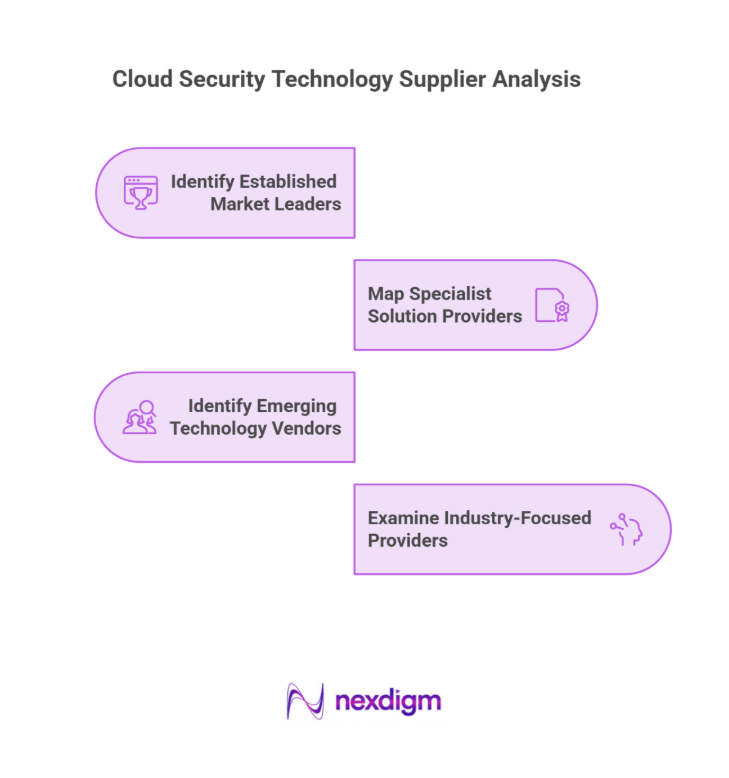
- Established Market Leaders: Identify providers with broad cloud security portfolios and capabilities across multiple technology categories.
- Specialist Solution Providers: Map vendors focused on workload protection, cloud posture management, container security, and data protection.
- Emerging Technology Vendors: Identify newer suppliers developing capabilities in AI-led threat detection, automated remediation, and cloud-native security.
- Industry-Focused Providers: Examine suppliers offering cloud security solutions tailored to sector-specific compliance, operational, and data protection requirements.
This mapping helps enterprises develop a relevant pool of providers for further assessment and potential engagement.
Evaluating the Competitive Strengths of Shortlisted Cloud Security Vendors with Nexdigm
Once relevant providers are identified, Nexdigm can help enterprises understand what differentiates them in the competitive landscape. Our research can examine:
- Product Portfolio Strength: Assess the breadth and depth of cloud security offerings across key technology categories.
- Innovation and Development: Track product enhancements, technology investments, partnerships, and emerging capabilities.
- Market Presence: Examine vendor positioning, industry reach, customer segments, and competitive activity.
- Strategic Differentiation: Identify distinctive capabilities, specialization, and portfolio advantages that may influence enterprise adoption.
These insights help organizations understand supplier strengths and identify providers that merit closer technical and commercial consideration.
Nexdigm’s Case
A multinational enterprise sought to evaluate cloud security providers for its expanding multi-cloud environment. Nexdigm assessed 24 suppliers across cloud posture management, workload protection, identity security, data protection, and platform integration. The analysis found that 38% of vendors had limited hybrid-cloud integration capabilities, while 29% lacked advanced automated threat response features. Based on the assessment, 6 suppliers were prioritized for detailed technical and commercial evaluation.
To take the next step, simply visit our Request a Consultation page and share your requirements with us.
Harsh Mittal
+91-8422857704