

Cloud procurement decisions can influence an organisation’s technology expenditure, application performance, data security and ability to scale. Yet comparing cloud providers is rarely straightforward. Each vendor offers a different combination of infrastructure services, pricing models, security capabilities, geographic coverage and enterprise support. Even when providers appear to offer similar computing and storage services, differences in architecture and commercial terms can materially affect the long-term cost of ownership.
For technology leaders and procurement teams, the challenge is to identify which provider delivers the strongest fit for the organisation’s workloads, operating model and future requirements. A structured cloud service provider benchmarking exercise makes this decision more objective by comparing vendors against consistent technical, commercial and operational criteria.
Cloud Adoption Is Expanding, but Procurement Decisions Are Becoming More Complex
Cloud infrastructure has moved well beyond basic storage and email hosting. Enterprises now use cloud platforms for application development, databases, analytics, cybersecurity, enterprise software and increasingly demanding AI workloads.
Eurostat’s 2025 enterprise ICT data found that 52.7% of EU enterprises used paid cloud computing services, compared with 45.3% in 2023. Adoption among large enterprises was approximately 84.7%, illustrating how deeply cloud services have entered enterprise technology environments.
As adoption expands, procurement teams are evaluating a broader range of services and commercial commitments. A platform selected for its compute pricing may not offer the best database economics, regional availability or support for specialised workloads. The buying decision must therefore move beyond vendor reputation and headline pricing.
What Should Enterprises Compare When Benchmarking Cloud Providers?
A meaningful comparison should examine the capabilities that influence actual workload performance and operating expenditure.
- Platform capabilities and workload suitability should be assessed first. Providers need to be evaluated on their ability to support existing and planned workloads, including compute performance, virtual machines, container services, storage options, backup capabilities, databases, networking and integration with existing systems.
Support for AI, analytics and high-performance computing may also influence the decision. A provider with an extensive service catalogue may still be unsuitable if its specialised capabilities do not align with the organisation’s architecture. - Security, compliance and governance require equally close attention. Comparisons should examine identity and access management, encryption, key management, logging, threat detection and incident response.
Procurement teams should also assess relevant certifications, data residency arrangements, regulatory requirements and contractual responsibilities.
Cloud security is a shared responsibility, so the allocation of controls between provider and customer must be clearly understood. - Enterprise support and service reliability can determine whether a platform is suitable for critical workloads.
Service-level commitments, support response times, escalation procedures, availability zones and disaster recovery capabilities should be examined alongside technical specifications.
A lower-priced service may create greater business exposure if the support model does not meet the organisation’s recovery requirements.
The Commercial Model Can Change the Entire Cost Comparison
Cloud pricing is often consumption-based, but the commercial structures available to enterprise customers can be considerably more complicated. Costs may include compute usage, storage consumption, data transfer, API requests, premium support, licensing and managed services. Discounts may be linked to committed usage, reserved capacity or longer contract periods.
Procurement teams should compare providers under different usage scenarios.
On-demand pricing offers flexibility but can expose businesses to variable expenditure. Committed-use arrangements may reduce unit costs, although they introduce minimum consumption obligations. Reserved or dedicated capacity can offer greater predictability for stable workloads but may reduce flexibility when requirements change.
The assessment should also account for data egress charges, idle resources, licence portability and the cost of migrating workloads away from a provider. These factors can materially change the economics of a cloud contract.
Matching Provider Strength to Enterprise Requirements
The strongest cloud provider is not necessarily the one with the largest infrastructure footprint or broadest product portfolio. The right choice depends on the organisation’s workload profile, technical maturity, regulatory environment and internal operating capabilities.
A financial services organisation may place greater emphasis on data governance, resilience and regulatory controls. A digital business experiencing variable demand may prioritise scalability and consumption flexibility. An enterprise running legacy applications may need strong migration support and compatibility with existing systems.
Vendor benchmarking should distinguish between mandatory requirements and areas where trade-offs are acceptable. This makes it easier to identify which providers genuinely meet enterprise needs rather than simply ranking vendors by the number of services they offer.
Nexdigm’s Cloud Service Provider Benchmarking Framework
A procurement-led comparison can be organised around six decision areas:
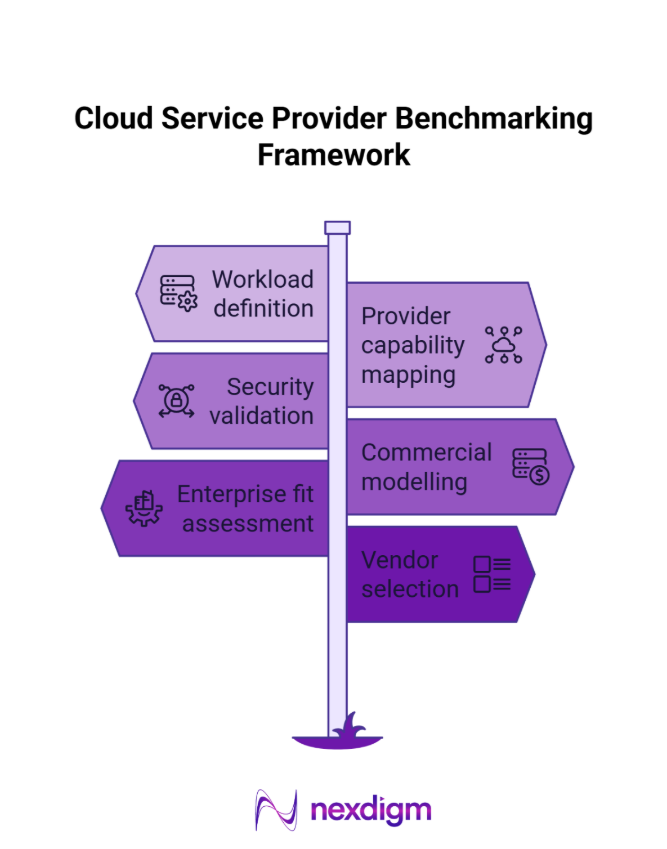
- Workload definition: Classify applications by compute intensity, storage needs, performance requirements and criticality.
- Provider capability mapping: Compare infrastructure, databases, networking, analytics, AI and geographic availability.
- Security and compliance validation: Examine certifications, data residency, access controls and contractual responsibility.
- Commercial modelling: Compare on-demand, committed-use and reserved-capacity pricing, including migration and exit costs.
- Enterprise fit assessment: Evaluate integration, support, service-level commitments and internal capability requirements.
- Vendor selection: Weight providers against business priorities and document the commercial and technical rationale for the shortlist.
Nexdigm can support technology buyers through cloud market research, provider benchmarking, commercial intelligence and enterprise technology procurement research. This helps organisations evaluate vendor positioning, compare service economics and build a defensible sourcing strategy.
Nexdigm’s Case Study: Benchmarking Enterprise Cloud Providers
Nexdigm compared 10 cloud providers across 5 enterprise workload categories, assessing platform capabilities, security, support and commercial models. The study identified a 21% variation in comparable service costs, shortlisted 4 providers and established 8 evaluation benchmarks.
To take the next step, simply visit our Request a Consultation page and share your requirements with us.
Harsh Mittal
+91-8422857704