

Enterprise cloud demand is becoming increasingly workload-specific. The early phase of cloud adoption was dominated by migration, infrastructure modernization and the shift from on-premise environments. The next phase is being shaped by AI workloads, data-intensive applications, platform engineering, cybersecurity and the economics of running those workloads at scale.
Global IT spending is forecast to reach $6.37 trillion in 2026, up 14.2% from 2025. Gartner identifies data-center systems and IaaS as the fastest-growing major segments, with data-center spending forecast to rise 62.5% and IaaS 29.3%.
The headline growth is significant, but it does not answer the more useful commercial question: which workloads are actually creating incremental cloud demand?
Migration is still relevant, but it is no longer the whole story
Enterprises continue to modernize legacy applications and move workloads across cloud environments. However, the economics and architecture of newer workloads are creating additional requirements.
In India, Gartner forecasts public cloud spending to reach $17.5 billion in 2026, up 28.1% from 2025. IaaS is expected to grow 40%, while PaaS is projected to grow 25.4%. PaaS spending is forecast at $6.4 billion, making it the largest cloud spending category in the country.
Gartner attributes the growth to AI-ready infrastructure, application modernization, data integration, real-time digital services and more scalable consumption-based IT.
This changes the shape of cloud demand. Customers increasingly need an environment where infrastructure, data and applications can operate together.
AI is changing the workload profile
AI is creating demand at several layers simultaneously.
Gartner forecasts global AI spending at $2.7 trillion in 2026, up 49.5% year over year. AI infrastructure represents the largest spending component, while AI software, services, models and agents create additional demand across the technology stack.
AI-optimized IaaS alone is projected to reach $42.3 billion in 2026, up 96.4%. Importantly, inference spending is forecast to reach $23.3 billion, exceeding training expenditure of $19 billion.
That distinction is commercially important.
Training can create large but episodic infrastructure requirements. Production inference can generate recurring demand as AI becomes embedded in customer-facing applications and internal workflows.
Cloud demand analysis therefore needs to examine where AI is moving from experimentation into continuous production use.
The enterprise cloud demand map
A useful assessment can organize demand around four workload layers.
- Modernization workloads
Legacy application modernization, containers, databases and application refactoring remain important sources of demand. The opportunity is particularly relevant where organizations have large on-premise estates and increasing pressure to improve agility. - Data workloads
Real-time analytics, data integration, data warehouses, lakehouses and AI-ready data architectures create demand for scalable storage and processing. Data is also becoming more distributed, increasing the need for integration across cloud environments. - AI workloads
Training, inference, model serving, vector databases, AI development platforms and agentic applications create a different infrastructure profile. Compute intensity, latency and networking requirements can materially alter cloud economics. - Security and governance workloads
Cloud expansion creates demand for identity, security monitoring, compliance, data protection and governance. Gartner forecasts Indian information-security spending at $3.4 billion in 2026, with security software spending expected to grow 12.4%.
Geography changes the demand equation
Enterprise cloud demand is not uniform across markets.
India combines rapid cloud expansion with rising AI infrastructure requirements. Gartner expects public cloud spending to rise from $13.7 billion in 2025 to $17.5 billion in 2026.
Other markets may show different patterns. Mature cloud economies may have greater demand for optimization, modernization, sovereignty and multicloud governance, while developing markets may be moving more rapidly into cloud-native architectures without the same legacy burden.
The geographic opportunity therefore needs to be assessed alongside workload maturity.
A framework for cloud demand analysis
A structured cloud services demand analysis research exercise can connect spending forecasts with actual workload requirements.
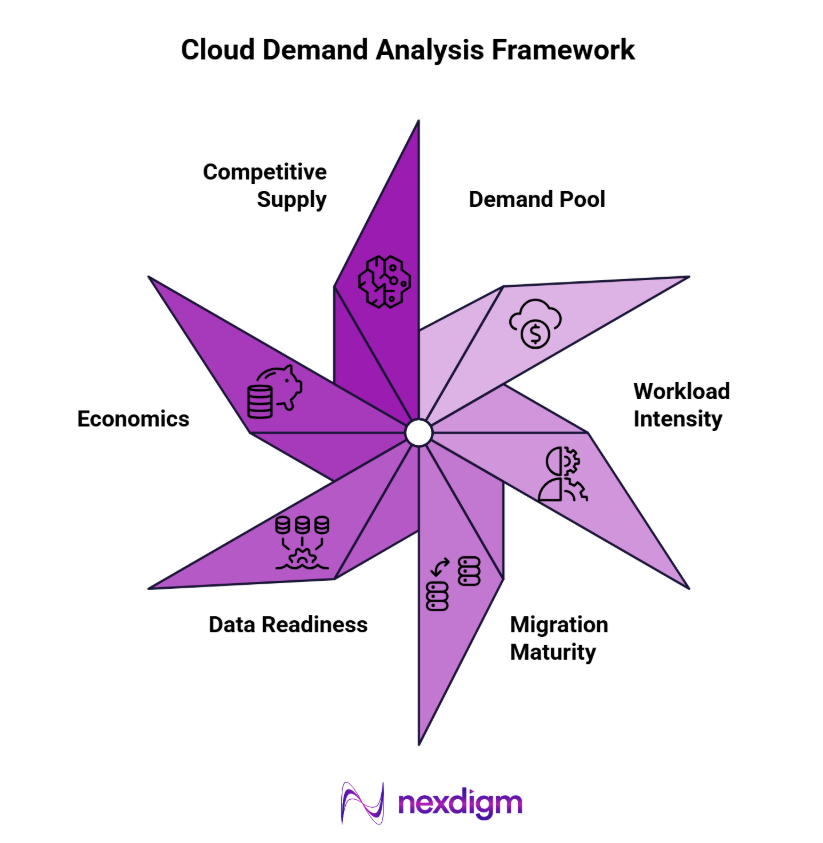
- Demand pool
Size spending by IaaS, PaaS, SaaS, managed services, security and data platforms. - Workload intensity
Estimate the compute, storage, networking and latency requirements of priority workloads. - Migration maturity
Assess how far enterprises have progressed from on-premise infrastructure to hybrid and multicloud environments. - Data readiness
Determine whether organizations have the data architecture needed to support analytics and AI at scale. - Economics
Evaluate utilization, infrastructure costs, FinOps maturity and workload optimization requirements. - Competitive supply
Map hyperscalers, specialist cloud providers, managed-service providers and regional infrastructure companies.
Gartner expects more than 60% of enterprises to perform intensive AI model activity in one cloud while leveraging the resulting models with data in another by 2030, compared with less than 10% today.
That makes multicloud data movement, governance and workload placement increasingly important parts of the demand equation.
Demand is increasingly attached to workload economics
Cloud growth should therefore be tracked through the applications and workloads consuming capacity, rather than cloud adoption alone.
The opportunity is shifting toward environments that can support production AI, real-time data, modernization and security while keeping infrastructure costs controllable.
For providers and investors, this creates a more granular market view: which workloads are expanding, where they are being deployed, what technical constraints remain, and which parts of the cloud stack can capture the resulting spending.
Nexdigm Case: Enterprise Cloud Demand
A cloud provider with $210M annual revenue evaluated 8 markets. Nexdigm analyzed 17 workload categories across 320 enterprises, identifying AI inference, data platforms and modernization as 3 priority pools worth $1.9B in projected demand.
To take the next step, simply visit our Request a Consultation page and share your requirements with us.
Harsh Mittal
+91-8422857704