

Cloud markets are entering a more complex phase. Enterprise demand is still expanding, but the commercial opportunity is increasingly concentrated in the infrastructure and platform capabilities required to run demanding workloads. Migration alone is no longer a sufficient lens for understanding where cloud spending is heading.
Gartner forecasts India’s public cloud spending at $17.5 billion in 2026, representing 28.1% growth from $13.7 billion in 2025. IaaS is expected to grow 40%, while PaaS spending is forecast at $6.4 billion. Gartner attributes the momentum to AI-ready infrastructure, application modernization, digital sovereignty and consumption-based IT models.
The opportunity, therefore, lies in understanding which layers of the cloud stack are receiving incremental investment and why.
The new cloud demand map
Enterprise cloud requirements increasingly combine infrastructure, data, security and workload economics.
AI is accelerating this shift. The need for GPUs and high-performance compute is accompanied by requirements for high-speed networking, scalable storage, inference capacity and stronger data foundations. Gartner expects AI-optimized IaaS spending globally to grow sharply in 2026, while India’s IaaS market is forecast to reach $6.3 billion.
At the same time, PaaS is becoming important because enterprises need environments that connect applications, data and AI services without rebuilding their technology architecture for every use case.
This produces several distinct opportunity pools:
- AI infrastructure and accelerated compute
- Data platforms and integration
- Cloud security and governance
- Application modernization
- Cloud networking
- Platform engineering
- FinOps and workload optimization
- Sovereign and regulated cloud environments
The commercial attractiveness of each pool depends on the underlying customer problem.
Growth does not automatically mean attractive cloud economics
Cloud suppliers face a second question: where is spending large enough to support a specialist offering?
A hyperscaler may dominate raw infrastructure, while specialist providers can compete where enterprise requirements become more complex. Data governance, security, workload optimization and industry-specific architecture are examples where technical complexity can create room for differentiated services.
Cost is becoming particularly important. As AI workloads increase compute requirements, customers are paying closer attention to utilization, inference costs, storage and network charges. Gartner notes that enterprises are moving toward disciplined cloud execution involving FinOps, governance, security-by-design and dynamic workload placement across hybrid and multicloud environments.
This means the cloud opportunity cannot be assessed purely through spending forecasts. It must also consider how customers experience the economics of that spending.
Where the next spending pools can be found
A structured cloud services opportunity assessment research exercise can connect market growth with enterprise buying behaviour.
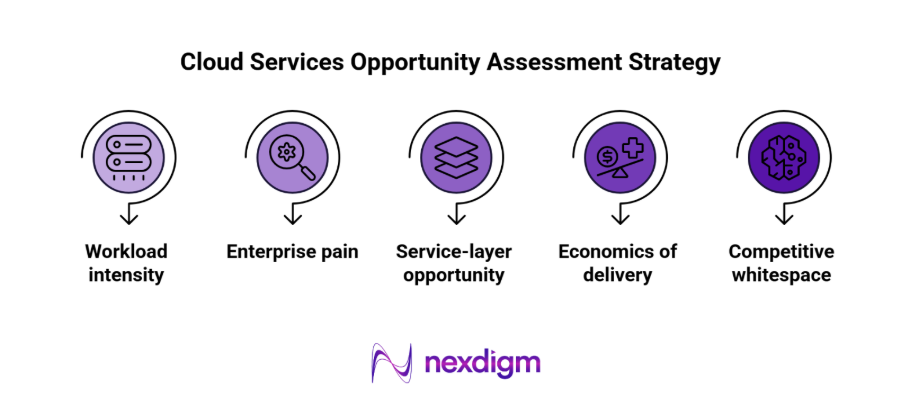
- Workload intensity
Map workloads according to their compute, storage, networking, latency and availability requirements. AI training, inference, real-time analytics and high-volume transaction processing create different infrastructure needs. - Enterprise pain
Identify where customers experience unresolved problems. High cloud bills, fragmented data, security exposure, poor application performance and migration complexity can indicate stronger demand than generic cloud adoption figures. - Service-layer opportunity
Determine where value can be captured. Infrastructure, platforms, managed services, security, data engineering and optimization have different competitive structures and margins. - Economics of delivery
Assess infrastructure costs, utilization requirements, hyperscaler dependence, talent availability and implementation complexity. A rapidly growing market can still be unattractive if delivery economics are structurally weak. - Competitive whitespace
Map hyperscalers, global technology providers, regional specialists and emerging vendors. The objective is to identify areas where customer requirements exceed what large platforms provide through standardized offerings.
The investment question is increasingly workload-specific
India’s cloud market demonstrates why this matters. PaaS and IaaS are expanding at significantly different rates, while SaaS growth is comparatively moderate as organizations rationalize licenses and redirect incremental spending toward infrastructure and platforms.
For a cloud provider, technology company or investor, the useful question is therefore not simply how large cloud adoption will become. It is which workloads are generating new spending, which constraints are preventing customers from scaling them, and which providers can solve those constraints profitably.
That creates a much clearer basis for evaluating market entry, portfolio expansion and investment priorities.
Nexdigm Case: Cloud Optimization Opportunity
A regional cloud-services provider generated $14M revenue from 180 enterprise accounts but faced 22% gross-margin pressure. Nexdigm assessed 9 workload segments across 4 sectors, identifying AI infrastructure and FinOps as priority pools with a projected $31M addressable opportunity.
To take the next step, simply visit our Request a Consultation page and share your requirements with us.
Harsh Mittal
+91-8422857704