

Cloud service providers operate in a rapidly expanding market where infrastructure capacity, platform capabilities, AI workloads, consumption patterns, and customer commitments continuously reshape pricing expectations. A cloud services pricing feasibility study helps providers benchmark competitors, assess price-to-performance value, test customer sensitivity, and model revenue and margin outcomes.
Supported by cloud pricing analysis, infrastructure pricing benchmarking, platform pricing research, competitive pricing intelligence, and pricing feasibility assessment, providers can strengthen market positioning, monetization, and growth in the highly competitive landscape.
Global enterprise spending on cloud infrastructure services reached $419 billion in 2025, while Q4 spending increased about 30% year over year. This scale and growth reinforce the need for Pricing Analysis Services to benchmark rates and maintain competitive pricing.
Pricing Analysis for Cloud Service Commitments, Margin Economics and Growth
Cloud pricing analysis helps businesses evaluate consumption behavior, commitment structures, infrastructure costs, and margin dynamics to improve pricing efficiency, revenue predictability, and sustainable cloud service profitability. Its key aspects helping providers align cloud usage and delivery economics are:
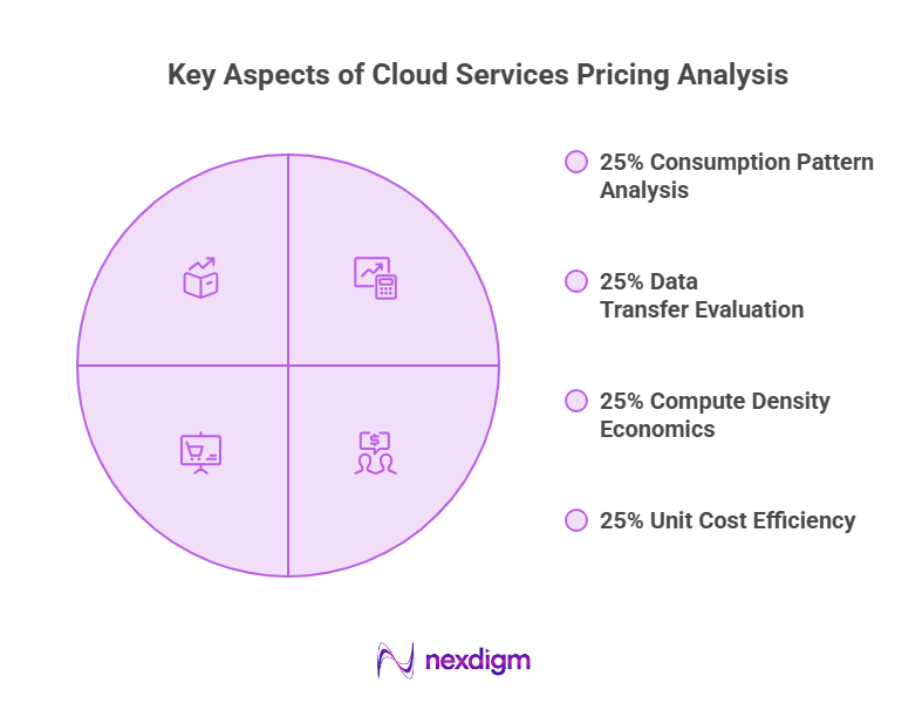
- Consumption Pattern Analysis: Examines compute, storage, data transfer, API, and platform usage to understand customer demand patterns and determine commercially appropriate usage-based pricing structures.
- Data Transfer Evaluation: Evaluates ingress, egress, inter-region, and network charges to understand how data movement influences effective customer costs and provider margin performance.
- Compute Density Economics: Assesses revenue generated relative to compute resources consumed, helping providers understand whether intensive workloads contribute proportionately to infrastructure and operating costs.
- Unit Cost Efficiency: Tracks infrastructure cost per minute, storage unit, transaction, or workload to identify where operational improvements can strengthen pricing competitiveness and margins.
Nexdigm’s Pricing Intelligence Support for Cloud Commitments and Profitability
Nexdigm helps cloud service providers strengthen commercial decisions through structured pricing analysis services, consumption economics, competitive benchmarking, and margin assessment. With such strategic approach, Nexdigm supports businesses with effective commitments, customer value, and revenue growth in the following areas:
- Cloud Consumption Pattern Assessment
- Competitive Rate Benchmarking
- Reserved Commitment Economics
- Usage-Based Pricing Optimization
- Infrastructure Cost-to-Price Alignment
Nexdigm’s Cloud Pricing Roadmap for Consumption, Commitments, and Growth
Nexdigm’s cloud pricing roadmap integrates consumption insights, competitive benchmarks, and margin analysis to help providers optimize pricing and support growth sustainably. Its structured steps connect cloud usage and service economics with practical pricing decisions that strengthen long-term growth, including:
- Segment Cloud Usage Profiles: Classify customers by workload intensity, consumption patterns, service mix, and growth potential to establish differentiated pricing approaches across cloud customer groups.
- Evaluate Commitment Pricing: Evaluate prepaid usage, reserved capacity, annual commitments, and minimum spend levels to create structures that improve customer value and revenue predictability.
- Align Pricing With Service Value: Connect pricing with performance, availability, scalability, security, and support levels to ensure higher-value cloud services command commercially appropriate pricing.
- Test Revenue and Margin Ratios: Model alternative usage rates, discounts, commitment levels, and service mixes to understand their effects on revenue growth, profitability, and customer adoption.
- Scale Pricing With Customer Growth: Adjust tiers, commitments, and pricing metrics as customer workloads expand to improve expansion revenue while maintaining competitive and sustainable cloud economics.
Nexdigm’s Case
Nexdigm supported a cloud services provider in optimizing consumption tiers, commitment discounts, and service-level economics. The engagement contributed to 13% higher revenue realization, 10% improved margin performance, and 16% stronger committed usage, improving monetization, utilization, and revenue predictability.
To take the next step, simply visit our Request a Consultation page and share your requirements with us.
Harsh Mittal
+91-8422857704