

Enterprise data storage has become a procurement decision with implications for business continuity, cybersecurity, application performance and long-term technology expenditure. Organisations are storing larger volumes of customer records, operational data, financial information, application files and analytics workloads. As these requirements expand, choosing a cloud storage provider involves more than comparing the cost per gigabyte.
Providers differ in storage architecture, retrieval performance, redundancy, data protection, geographic availability and pricing structures. A service that appears inexpensive at the point of purchase may become costly when businesses account for data retrieval, transfers, backup requirements and long-term retention.
A structured cloud storage vendor benchmarking exercise helps enterprises compare providers against their actual data requirements and understand the commercial and operational implications of each option.
The Growing Demand for Enterprise Cloud Storage
Cloud storage is no longer limited to file sharing and document access. It supports application databases, backup environments, business continuity, analytics, collaboration and large-scale data processing.
Eurostat’s 2025 enterprise ICT data found that 71.5% of EU enterprises purchasing paid cloud services used them for file storage. This makes storage one of the most widely adopted cloud service categories among businesses already using paid cloud computing.
For suppliers, this creates a competitive market spanning object storage, block storage, file storage, backup platforms and specialised data management services. For buyers, the challenge is determining which architecture and commercial model best suit each workload.
Start With the Nature of the Data
Different data types have different storage requirements. Treating all enterprise information as one category can lead to unnecessary expenditure or inadequate performance.
A practical assessment should distinguish between:
- Frequently accessed data: Application files, active databases and operational records requiring predictable retrieval performance.
- Infrequently accessed data: Historical documents, older project files and records that need to remain available but are accessed less often.
- Backup and recovery data: Copies maintained to restore systems following accidental deletion, cyber incidents or infrastructure failures.
- Archive data: Information retained for legal, regulatory or business purposes over extended periods.
The storage tier selected should reflect access frequency, retrieval expectations, retention requirements and the cost of downtime. Moving frequently accessed information into a low-cost archival tier may reduce storage charges but create delays and additional retrieval expenses.
What Separates Competing Cloud Storage Providers?
The comparison should begin with scalability. Enterprises need to understand whether providers can accommodate increasing data volumes without requiring major architectural changes. Capacity limits, performance consistency, regional availability and integration with existing infrastructure all matter.
Data protection is equally important. Procurement teams should examine encryption at rest and in transit, access controls, backup capabilities, versioning, replication, recovery options and retention policies. Where sensitive information is involved, data residency and deletion requirements should also be validated.
Performance must be assessed against actual workloads. Relevant measures include retrieval latency, throughput, availability and the ability to support concurrent requests. A platform designed for archival storage may not be suitable for applications that require rapid data access.
Service performance also depends on support arrangements. Response times, incident escalation, service-level commitments and technical assistance can influence the suitability of a provider for business-critical workloads.
The Pricing Model: Beyond Storage Capacity
Cloud storage pricing can contain several components, and the headline rate rarely represents the entire cost.
Procurement teams should account for:
- Storage capacity and the selected storage tier.
- Data retrieval and request charges.
- Outbound data transfer and inter-region movement.
- Replication, backup and recovery services.
- Minimum storage duration and early deletion fees.
- Support, monitoring and management services.
A useful comparison models costs against realistic usage scenarios. For example, an organisation with high retrieval volumes may find that a lower-priced storage tier becomes more expensive once access charges are included. Businesses with predictable demand may benefit from committed pricing, while those with fluctuating storage requirements may value flexibility.
Exit costs also deserve attention. Data transfer charges, migration complexity and proprietary interfaces can make changing providers more expensive than expected.
Matching Storage Suppliers to Enterprise Requirements
A supplier should be evaluated according to the workload it is expected to support. A business storing compliance records may prioritise retention controls and auditability. A media company may place greater emphasis on throughput and content delivery integration. An enterprise running distributed applications may need low-latency access across multiple regions.
The procurement team should therefore avoid selecting a single provider solely on the basis of a general vendor ranking. It may be more commercially sensible to allocate different data categories to different storage tiers or providers, provided that the resulting environment remains manageable and secure.
Cloud Storage Vendor Benchmarking Framework
Use this assessment to turn storage requirements into a defensible supplier comparison:
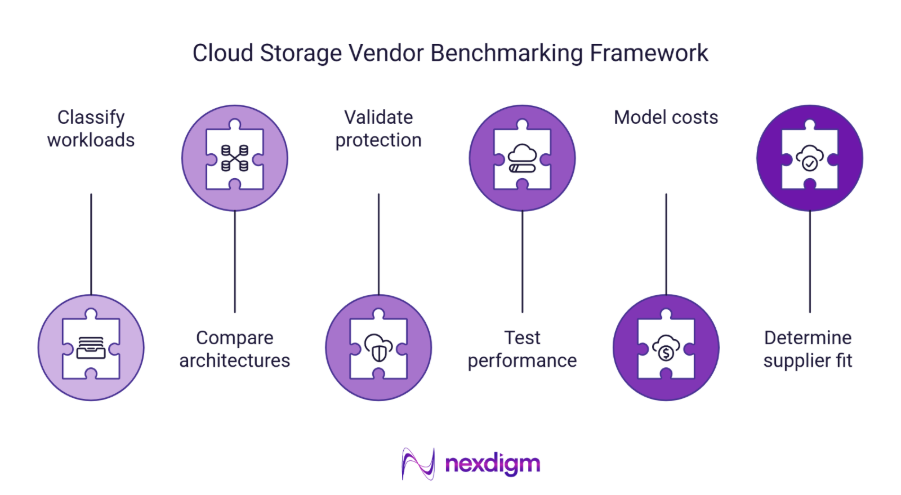
- Classify data workloads: Identify access frequency, data sensitivity, retention periods, recovery requirements and expected growth.
- Compare storage architectures: Assess object, block, file, backup and archive capabilities against workload needs.
- Validate data protection: Examine encryption, access controls, replication, backup, recovery and data residency.
- Test performance: Compare retrieval latency, throughput, availability and workload compatibility.
- Model total storage costs: Include capacity, retrieval, transfer, replication, support, migration and exit charges.
- Determine supplier fit: Rank providers against weighted business requirements and identify the most suitable storage configuration.
Nexdigm can support enterprises through cloud storage market research, vendor benchmarking, pricing analysis and supplier capability assessment. This helps technology and procurement teams compare storage providers, understand cost structures and identify sourcing options that balance performance, security and commercial value.
Nexdigm’s Case Study: Comparing Enterprise Cloud Storage Providers
Nexdigm assessed 12 cloud storage providers across 4 enterprise workload categories, comparing scalability, data protection, performance and pricing. The study identified a 19% variation in comparable service costs, shortlisted 4 providers and established 8 technical and commercial benchmarks.
To take the next step, simply visit our Request a Consultation page and share your requirements with us.
Harsh Mittal
+91-8422857704