

Global coal demand is approaching a plateau, but the aggregate number hides a fundamental geographic shift. In 2025, global coal demand increased only 0.3% to 8.84 billion tonnes, reaching another record. The IEA’s 2026 outlook expects India and Southeast Asia to remain the main sources of growth, while coal use in Europe and several mature Asian economies continues to decline.
For mining companies, this divergence matters because the location and type of demand determine whether additional production has a viable market.
Asia Continues to Anchor Coal Consumption
China and India accounted for roughly 71% of global coal consumption in 2024, making their domestic markets central to the global outlook.
India is currently the clearest source of incremental demand. After coal consumption fell 1% in 2025, the IEA expects demand to rise 4.2% in 2026 to approximately 1,353 million tonnes. Power generation remains the largest source of consumption, alongside pig iron, direct reduced iron and cement.
Southeast Asia represents another growth market. Regional coal imports are expected to increase from 156 million tonnes in 2025 to around 164 million tonnes in 2026, led by Viet Nam, where imports are projected to rise from 55 million to 62 million tonnes.
Key demand drivers include:
- Rising electricity consumption
- New power and industrial capacity
- Metals processing, particularly in Indonesia
- Expanding steel and cement production
- Limited availability or higher costs of alternative fuels in some markets
Renewable generation is nevertheless expanding rapidly across Asia. Coal is increasingly being used alongside growing renewable capacity to support grid reliability, meaning future demand will depend as much on power-system requirements as on overall electricity growth.
China Is Moving from Growth to Stability
China remains the world’s largest coal consumer, with demand close to 5 billion tonnes annually. Its market is increasingly shaped by competing forces: strong electricity demand and energy-security priorities continue to support coal, while rapid renewable deployment limits the amount of incremental generation required from coal-fired plants.
In 2025, China generated less electricity from coal for the first time since 2015 despite strong overall electricity demand. Industrial demand is also changing, with the IEA expecting coal use in cement and steel to weaken while coal-to-chemicals activity provides an offset.
China’s importance is therefore shifting from straightforward demand growth toward market stability, domestic supply, imports and international trade flows.
Europe Is Structurally Different
The European Union represents a fundamentally different demand trajectory. Coal consumption fell 5% in 2025, following substantial declines over the previous decade as coal-fired capacity closed, renewable generation expanded and carbon costs increased.
Short-term factors can still produce temporary increases in coal use. Lower wind and hydropower output, higher gas prices or energy-security concerns can increase coal-fired generation in individual years. These fluctuations should not be interpreted as a reversal of the structural decline.
Temporary demand support does not necessarily justify a long-life mine when the underlying customer base is contracting.
The Export Market Is Becoming More Selective
The shift is also visible in international coal trade. India’s thermal-coal imports are projected to fall to around 160 million tonnes in 2026 from 167 million tonnes in 2025 as domestic production and inventories reduce import requirements.
Southeast Asia is moving in the opposite direction, with regional coal imports expected to reach around 164 million tonnes in 2026. This creates different opportunities for producers:
- Growing import markets can support new supply where domestic production cannot keep pace.
- Import-substitution markets may offer limited opportunities for seaborne suppliers even when domestic consumption is rising.
- Mature markets can provide short-term trading opportunities but carry greater long-term policy and asset-retirement risk.
Coal quality also becomes more important as buyers become selective. Calorific value, ash and sulphur content influence plant compatibility, delivered economics and the price received by producers.
Where Investment Can Still Make Commercial Sense
A useful coal mining demand assessment services approach should distinguish between demand that is growing, stable and structurally declining. The strongest opportunities are generally markets where several conditions overlap:
- Growing end-use demand: Electricity, steel, cement or metals processing is expanding.
- Domestic supply constraints: Local production cannot fully satisfy consumption.
- Competitive logistics: Rail, road, port or conveyor infrastructure supports an attractive delivered cost.
- Product-market fit: Coal quality matches customer requirements.
- Policy visibility: Government policy provides sufficient clarity over mining and coal consumption.
- Customer security: Long-term contracts or captive demand reduce exposure to spot-market volatility.
The commercial opportunity is therefore increasingly regional rather than global. India and parts of Southeast Asia retain structural demand drivers, while Europe and several mature Asian markets face continued substitution pressure.
Nexdigm’s Framework for Coal Demand Assessment
Nexdigm can evaluate coal markets by combining regional demand forecasting with end-use analysis, supply economics and trade flows.
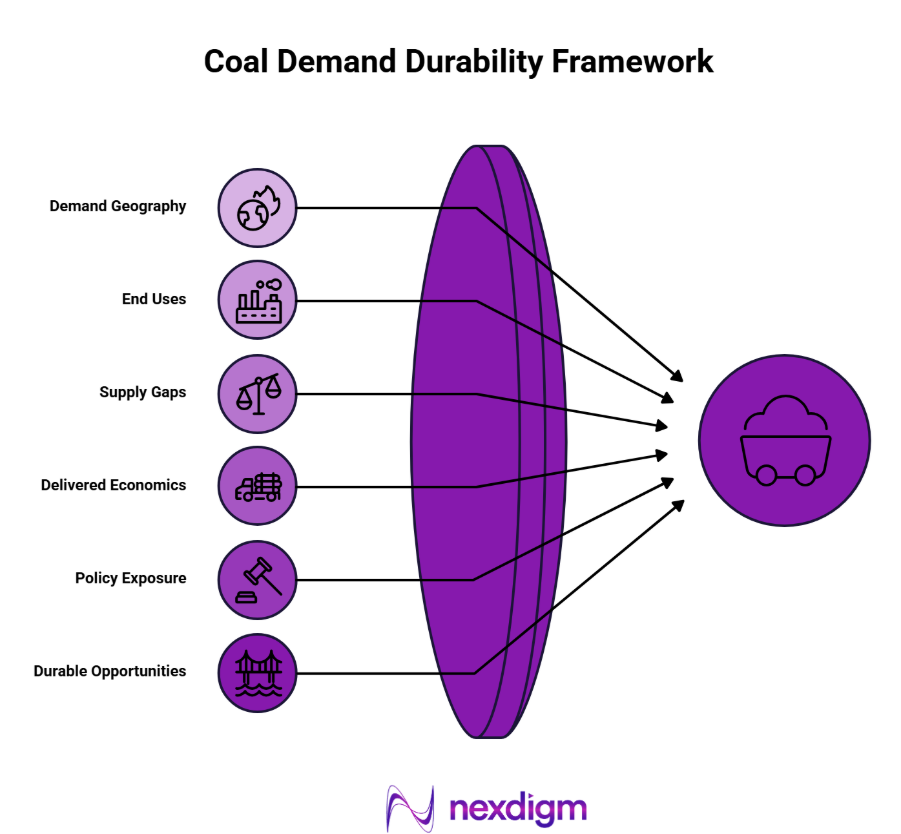
- Map demand geography: Identify markets where coal consumption is growing, stable or structurally declining.
- Trace end uses: Separate power, steel, cement, chemicals and metals processing to determine what is sustaining demand.
- Assess supply gaps: Compare domestic production, imports, mine expansions and planned capacity with projected consumption.
- Test delivered economics: Incorporate coal quality, freight, rail, port and handling costs to determine supply competitiveness.
- Evaluate policy exposure: Assess phase-outs, domestic production policies, emissions requirements and permitting conditions.
- Identify durable opportunities: Prioritise markets where demand is supported by structural industrial and infrastructure drivers rather than temporary disruptions.
This approach separates durable coal demand from short-term market movements, helping investors determine where a market can support long-term production and where declining consumption creates increasing commercial risk.
Nexdigm Case: Coal Demand Market Screening
A mining company screened 15 coal markets across Asia, Europe and the Middle East. Nexdigm assessed end-use demand, domestic supply, import dependence, logistics and policy exposure, identifying five markets with sustained demand potential through 2030 and three facing structural volume declines.
To take the next step, simply visit our Request a Consultation page and share your requirements with us.
Harsh Mittal
+91-8422857704