
For coal producers, distribution economics can determine whether additional production translates into stronger commercial returns. A mine may have a competitive extraction cost, but its advantage can disappear when rail freight, handling, quality adjustments and inventory costs are included. The buyer’s requirements matter just as much: coal suitable for one power plant may not be suitable for a steel producer or another industrial user.
A coal distribution strategy should therefore connect customer demand, product quality and logistics capacity to the price the producer ultimately receives.
Coal Demand Is Large, but Buyers Have Different Requirements
Coal remains a significant component of India’s energy and industrial system. The Ministry of Coal reported national production of approximately 1,047.52 million tonnes in FY2024–25, up 4.98% from 997.83 million tonnes in FY2023–24. This expansion demonstrates the scale of the domestic supply base, but it also means producers must understand where their product can compete, and which customers can absorb additional volumes.
The International Energy Agency’s Coal Mid-Year Update 2026 estimated global coal demand at 8.84 billion tonnes in 2025, with demand increasing by around 0.3%. Its analysis points to differing regional trajectories rather than uniform growth. For an individual producer, national or global demand figures provide context, while customer procurement plans and delivered-cost comparisons determine the immediate commercial opportunity.
Map the Main Buyer Segments
- Power utilities purchase large volumes and often require dependable deliveries, consistent quality and coordination with plant inventories. Procurement arrangements, rail access and the coal specifications permitted by the boiler system influence supplier selection.
- Steel producers may require coking coal for conventional blast-furnace operations, while integrated plants and other steelmaking routes have different fuel and raw-material needs. Coking coal cannot be treated as interchangeable with ordinary thermal coal. Quality, coking properties, blending requirements and import alternatives influence the commercial case.
- Cement, sponge iron and other industrial buyers have their own fuel specifications, consumption patterns and delivery requirements. Some may value local supply and smaller shipments, while others depend on reliable bulk deliveries and predictable pricing.
The distribution strategy should identify the actual procurement route for each segment, including tenders, direct contracts, approved supplier arrangements and purchases through intermediaries.
Coal Quality Determines Which Markets Are Accessible
Coal quality influences both price and usability. Calorific value affects the energy obtained from a given quantity, while ash, moisture and sulphur can influence handling, combustion performance, emissions and waste generation. For metallurgical applications, additional properties determine whether coal is suitable for coke production and blending.
Producers should match mine-level quality data with buyer specifications before prioritising a destination. They should also account for variation across seams and production batches. Washing or beneficiation may improve product quality, but the associated recovery losses, processing charges and handling requirements must be included in the economics.
A high-volume buyer is not necessarily attractive if the mine cannot consistently meet its specifications or must discount the product heavily to do so.
Rail, Ports and the Delivered-Cost Calculation
For bulk coal, transport is often one of the largest determinants of market reach. A mine’s viable sales radius depends on extraction cost, loading infrastructure, rail availability, transit time, handling charges and the cost of the final delivery leg. Export routes add port charges, vessel availability, customs procedures, insurance and exposure to international price movements.
The relevant metric is delivered cost compared with the price the buyer is willing to pay for the product. The model should include mine-mouth cost, preparation and loading, freight, terminal handling, storage, quality adjustments and financing. It should also account for demurrage or delays where these are commercially relevant.
A coal mining distribution entry consulting assessment can compare routes by customer segment and identify where a producer retains a competitive margin after logistics. It should test disruptions, freight changes, lower selling prices and delays rather than relying on a single route-cost estimate.
Select the Right Distribution and Contract Model
Direct sales can provide stronger customer relationships and greater control over commercial terms, but require procurement expertise, credit management and delivery coordination. Traders can provide market access and shipment flexibility, while distributors may help serve smaller industrial buyers. Long-term supply agreements can improve volume visibility, although pricing formulas and delivery commitments need careful evaluation.
Producers should compare these models by net realisation, sales certainty, payment terms and operating complexity. Contracts should define quality tolerances, sampling procedures, delivery schedules, quantity flexibility, penalties and dispute resolution.
Coal Distribution and Netback Framework
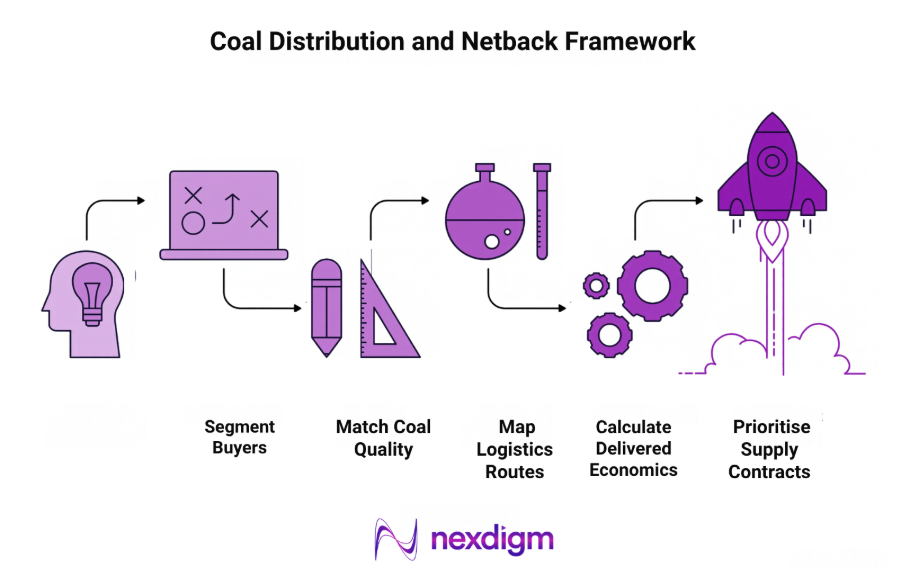
- Segment Buyers: Identify power utilities, steel producers and industrial consumers based on coal demand, purchasing frequency and sourcing requirements.
- Match Coal Quality: Align calorific value, ash content, moisture levels and saleable output with each buyer’s technical specifications.
- Map Logistics Routes: Evaluate rail, road, port and handling infrastructure, including freight costs, capacity and delivery reliability, to identify efficient supply routes.
- Calculate Delivered Economics: Compare selling prices with transportation, handling and distribution costs while assessing net realisation, payment terms and working capital requirements.
- Prioritise Supply Contracts: Select buyers and agreements that offer competitive margins, reliable demand volumes, manageable payment exposure and dependable logistics.
Nexdigm Case Study
A coal producer assessed six buyer opportunities across power and industrial segments. Route-level modelling showed that the highest-volume opportunity had weaker projected margins after freight and handling. The producer prioritised two buyers with better quality fit and more reliable logistics, subject to contract and delivery-capacity validation.
To take the next step, simply visit our Request a Consultation page and share your requirements with us.
Harsh Mittal
+91-8422857704