

Coal mining investment increasingly depends on the specific market being served. Thermal coal used for power generation faces different demand drivers from coking coal used in steelmaking. Even within thermal coal, quality, location, transport costs and the reliability of customer demand can determine whether a mine is commercially competitive.
The investment question is therefore more specific than whether coal demand will rise or fall globally. A project must establish which buyers need its product, how long that demand is likely to persist and whether the mine can deliver coal at a competitive cost while meeting applicable regulatory and environmental requirements.
Global Demand Is Near a Plateau, but Regional Markets Differ
The International Energy Agency’s 2026 Coal Mid-Year Update estimated that global coal demand increased by approximately 0.3% in 2025 to 8.84 billion tonnes. The modest growth followed a period of expansion and suggests that aggregate demand has entered a more stable phase. However, regional conditions differ: the report estimated that India’s coal demand declined by 1% to approximately 1.299 billion tonnes in 2025, even as domestic production remained around 1.1 billion tonnes.
India’s production figures provide additional context. The Ministry of Coal reported provisional production of 1,047.57 million tonnes in FY2024–25, up 4.99% from 997.83 million tonnes in the previous year. The figures show that supply expansion can continue even when demand growth is uneven. For a new entrant, rising national production does not by itself establish an attractive opportunity. The relevant question is whether a particular mine can serve a customer more competitively than existing sources.
Thermal Coal and Coking Coal Require Different Investment Cases
- Thermal coal is primarily used for electricity generation and other heat-intensive applications. Its commercial prospects depend on power demand, plant utilisation, fuel procurement arrangements, coal quality and the economics of competing energy sources. A mine near a suitable power plant may have an advantage if it reduces delivered costs and supply uncertainty.
- Coking coal is used in conventional blast-furnace steelmaking, where coal quality and coke-making properties can be critical. Its market assessment must examine steel production, customer specifications, blending requirements and the availability of suitable alternatives. Metallurgical coal should not be assessed using the same assumptions as lower-grade thermal coal because its buyers, quality requirements and pricing dynamics differ.
The distinction affects both demand forecasting and mine design. A deposit’s quality determines which customer segments it can serve, while processing and blending requirements affect saleable output and costs.
Coal Quality, Mining Costs and Delivered Economics
Coal quality influences commercial value through calorific value, ash, moisture, sulphur and, for metallurgical applications, coking characteristics. Lower-quality coal may be usable in some plants but unsuitable for others without blending or preparation. The mine therefore needs a credible quality profile linked to actual buyer specifications.
A feasibility model should estimate:
- Recoverable reserves and the mine’s expected production profile.
- Stripping ratio, extraction method, labour, equipment and maintenance.
- Washing or beneficiation requirements and the yield of saleable coal.
- Rail, road, port and handling charges from mine to customer.
- Contract pricing, quality penalties, inventory and payment terms.
Transport can determine the viable market radius. For bulk coal, the cost of moving product over long distances can erode the advantage of low mine-mouth costs. Rail capacity, last-mile connectivity, port access and loading infrastructure should be confirmed before a project relies on a particular customer market.
What Could Support a New Coal Mining Opportunity?
A project may remain commercially relevant where there is durable demand from an identifiable customer base, a competitive delivered cost and reliable infrastructure. Potential advantages include proximity to an industrial user, suitable quality for a specific plant, an established offtake arrangement or access to a market that cannot be served economically by alternative sources.
However, these advantages must be weighed against policy and transition risks. The IEA’s 2026 assessment expects global coal demand to remain broadly stable in the near term before declining gradually towards 2030. Investment models that assume uninterrupted demand growth over a long mine life could therefore overstate future sales.
A coal mining feasibility study consulting services assessment should test mine economics against several demand and pricing scenarios. It should account for changes in power generation, steelmaking, competing fuels, emissions requirements, mine rehabilitation and the potential for customers to reduce or change coal consumption.
The Investment Conditions That Matter Most
Before committing capital, an investor should establish whether the mine has economically recoverable reserves, a product that meets customer requirements, an achievable production schedule and an affordable route to market. It should also confirm permits, land access, environmental obligations and the funding required for rehabilitation and closure.
The assessment should distinguish between short-term demand support and durable project economics. A mine that depends on high spot prices or one customer without a secure contract is more exposed than an operation with a competitive cost position, diversified demand and a credible offtake pathway.
A Coal Mining Commercial Viability Framework
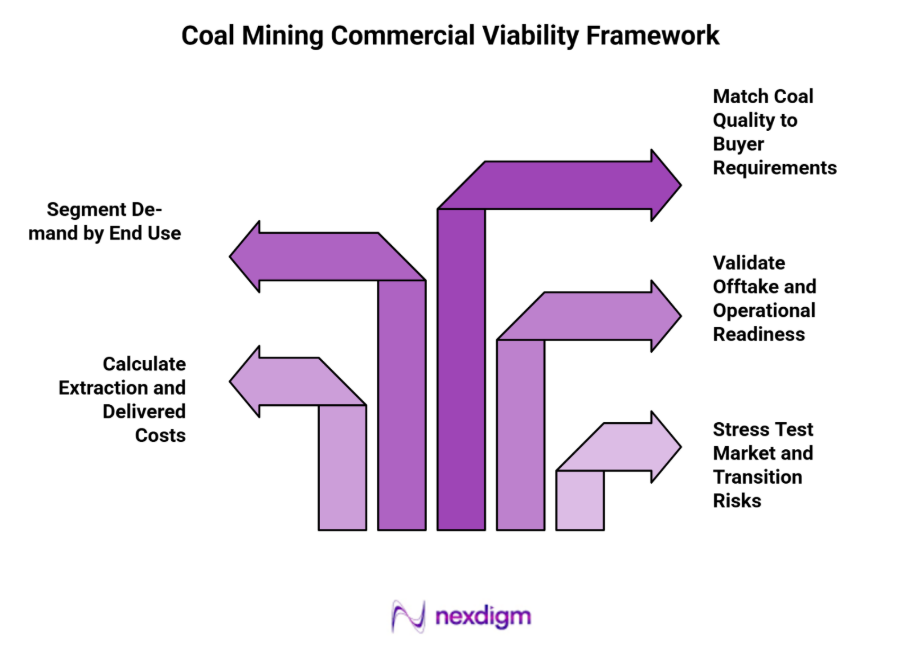
- Segment Demand by End Use: Assess demand across thermal coal for power generation, metallurgical coal for steel production and coal used in industrial applications. Evaluate consumption trends, major buyers and future demand drivers within each segment.
- Match Coal Quality to Buyer Requirements: Analyse coal grades, calorific value, ash content, sulphur levels and saleable yield to determine whether the resource meets buyer specifications and can command commercially competitive prices.
- Calculate Extraction and Delivered Costs: Estimate mining, coal preparation, processing, transportation, handling and distribution costs to establish the total cost of delivering saleable coal to target customers.
- Validate Offtake and Operational Readiness: Examine buyer commitments, offtake agreements, transport infrastructure, permits, environmental obligations and mine rehabilitation requirements to assess operational feasibility and long-term liabilities.
- Stress Test Market and Transition Risks: Evaluate the impact of changes in coal demand, commodity prices, energy policies, carbon regulations and the transition towards lower carbon energy sources on project profitability and long-term commercial viability.
Nexdigm Case Study
A mining investor assessed four coal opportunities against customer demand, coal quality, extraction costs and transport routes. Two projects were removed after delivered-cost analysis weakened their competitive position. The remaining shortlist focused on assets with clearer customer fit and more defensible logistics economics, subject to regulatory and long-term demand validation.
To take the next step, simply visit our Request a Consultation page and share your requirements with us.
Harsh Mittal
+91-8422857704