

Global coal demand is increasingly fragmented. While the IEA projects total consumption to hit a record 8.94 billion tonnes in 2026 (up 1.2%), growth is heavily concentrated in developing Asia, led by India (up 4.2% to 1,353 Mt) and Southeast Asia, while mature European markets face structural decline.
For investors, granular regional and end-use exposure matters far more than global totals: assets serving expanding domestic power grids carry fundamentally lower demand risk than export thermal mines reliant on shrinking seaborne trade.
Where Demand Is Still Expanding
Power generation remains the largest source of coal consumption, accounting for roughly two-thirds of global coal demand. Its trajectory depends on electricity demand, renewable generation, gas prices, weather and the reliability of the wider power system.
India illustrates why coal demand can remain resilient even as renewable capacity expands. The IEA expects Indian coal demand to reach 1,353 Mt in 2026, supported by electricity generation as well as industrial consumption in pig iron, direct reduced iron and cement.
Southeast Asia presents another important demand pool.
Indonesia remains heavily reliant on coal for power generation and captive industrial facilities, including energy-intensive nickel and cement operations.
Vietnam is also seeing strong demand from the power sector.
The more relevant investment screen is therefore the durability of each demand pool:
- Power: Assess electricity-demand growth, plant utilisation, renewable additions, gas availability and grid reliability.
- Steel: Distinguish thermal coal from metallurgical coal and evaluate steel-production capacity and technology changes.
- Cement: Examine construction activity, clinker production and the availability of alternative fuels.
- Industrial and chemical uses: Consider applications where coal substitution remains technically or economically difficult.
- Captive consumption: Identify industrial facilities with dedicated coal requirements and limited fuel-switching flexibility.
Domestic Demand Can Matter More Than Global Trade
Global coal trade presents a more difficult picture for many producers. The IEA expects India’s thermal-coal imports to fall to around 160 Mt in 2026 from 167 Mt in 2025 as inventories remain high and domestic production increasingly substitutes for imports. Indonesia’s exports are also projected to fall sharply, while Southeast Asian imports are expected to increase.
This creates a critical distinction between a coal market that is growing and an individual export opportunity that is growing. A producer may face declining international trade even while domestic consumption in its own market remains strong.
India’s policy emphasis on domestic production reinforces this dynamic. The IEA reports that Coal India accounts for around three-quarters of national coal production, while record auction volumes and import substitution initiatives are reshaping the supply structure.
For a prospective mine, the commercial question is therefore whether the asset can secure a customer and remain competitive within the relevant domestic or export market.
Cost and Logistics Determine the Real Market
Coal is particularly sensitive to delivered economics because transportation can represent a substantial portion of the final customer price. A mine with attractive pithead costs can lose its advantage through expensive rail haulage, road transport, port handling or inefficient loading infrastructure.
A project assessment should examine:
- Mine economics: Strip ratio, coal quality, mine depth, productivity and expected mine life.
- Quality premiums: Calorific value, ash, sulphur and other characteristics that determine suitability and pricing.
- Transport access: Rail, road, conveyor, inland waterways and port capacity.
- Delivered cost: Total cost from mine to end-user rather than production cost alone.
- Supply competition: Domestic producers, imports and competing fuel sources available to the customer.
This is particularly relevant for export-oriented thermal coal. The IEA expects international thermal-coal trade to continue contracting, while metallurgical coal has a comparatively stronger medium-term outlook because steel production remains dependent on conventional blast-furnace routes in many markets.
Policy Can Change the Investment Horizon
Coal projects also carry greater policy sensitivity than many other mining assets. Phase-out schedules, emissions standards, permitting requirements, domestic supply policies and restrictions on new coal-fired generation can alter the addressable market during the life of a mine.
Policy analysis should therefore distinguish between:
- Demand policy: Restrictions or support affecting coal-consuming industries.
- Supply policy: Domestic production targets, auctions, royalties and export controls.
- Environmental requirements: Emissions standards, mine permitting and rehabilitation obligations.
- Infrastructure policy: Rail, port and power investments that affect delivered competitiveness.
- Contract security: Captive consumption, long-term supply agreements and regulated procurement.
The commercial value of a coal asset ultimately depends on how these factors interact. A mine serving a growing domestic industrial market with established transport infrastructure may remain attractive even as international thermal-coal trade contracts. Conversely, an export project exposed to declining markets and high logistics costs can face structural pressure even when global coal consumption remains near record levels.
Nexdigm’s Framework for Coal Mining Market Assessment
Nexdigm’s coal mining market assessment consulting can evaluate coal opportunities by linking demand durability with mine economics, logistics and policy exposure.
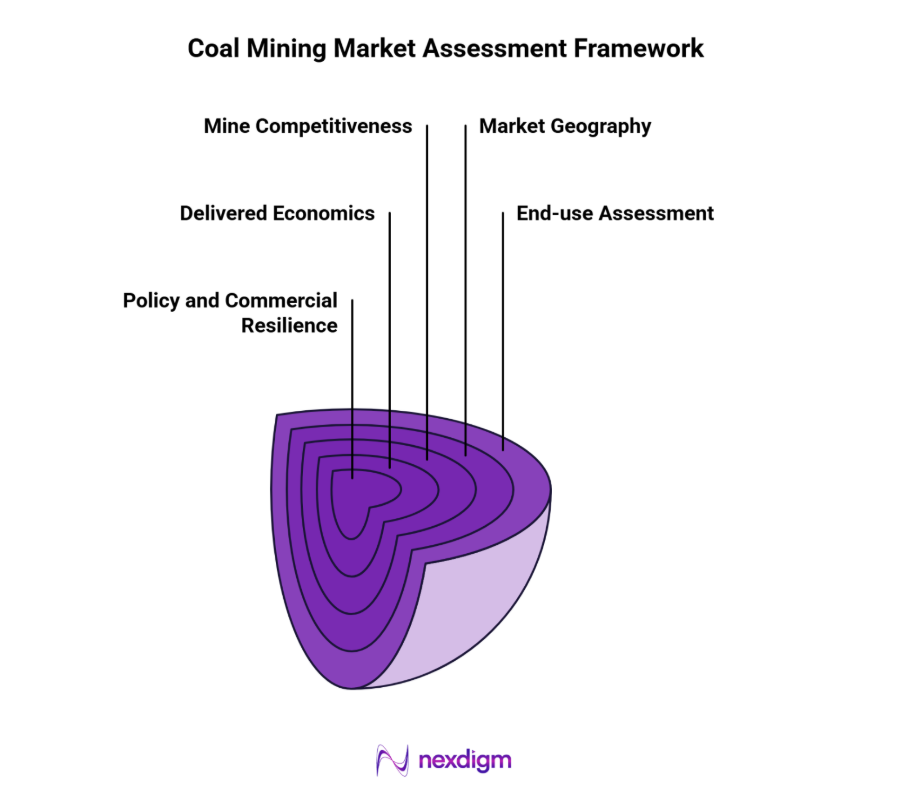
- End-use assessment: Identify the sectors and customers supporting demand and determine how durable their coal requirements are.
- Market geography: Separate growth markets from structurally declining regions and assess domestic versus export exposure.
- Mine competitiveness: Benchmark coal quality, production costs, stripping requirements, productivity and mine life against competing supply.
- Delivered economics: Model rail, road, port and handling costs to establish the project’s actual customer-level competitiveness.
- Policy and commercial resilience: Stress-test the project against regulatory changes, import substitution, coal phase-outs, customer concentration and alternative fuels.
This approach identifies where coal investment remains commercially defensible and where apparent demand growth may not translate into sustainable project economics.
Nexdigm Case: Coal Market Prioritisation
A mining company screened 12 coal assets across six markets. Nexdigm assessed end-use demand, mine costs, logistics, policy exposure and customer security, identifying four assets with delivered-cost advantages and contracted demand covering more than 60% of projected output.
To take the next step, simply visit our Request a Consultation page and share your requirements with us.
Harsh Mittal
+91-8422857704