

Coal mining opportunity research is increasingly about identifying where competitive supply can still be built, rather than simply finding markets where coal consumption is growing.
Global coal demand reached 8.84 billion tonnes in 2025 and is expected to increase to 8.94 billion tonnes in 2026. India is expected to account for 1.35 billion tonnes of demand in 2026, a 4.2% increase, while ASEAN demand is also rising. Yet global coal demand is becoming more geographically fragmented. China remains the largest market, several Asian economies are adding consumption, while mature markets continue to decline.
For mine developers, this creates a narrower opportunity window. Demand needs to be matched with the right resource, cost position and route to customers.
Demand Growth Does Not Automatically Create a Mine Opportunity
The first question is where incremental coal demand is actually coming from.
In India, rising electricity consumption and industrial activity are expected to support coal demand in 2026. Southeast Asia presents a different opportunity, with regional coal imports expected to reach around 164 million tonnes, led by Vietnam. India, meanwhile, is expected to reduce thermal coal imports to around 160 million tonnes as domestic supply and inventories increase.
These differences matter because a domestic growth market and an export market require different investment strategies. A mine serving Indian power generation may compete primarily with domestic producers. An export-oriented project must also account for international coal prices, port access, freight rates and competing exporters.
The demand assessment therefore needs to identify the specific customer pool rather than treating national consumption as the addressable market.
Resource Quality Determines Who Will Buy the Coal
Once the demand pool is established, the resource has to be translated into a saleable product.
For thermal coal, calorific value, ash, sulphur and moisture determine suitability for different power and industrial applications. Metallurgical coal requires additional analysis of coking properties and its ability to enter steelmaking blends.
This affects the economics at several stages. Lower-quality coal may require beneficiation, blending or additional handling. Higher-quality material may access a broader customer base or command better pricing.
A resource assessment should therefore establish:
- recoverable reserves rather than headline geological resources;
- saleable yield after processing;
- product specifications;
- likely customer acceptance; and
- realised pricing by product grade.
The objective is to determine how much of the deposit can become commercially saleable coal.
Production Cost Is Only Half of Competitiveness
Mining costs need to be assessed against competing supply.
Strip ratio, seam thickness, mine depth, equipment productivity, labour, diesel, royalties, infrastructure and sustaining capital all influence the project’s cost-curve position. The analysis should test different production scales because a mine’s economics can change materially between initial and full-scale operations.
However, mine-gate cost alone can produce misleading rankings.
A project with a lower extraction cost may lose its advantage if coal has to be trucked over long distances before reaching a railhead. Conversely, a higher-cost mine with direct rail access or proximity to a major power plant may achieve a lower delivered cost.
This is where coal mining opportunity market research needs to move from resource screening into supply-chain economics.
Delivered Cost Reveals the Commercially Viable Projects
Nexdigm’s assessment can model the complete journey from pit to customer:
Mine → processing → inland transport → rail/port → handling → freight → customer
Each route is evaluated for cost, capacity and reliability. Rail congestion, port utilisation, road availability, handling charges and seasonal constraints can then be incorporated into the delivered-cost model.
The result is a customer-level view of competitiveness. It can show, for example, that a project is attractive for one power cluster but uncompetitive for another, or that an export route becomes viable only above a particular production scale.
Nexdigm’s Coal Opportunity Framework
The framework converts a broad mining opportunity into an investment ranking through five connected tests.
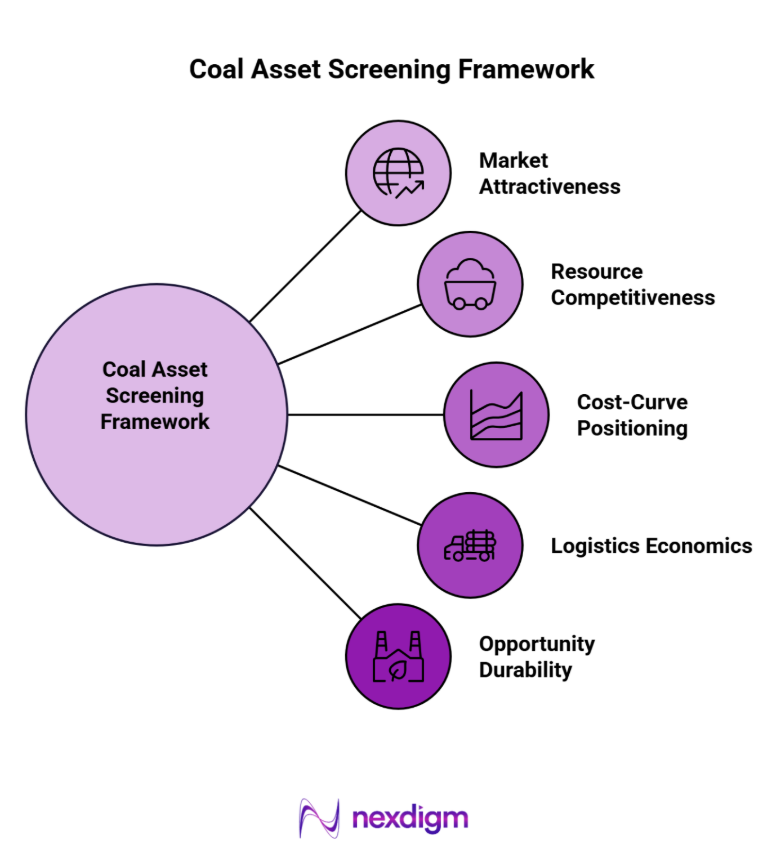
- Market attractiveness
The first stage identifies where demand is likely to remain durable and which end uses will generate incremental consumption. Power generation, steel, cement and industrial users are assessed separately because their procurement requirements and demand trajectories differ. - Resource competitiveness
The next stage establishes whether the deposit can produce a saleable specification at viable recovery rates. Quality, beneficiation requirements, product yield and achievable pricing are used to determine the commercially usable resource. - Cost-curve positioning
Mining, processing and sustaining costs are compared with competing domestic and international supply. Different production scales and operating assumptions are tested to identify where the project sits on the relevant cost curve. - Logistics economics
The assessment then calculates delivered cost to priority customers across road, rail, port and multimodal routes. Infrastructure constraints and potential logistics investments are included rather than treating transport as a fixed assumption. - Opportunity durability
Finally, the project is stress-tested against import substitution, policy changes, renewable penetration, coal-price movements and changes in customer demand. This distinguishes a short-term market opportunity from one that can support investment over the mine’s development and operating life.
The framework produces a practical decision output: develop, acquire, partner, export, optimise logistics or reject the opportunity.
Nexdigm Case: From 18 Assets to 3 Priority Projects
Nexdigm evaluated 18 coal assets across India and Southeast Asia representing approximately 146 Mt of resources. Demand screening reduced the universe to 11 assets; delivered-cost modelling reduced it to five. Three projects remained competitive under base and downside scenarios, with estimated project IRRs of 16.2%–19.1% and logistics savings of up to US$7.40/tonne after route optimisation.
To take the next step, simply visit our Request a Consultation page and share your requirements with us.
Harsh Mittal
+91-8422857704