

A refrigerated truck and a temperature-controlled warehouse are easy to count. Reliable cold-chain performance is much harder to measure. For customers handling pharmaceuticals, vaccines, biologics, food and other temperature-sensitive products, the value of a logistics provider lies in whether the required conditions are maintained throughout the journey, including during loading, transfer, delays and unexpected disruptions.
The requirements are becoming more demanding as the range of temperature-sensitive products expands. WHO’s seventh edition of its international vaccine shipping guidelines, published in 2025, now incorporates ultra-low-temperature shipments alongside conventional refrigerated transport. The guidance addresses packaging, temperature control, route profiling, reception checks and the qualification of transport equipment.
That makes infrastructure only the starting point. Two providers can have similar numbers of refrigerated vehicles and storage locations while offering very different levels of operational protection.
Reliability is built into the network
Cold-chain failure rarely happens because a provider has no refrigeration at all. More often, risk accumulates between operating points.
A shipment can encounter a power failure at a warehouse, an extended loading period, a vehicle breakdown, a congested border or an unplanned transfer between facilities. Each event creates another opportunity for a temperature excursion.
Consequently, competitive assessment needs to examine what happens when normal operations fail. Does the provider have backup power? Can it deploy another vehicle quickly? Are alternative routes available? Is temperature data captured continuously? Who receives an alert when conditions move outside the permitted range?
WHO’s immunisation supply-chain guidance places temperature monitoring, cold-chain equipment and logistics information systems alongside storage and distribution as components of an effective supply chain.
The competitive advantage therefore sits partly in the provider’s ability to prevent an incident and partly in its ability to respond when prevention fails.
Compliance changes the barriers to entry
Compliance can be even more important for healthcare-related cold chains. The logistics provider may have to demonstrate appropriate packaging, documentation, refrigeration, handling procedures and staff competence, depending on the product and transport category.
WHO’s 2025–2026 guidance on transporting infectious substances, applicable from October 2025, covers classification, packaging, marking, labelling, documentation, refrigeration, training and incident management.
These requirements create a different form of competitive moat. A provider with a large refrigerated fleet but weak documentation or limited compliance capability may struggle to serve regulated customers. A smaller provider with strong quality systems, trained personnel and reliable monitoring can compete for higher-value contracts despite having fewer physical assets.
This is why cold chain logistics competitor assessment services should compare operating maturity alongside capacity.
What Nexdigm would measure behind the fleet numbers
A useful competitor assessment should reconstruct the service customers are actually buying.
The analysis can examine five areas:
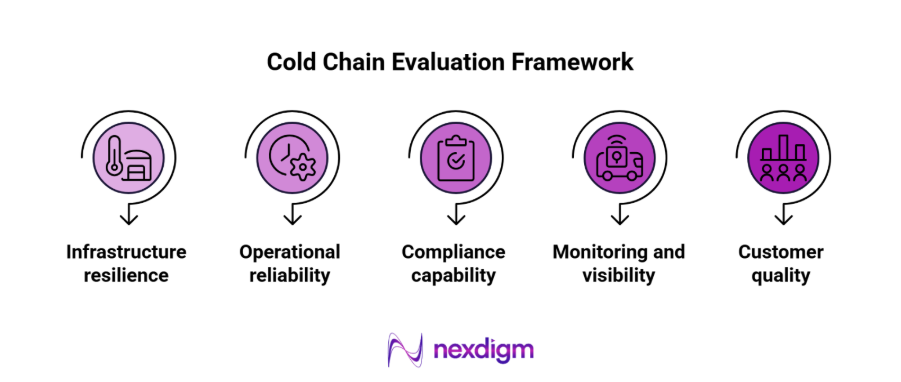
- Infrastructure resilience: Compare cold-storage capacity, vehicle fleets, temperature zones, backup power, maintenance and geographic coverage.
- Operational reliability: Examine utilisation, equipment uptime, temperature-excursion history, contingency capacity and response procedures.
- Compliance capability: Assess SOPs, staff training, documentation, audit performance, certifications and the provider’s ability to handle regulated products.
- Monitoring and visibility: Benchmark sensors, data logging, automated alerts, shipment traceability and the speed at which incidents are escalated.
- Customer quality: Map the provider’s exposure to pharmaceutical, healthcare, food and other temperature-sensitive accounts, including contract duration, concentration and service requirements.
The resulting competitive ranking can look very different from one based on fleet size. A provider with fewer assets may have stronger customer economics if those assets are supported by better monitoring, contingency planning and compliance systems.
Reliability can support a price premium
For many cold-chain customers, the cost of a failed shipment is considerably greater than the incremental cost of a more reliable provider. Product spoilage, rejected consignments, regulatory exposure and supply interruptions can outweigh small differences in freight rates.
That gives providers an opportunity to compete on risk reduction rather than refrigeration capacity alone. The strongest proposition may combine physical infrastructure with documented performance, real-time visibility and a demonstrated ability to manage exceptions.
For a market entrant, this also changes the investment question. Building more refrigerated capacity is only one route to differentiation. In some markets, improving monitoring, compliance systems and contingency coverage may create greater commercial value than adding another warehouse.
Nexdigm Case: Benchmarking Reliability Beyond Capacity
A Nexdigm competitive assessment compared 14 cold-chain providers across infrastructure, monitoring, compliance and contingency capabilities. Physical capacity explained less than half of the variation in customer preference. Providers with stronger temperature visibility and documented contingency systems supported estimated pricing premiums of 9% to 14% on selected healthcare and pharmaceutical contracts.
To take the next step, simply visit our Request a Consultation page and share your requirements with us.
Harsh Mittal
+91-8422857704