

Cold-chain logistics is becoming increasingly important as pharmaceutical distribution, fresh food consumption, biologics, vaccines, specialty chemicals, and temperature-sensitive e-commerce expand. Unlike conventional logistics, cold-chain networks must maintain product quality across storage, transportation, handling, and delivery.
The global cold-chain logistics market continues to expand alongside food and pharmaceutical supply chains. The Westimates show that around 50% of temperature-sensitive pharmaceutical products can be degraded by the time they reach their destination because of inadequate temperature control, highlighting the importance of reliable cold-chain infrastructure.
For pharmaceutical manufacturers, food companies, retailers, logistics providers, 3PLs, cold-storage operators, healthcare companies, investors, and infrastructure developers, the opportunity lies in the growing cold-chain demand.
A cold chain logistics feasibility study services approach helps evaluate product volumes, temperature requirements, storage capacity, utilization, transportation, infrastructure, customer demand, operating costs, and network economics.
Understanding the Cold Chain Market Dynamics
Cold-chain demand is being driven by the growth of temperature-sensitive products across pharmaceutical, food, healthcare, and specialty industries. As supply chains become more complex, organizations must evaluate how evolving customer requirements, product profiles, and distribution patterns influence long-term cold-chain opportunities.
Key Factors Influencing Cold Chain Success
The success of a cold-chain network depends on the ability to maintain product integrity while balancing capacity, efficiency, and commercial viability. Evaluating the following factors helps determine whether a cold-chain investment can support sustainable operations and long-term growth.
- Product Volume and Demand: Assess current and projected volumes to determine storage requirements, network scale, and future capacity needs.
- Temperature Requirements: Evaluate the temperature ranges needed for different products to ensure compliance, quality, and product integrity.
- Storage and Utilization Levels: Measure facility occupancy and capacity utilization to identify efficiency improvements and expansion requirements.
A comprehensive assessment of these factors helps organizations develop resilient cold-chain networks that support operational efficiency, product quality, and sustainable growth.
Role of Nexdigm in Building Resilient Cold Chain Networks
As demand for temperature-sensitive products continues to grow, developing a successful cold-chain network requires more than adding refrigerated storage or transportation capacity. Nexdigm’s experts believe that long-term network success depends on aligning product requirements, temperature controls, facility utilization, distribution coverage, and operational capabilities. Organizations that take a network-wide approach can improve product integrity, enhance service reliability, and create scalable cold-chain ecosystems that support evolving business needs.
Nexdigm’s Cold Chain Network Feasibility Assessment
Through its cold chain logistics feasibility study services, Nexdigm helps organizations evaluate the operational, commercial, and infrastructure requirements needed to develop efficient and scalable cold-chain networks. This assessment enables stakeholders to identify optimal network configurations through:
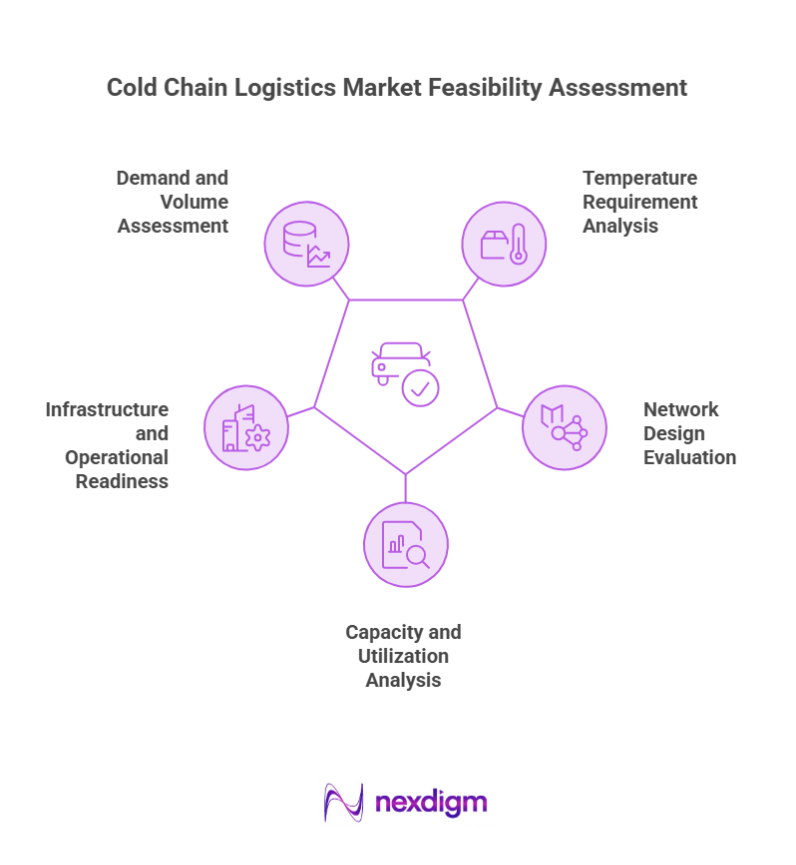
- Demand and Volume Assessment: Evaluation of product flows, customer demand, and growth projections to determine network capacity and coverage requirements.
- Temperature Requirement Analysis: Assessment of product-specific temperature needs to ensure appropriate storage, handling, and transportation capabilities across the network.
- Network Design Evaluation: Reviewing facility locations, distribution reach, and transportation linkages to optimize service levels and operational efficiency.
- Capacity and Utilization Analysis: Examination of storage occupancy, throughput levels, and asset utilization to identify scalability and performance improvement opportunities.
- Infrastructure and Operational Readiness: Assessment of cold-storage facilities, monitoring systems, utilities, and logistics capabilities required to support reliable operations.
With Nexdigm’s feasibility assessment, this help organizations design resilient, efficient, and scalable cold-chain networks that align with demand, operational requirements, and long-term growth objectives.
Nexdigm in Building Future-Ready Cold Chain Networks
As product portfolios expand and regulatory requirements become more stringent, cold-chain networks must be designed for flexibility and scalability. Nexdigm helps organizations anticipate evolving demand patterns, distribution requirements, and customer expectations through:
- Scalable Network Development: Designing networks capable of supporting future growth while maintaining operational efficiency and service quality.
- Supply Chain Resilience: Identification of measures to reduce disruptions and maintain temperature integrity across storage and transportation operations.
- Regulatory Preparedness: Supporting alignment with evolving quality standards and compliance requirements across temperature-sensitive industries.
- Customer-Centric Network Planning: Aligning network capabilities with delivery expectations, service levels, and product-specific handling requirements.
With this, Nexdigm helps organizations build adaptable cold-chain networks that support reliable operations, sustainable growth, and long-term supply chain performance.
Why Organizations Partner with Nexdigm for Cold Chain Feasibility
Nexdigm combines market intelligence, supply chain expertise, and operational analysis to help organizations make informed cold-chain investment decisions. By evaluating demand patterns, temperature requirements, capacity utilization, network design, and cost structures, Nexdigm enables businesses to identify practical opportunities for optimization, enhance service reliability, and build scalable cold-chain networks that support sustainable growth and long-term business objectives.
Nexdigm’s Case
A food and pharmaceutical logistics provider engaged with Nexdigm to assess temperature requirements, storage demand, utilization, and network economics. The assessment supported a redesigned cold-chain network that improved facility utilization by 22%, reduced operating costs by 14%, and lowered transportation expenses by 11%, strengthening service reliability and investment efficiency.
To take the next step, simply visit our Request a Consultation page and share your requirements with us.
Harsh Mittal
+91-8422857704