
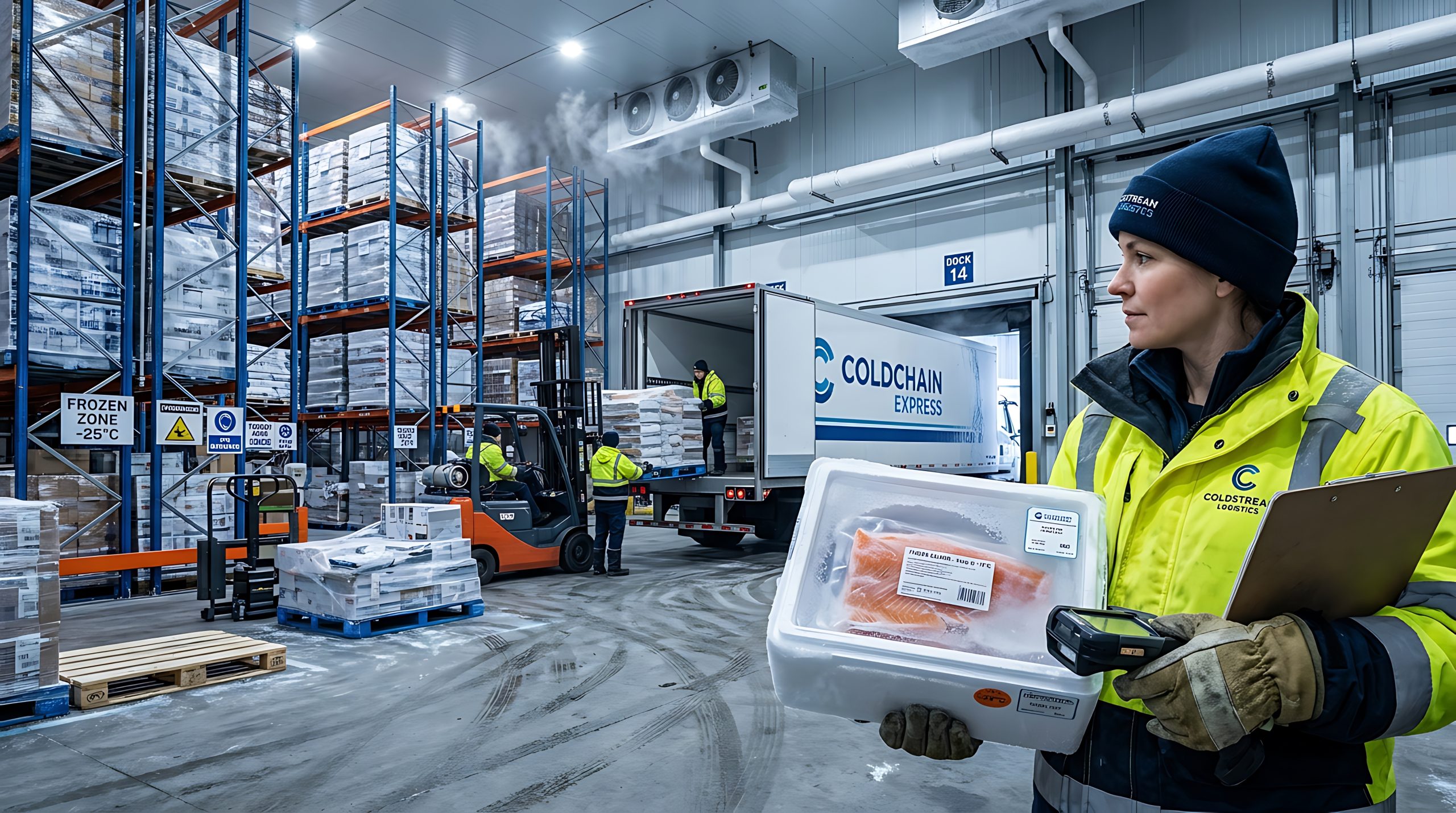
Cold-chain markets are unusual because demand can exist long before dependable logistics capacity does. Food producers may have strong output, pharmaceutical companies may be expanding distribution, and consumers may be buying more temperature-sensitive products, yet the commercial opportunity can remain constrained by unreliable storage, transport or monitoring.
The scale of the underlying problem is considerable. In March 2026, the Food and Agriculture Organization reported that inadequate refrigeration contributes to the loss or waste of approximately 526 million tonnes of food each year, around 12% of the global total. Refrigeration alone does not solve the problem, but the figure illustrates how much value remains exposed to weaknesses in temperature-controlled infrastructure.
Healthcare creates an even tighter operating requirement. WHO states that almost all vaccines used in immunisation programmes are licensed for storage and distribution at 2°C to 8°C, while other products require frozen or ultra-cold conditions. Maintaining these ranges requires appropriate equipment, monitoring and handling throughout the journey, rather than simply having refrigerated storage at one point in the network.
Demand has to be mapped to the temperature journey
A cold-chain assessment therefore begins with the product rather than the warehouse.
Fresh produce can require pre-cooling, controlled storage and refrigerated transport, while dairy, meat and seafood can have different handling requirements. Pharmaceuticals introduce additional compliance and monitoring requirements, and some biologics can require much colder storage conditions.
The same distinction applies geographically. A facility located close to production may solve a collection problem but remain poorly positioned for downstream distribution. A large distribution hub near a major consumption centre may have stronger economics but require reliable inbound refrigerated transport.
India’s policy framework reflects this end-to-end requirement. The Ministry of Food Processing Industries’ Integrated Cold Chain and Value Addition Infrastructure scheme covers farm-level infrastructure, processing centres, distribution hubs, multi-temperature storage and refrigerated or insulated vehicles. Its revised 2025 guidelines continue to emphasise an integrated chain from farm gate to consumer.
That is important for market sizing because a warehouse cannot be assessed independently from the transport and upstream infrastructure required to keep its capacity productive.
Where Nexdigm can identify the real infrastructure gap
A useful cold chain logistics market assessment services approach should distinguish between nominal capacity, usable capacity and commercially addressable capacity.
These are three different numbers.
Nominal capacity is what the installed infrastructure can theoretically hold. Usable capacity reflects operational realities such as temperature zones, equipment uptime, loading patterns, maintenance and power resilience. Commercially addressable capacity goes one step further by considering whether the capacity is in the right location, at the right temperature, at an acceptable cost and connected to sufficient transport demand.
Nexdigm can assess this gap by combining facility mapping with demand forecasts, utilisation analysis and route-level economics. This helps identify whether an opportunity calls for new construction, better utilisation of existing assets, transport capacity, technology investment or a combination of the four.
The assessment needs to follow the product, not the asset
Five areas provide a more useful basis for evaluating cold-chain opportunities:
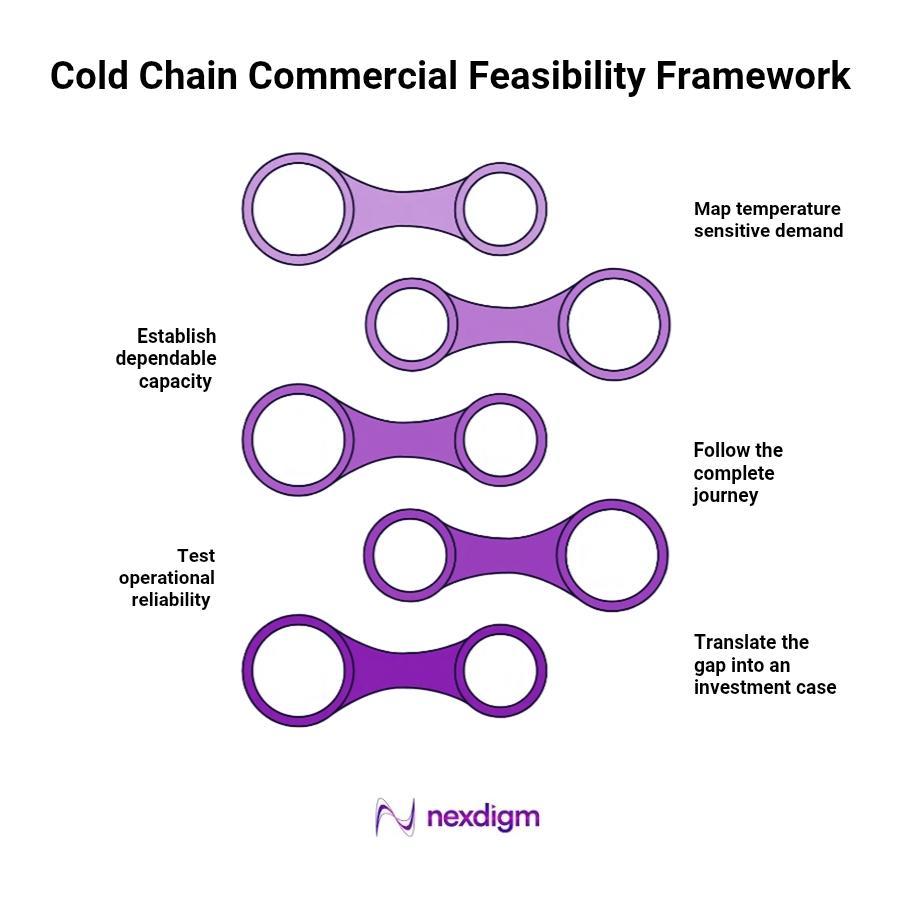
- Map temperature-sensitive demand. Quantify food, dairy, meat, seafood, pharmaceuticals, vaccines and other relevant product flows by origin, destination and temperature requirement.
- Establish dependable capacity. Measure storage volume alongside utilisation, temperature zones, equipment condition, backup power and monitoring capability.
- Follow the complete journey. Examine collection, pre-cooling, processing, storage, line-haul, cross-docking and final delivery to identify where temperature integrity is most vulnerable.
- Test operational reliability. Look at temperature excursions, equipment uptime, monitoring systems, power resilience and compliance requirements. WHO itself emphasises temperature monitoring and the identification of capacity gaps in vaccine supply chains.
- Translate the gap into an investment case. Estimate the revenue opportunity after accounting for utilisation, energy, transport, maintenance, compliance and capital requirements.
The resulting market view should reveal where additional infrastructure can actually unlock throughput. A region with substantial nominal cold-storage capacity may still represent an attractive opportunity if that capacity is poorly located, underutilised or unable to meet the requirements of higher-value products.
Nexdigm Case: Separating Installed Capacity from Usable Capacity
A cold-chain assessment reviewed 22 facilities with combined nominal capacity of more than 420,000 pallet positions. Utilisation, temperature-zone availability, equipment uptime and power resilience reduced dependable operating capacity to 71%. Targeted upgrades across priority facilities increased usable capacity by 14%, avoiding the need for equivalent new-build capacity.
To take the next step, simply visit our Request a Consultation page and share your requirements with us.
Harsh Mittal
+91-8422857704