

Temperature-controlled logistics is expanding as food consumption, pharmaceutical distribution, international trade, and demand for fresh and frozen products increase. Yet cold-chain infrastructure remains unevenly distributed across markets.
The World Bank estimates that less than 10% of temperature-sensitive perishable foods globally have access to cold-chain systems, highlighting significant infrastructure gaps and development potential.
For food producers, pharmaceutical companies, retailers, logistics providers, cold-storage developers, investors, and infrastructure businesses, the priority is understanding where temperature-controlled demand is increasing, what type of capacity is required, and whether existing networks can support future growth.
A Cold chain logistics market assessment connects these demand signals with infrastructure, product requirements, operating economics, and investment potential.
The Changing Cold Chain Opportunity
Cold-chain demand is no longer concentrated around traditional refrigerated warehouses.
Fresh produce, dairy, meat, seafood, frozen foods, pharmaceuticals, biotechnology products, specialty chemicals, and other temperature-sensitive goods can require different storage and transportation conditions.
Demand also varies by location. Nexdigm approaches the market by connecting product demand, geographic concentration, infrastructure availability, and commercial feasibility rather than treating cold storage as one uniform market.
Understanding the Demand Areas of Cold Chain Market
Several forces are expanding temperature-controlled logistics requirements. Some major demand areas of the temperature controlled logistics market are:
- Food consumption: Growing demand for fresh, frozen, dairy, meat, and seafood products increases refrigerated storage and transportation needs.
- Pharmaceutical growth: Expanding healthcare distribution creates requirements for specialized cold storage, controlled transportation, and temperature monitoring.
- Urbanization: Increasing urban populations concentrate food consumption and create demand for cold-storage capacity closer to major markets.
- International trade: Cross-border movement of sensitive products increases requirements around ports, airports, warehouses, and freight corridors.
- Food-loss reduction: Better cold chains can extend shelf life and reduce losses between production and consumption.
- Climate conditions: Hotter environments increase the importance of reliable refrigeration for food, medicines, and other temperature-sensitive products.
How Nexdigm Reads the Market Before Investment
Cold-chain opportunities cannot be judged by demand growth alone.
A market with growing food production may still lack suitable land, reliable electricity, refrigerated transport, or sufficient customer density. Similarly, a pharmaceutical market may have cold-storage facilities but lack specialized infrastructure for increasingly sensitive products.
Nexdigm brings these conditions together to understand the full market context before capacity decisions are made.
The assessment considers where products originate, where they are consumed, how they move between locations, what infrastructure already exists, and where capacity constraints are emerging. This helps distinguish a genuine cold-chain development opportunity from a market where additional capacity may struggle to achieve sustainable utilization.
Nexdigm’s Cold Chain Logistics Framework
Nexdigm’s framework conducts Cold chain logistics market assessment that identifies the key factors that can influence market expansion, operational performance, and long-term competitiveness. These factors are:
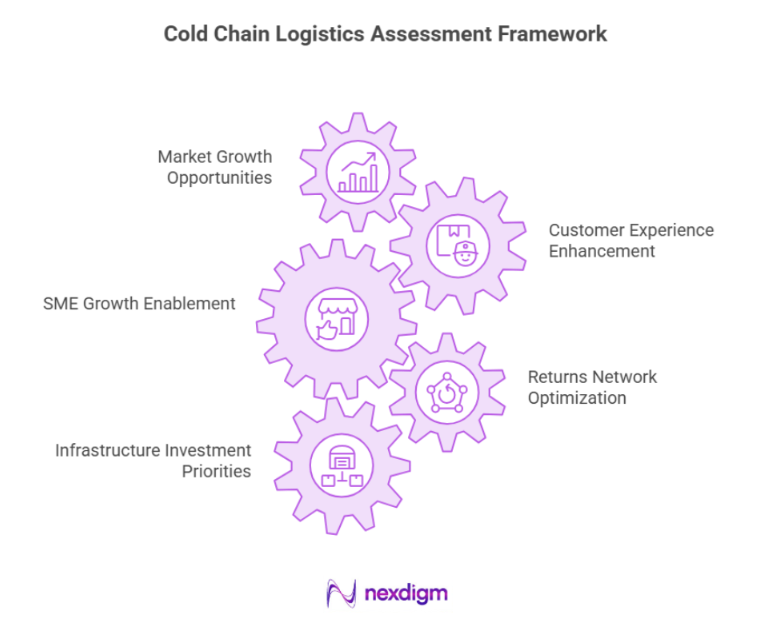
- Market Growth Opportunities: Identifies high-potential customer segments, emerging markets, and geographic clusters where increasing parcel demand can support network expansion, service diversification, and sustainable revenue growth.
- Customer Experience Enhancement: Highlights evolving customer expectations around delivery speed, affordability, visibility, and flexibility, enabling organizations to strengthen service offerings and improve customer retention.
- SME Growth Enablement: Identifies opportunities to better serve SMEs through scalable, cost-effective, and flexible delivery solutions that support business expansion and increasing shipment volumes.
- Returns Network Optimization: Assesses reverse logistics requirements to improve returns processing, reduce operational complexity, enhance customer satisfaction, and strengthen overall supply chain efficiency.
- Infrastructure Investment Priorities: Highlights areas where investments in delivery stations, fleet capacity, technology platforms, and last-mile capabilities can improve network scalability and service performance.
These strategic outcomes provide a data-driven foundation for evaluating growth opportunities, prioritizing investments, and strengthening parcel delivery capabilities.
Nexdigm’s Cold Chain Logistics Framework adding Business Value
The Parcel Delivery Market Assessment Framework helps organizations gain a holistic understanding of the parcel delivery landscape and supports more informed strategic planning. It adds value to businesses by providing the following benefits:
- Improved Market Visibility: Provides insights into demand drivers, customer segments, and emerging market trends to support informed growth and expansion decisions.
- Enhanced Investment Prioritization: Helps identify high-potential opportunities and focus investments on areas that offer the strongest business impact and long-term value.
- Customer-Centric Decision Making: Enables organizations to align service offerings with evolving customer expectations related to delivery speed, convenience, flexibility, and affordability.
- Operational Efficiency Assessment: Evaluates network capabilities, infrastructure readiness, and process requirements to identify opportunities for performance improvement and cost optimization.
Nexdigm’s Expert Recommendations
Based on the findings of the Parcel Delivery Market Assessment, Nexdigm provides practical recommendations to help organizations strengthen delivery networks, enhance customer experience, optimize operational efficiency, and prioritize investments.
These recommendations focus on aligning growth opportunities with market demand, improving service capabilities, and building a scalable parcel delivery ecosystem that supports long-term business objectives.
Nexdigm’s Case
A food logistics operator used Nexdigm’s Cold chain logistics market assessment to identify regional capacity gaps and optimize facility planning. Within 11 months, cold-storage utilization increased 24%, product spoilage declined 19%, refrigerated delivery efficiency improved 22%, and operating costs fell 14%, strengthening network reliability and supporting scalable growth.
To take the next step, simply visit our Request a Consultation page and share your requirements with us.
Harsh Mittal
+91-8422857704