

India’s cold chain logistics sector is gaining importance as demand for temperature-sensitive food, pharmaceuticals, dairy, and other perishable products increases. According to NaBFID’s 2025–26 infrastructure review, India’s cold chain logistics market was valued at approximately US$13 billion in 2025 and is projected to reach US$27 billion by 2034, reflecting an estimated CAGR of 8.62%.
The Ministry of Food Processing Industries reported that 301 integrated cold chain projects had been completed by December 2025, creating approximately 9.06 lakh metric tonnes of cold storage capacity and 1,525 reefer vehicles. This expansion makes supplier selection increasingly important. Cold chain logistics supplier analysis helps businesses assess infrastructure, temperature management, compliance capabilities, and service reliability before entering logistics partnerships.
The Role of Integrated Cold Chain Networks
Cold chain logistics involves more than refrigerated storage and transportation. It requires coordinated temperature-controlled operations across sourcing, handling, warehousing, distribution, and delivery. Any interruption can affect product quality, safety, and shelf life. Businesses therefore need logistics partners with suitable infrastructure, trained personnel, monitoring systems, and geographically connected networks to maintain product integrity throughout the supply chain.
What Businesses Should Evaluate Before Selecting a Supplier
Supplier selection requires attention to three fundamental areas that influence cold chain performance:
- Temperature Management: Assess temperature ranges, monitoring systems, refrigeration equipment, and contingency arrangements for maintaining product-specific conditions.
- Network and Infrastructure Coverage: Examine warehouse locations, reefer vehicle availability, distribution reach, and connectivity across sourcing and consumption markets.
- Compliance and Reliability: Evaluate regulatory practices, documentation, quality controls, handling procedures, and supplier track records.
A combined assessment helps businesses understand operational suitability and identify potential weaknesses before finalizing logistics partnerships.
The Importance of Cold Chain Logistics Supplier Analysis
A cold chain logistics supplier analysis helps businesses compare logistics partners beyond basic storage and transportation rates. By examining temperature-control capabilities, infrastructure quality, geographic reach, regulatory compliance, and service reliability, organizations like Nexdigm can identify supplier strengths, highlight operational gaps, and assess commercial competitiveness. These insights support informed partner selection and help businesses build reliable temperature-controlled supply chains.
Nexdigm’s Industry-led Expertise in Cold Chain Logistics Supplier Analysis
Nexdigm’s industry research and supplier intelligence can help businesses evaluate cold chain logistics providers across different sectors, considering their specific product handling and distribution requirements. These sectors are:
- Pharmaceuticals and Healthcare: Assess temperature-sensitive storage, refrigerated transportation, monitoring systems, and compliance practices required for medicines, vaccines, and healthcare products.
- Food and Agriculture: Evaluate cold storage infrastructure, reefer transportation, handling capabilities, and distribution networks for dairy, seafood, meat, fruits, and vegetables.
- Retail and Consumer Goods: Examine supplier capabilities in inventory management, temperature-controlled warehousing, regional distribution, and delivery reliability to support changing demand patterns.
This industry-focused perspective helps businesses identify specialized logistics partners and assess their suitability for sector-specific cold chain requirements.
What Differentiates Nexdigm’s Expertise in Cold Chain Logistics
Nexdigm’s approach combines market understanding, supplier intelligence, and procurement-focused analysis to help businesses address the specific challenges of temperature-controlled logistics. Our expertise can be reflected in three areas:
- Requirement-led Research: Align supplier assessments with product sensitivity, temperature requirements, distribution volumes, geographic priorities, and business objectives rather than applying a standard evaluation model.
- Integrated Market and Commercial Insights: Bring together supplier capabilities, infrastructure information, competitive positioning, and cost considerations to provide a broader view of sourcing opportunities.
- Decision-oriented Recommendations: Translate research findings into supplier comparisons, capability assessments, and actionable insights that support vendor shortlisting, negotiations, and long-term logistics planning.
This approach enables businesses to connect cold chain market intelligence with practical procurement decisions and develop supplier relationships suited to their operational priorities.
Strategic Decision Support Through Nexdigm’s Cold Chain Logistics Research
Nexdigm’s research can provide businesses with the market intelligence and supplier-level insights needed to make informed cold chain logistics decisions. By translating research findings into actionable recommendations, organizations can strengthen decision-making across key areas:
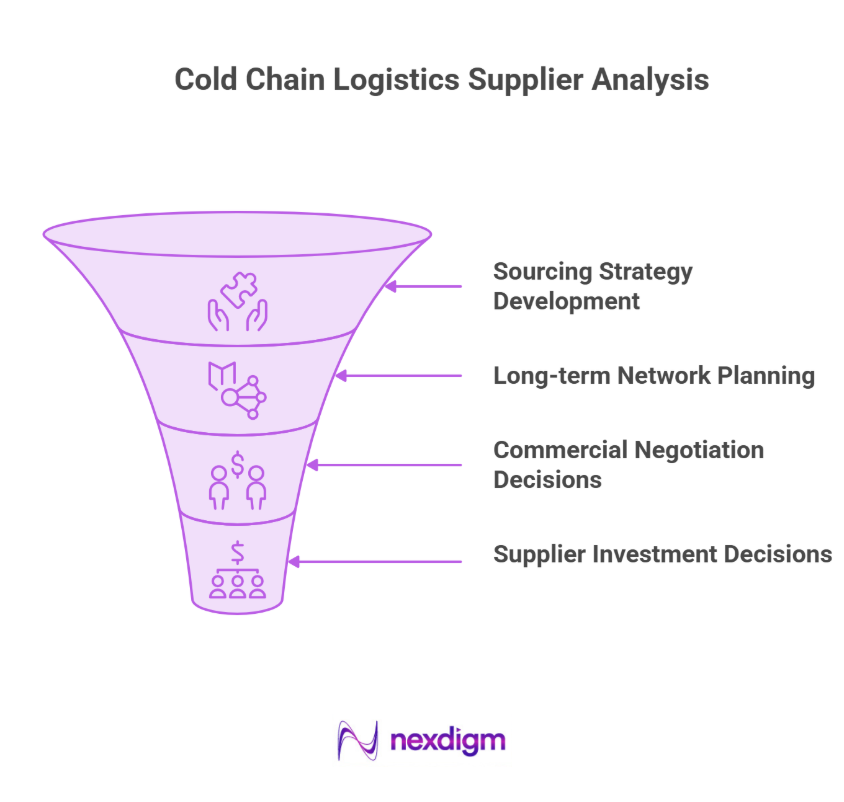
- Supplier Investment Decisions: Identify providers with the infrastructure, technology, and capacity required to support current and future logistics needs.
- Sourcing Strategy Development: Use supplier comparisons and market intelligence to determine suitable sourcing models, regional partnerships, and service arrangements.
- Long-term Network Planning: Evaluate market opportunities, infrastructure availability, and supplier capabilities to guide distribution expansion and partnership decisions.
- Commercial Negotiation Decisions: Use market pricing intelligence, supplier comparisons, and service benchmarks to establish negotiation priorities and evaluate contract terms.
Through evidence-based research and structured analysis, Nexdigm can help decision-makers assess available options, prioritize business requirements, and develop cold chain strategies aligned with long-term objectives.
Nexdigm’s Case
A pharmaceutical company sought to improve temperature-controlled distribution while expanding its regional logistics network. Nexdigm’s supplier research assessed cold storage infrastructure, temperature-monitoring systems, compliance practices, and commercial terms. The assessment identified 14% potential savings in logistics expenditure, 23% scope for improving temperature-monitoring coverage and 13% scope for expanding regional supplier coverage.
To take the next step, simply visit our Request a Consultation page and share your requirements with us.
Harsh Mittal
+91-8422857704