

Cold chain logistics involves the storage, handling and transportation of products under controlled environmental conditions. It supports industries such as pharmaceuticals, food processing, dairy, seafood, agriculture and biotechnology, where temperature variations can affect product quality, safety and usability.
Selecting a cold chain provider requires a more detailed procurement assessment than conventional logistics sourcing. Businesses must establish whether suppliers can maintain product-specific temperature conditions across storage facilities, transportation routes and distribution points.
The challenge is evaluating the entire operating network and determining whether temperature integrity can be maintained throughout the supply chain.
Understanding Product-Specific Cold Chain Requirements
Different products require different temperature ranges, monitoring arrangements and handling procedures.
Frozen food, fresh produce, dairy products and pharmaceutical shipments cannot be assessed using a single set of operating requirements. Even within the pharmaceutical sector, storage and transportation conditions may vary according to product specifications.
Procurement teams should therefore begin by identifying product characteristics, temperature requirements, shelf life, shipment volumes and handling restrictions.
Food businesses must maintain suitable temperature conditions throughout procurement, storage, transportation and distribution. Pharmaceutical supply chains have additional requirements concerning temperature-sensitive products, documented quality systems and good distribution practices.
Evaluating Cold Chain Infrastructure and Transportation Capability
A cold chain provider should demonstrate capabilities across both fixed infrastructure and transportation operations.
Storage facilities should be evaluated for temperature zones, refrigeration systems, monitoring devices, backup power, alarm arrangements and preventive maintenance.
- Transportation capabilities require a separate assessment.
Refrigerated vehicles, insulated containers and temperature-controlled loading areas should be suitable for the products being transported. - Route suitability is equally important.
Long-distance shipments, remote delivery locations and frequent loading or unloading activities can increase exposure to temperature excursions.
A supplier’s network should therefore be examined for refrigerated warehouse and vehicle availability, temperature monitoring, route coverage, transfer procedures, backup refrigeration and product traceability.
Compliance, Traceability and Operational Reliability
Compliance should be assessed according to product category, applicable jurisdiction and the activities performed by the provider.
Food logistics suppliers must meet applicable food safety and hygiene requirements. Pharmaceutical logistics providers may need to demonstrate documented quality systems, temperature mapping, equipment qualification and good distribution practice arrangements.
Procurement teams should examine how temperature data is collected, stored and reviewed. Continuous monitoring provides stronger evidence than occasional manual temperature checks.
The provider should also have documented procedures for handling temperature excursions, equipment failures, shipment delays and emergency transfers.
Traceability is another important requirement. Businesses should be able to identify where a shipment was stored, which transportation assets handled it and whether temperature conditions remained within the prescribed range.
Commercial Assessment and Network Suitability
Cold chain procurement involves additional cost components that are not usually present in conventional logistics contracts.
These may include refrigeration energy, specialised storage, temperature monitoring equipment, validation activities, insulated packaging, dedicated vehicles and additional handling. Supplier comparisons should therefore use equivalent product specifications, temperature ranges, routes and service requirements.
Organisations should also examine whether providers can accommodate seasonal demand, expand capacity and support additional distribution locations without compromising service quality.
Cold Chain Procurement Research Framework
A structured cold chain procurement research exercise should include:
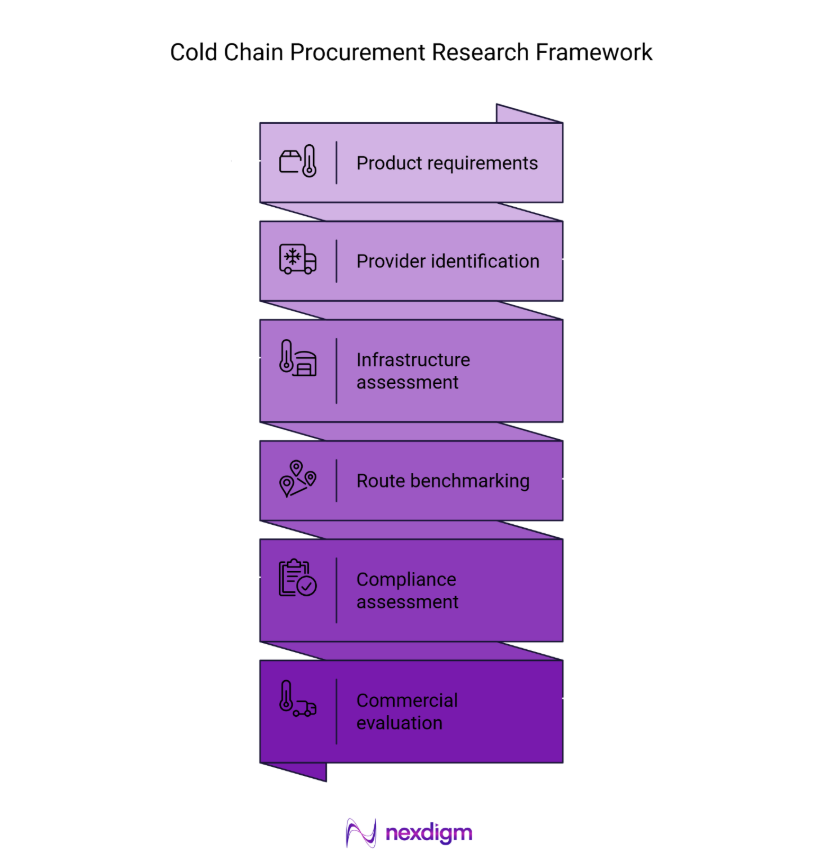
- Product requirement mapping: Define temperature ranges, product categories, shelf life and handling restrictions.
- Provider identification: Map refrigerated transporters, cold storage operators and integrated cold chain providers.
- Infrastructure assessment: Compare storage capacity, refrigeration systems, vehicle fleets and backup arrangements.
- Route benchmarking: Evaluate geographical coverage, transit times, transfer points and delivery reliability.
- Compliance assessment: Review applicable licences, quality procedures, temperature records and traceability.
- Commercial evaluation: Compare storage, transportation, monitoring and specialised handling costs.
Nexdigm can support organisations through cold chain market research, supplier identification, infrastructure benchmarking and procurement assessments. These services help businesses compare cold chain providers and identify partners suited to product-specific, geographical and regulatory requirements.
Nexdigm Strengthening Temperature-Controlled Supplier Selection: Case Study
Nexdigm evaluated 10 cold chain providers across 4 distribution corridors, comparing refrigerated capacity, temperature monitoring, compliance and pricing. The assessment shortlisted 3 suppliers, identified a 16% variation in comparable operating costs and established 8 cold chain performance benchmarks.
To take the next step, simply visit our Request a Consultation page and share your requirements with us.
Harsh Mittal
+91-8422857704