

Fresh agricultural products are exposed to quality deterioration at every stage between harvest and consumption. Temperature fluctuations, delays in handling, unsuitable packaging and poor coordination between storage and transport can reduce shelf life and commercial value. For producers, food processors, exporters and retailers, cold chain performance is therefore a supply continuity issue as much as a logistics requirement.
Selecting a cold chain provider involves evaluating an interconnected service network. Pre-cooling, packhouses, refrigerated storage, reefer transportation, ripening facilities and distribution hubs must work together. A provider with a modern warehouse may still be unsuitable if it cannot collect produce promptly or maintain required conditions during transit.
What Makes Agricultural Cold Chain Services Different?
Cold chain requirements vary significantly by commodity. Fruits, vegetables, flowers and other perishables have different temperature, humidity, ventilation and handling needs. Some products require rapid pre-cooling after harvest, while others need controlled-atmosphere storage or specialised ripening arrangements.
The supply chain also involves several operating environments. Produce may move from farms or collection centres to packhouses, processing facilities, distribution hubs and retail destinations. Every transfer creates a potential point of delay or temperature exposure.
For agricultural buyers, this means cold chain procurement should be based on the entire route rather than an isolated facility. Providers must demonstrate that their infrastructure, vehicles, monitoring systems and operating procedures can maintain product-specific conditions across each stage.
Evaluating Cold Chain Providers and Infrastructure
The first assessment should establish the provider’s service portfolio. Some companies specialise in refrigerated transportation, while others operate cold storage facilities, integrated logistics networks or end-to-end post-harvest infrastructure.
Buyers should identify whether services are owned, subcontracted or delivered through partner networks.
Facility-level capabilities need close examination. Relevant factors include temperature ranges, refrigeration capacity, backup power, humidity controls, loading arrangements, pre-cooling equipment and monitoring systems.
For transportation, buyers should assess vehicle availability, insulation standards, refrigeration performance, route planning and maintenance practices.
Technology can improve visibility, but its practical value depends on how consistently it is used. Temperature loggers, GPS tracking, alerts and digital inventory systems should provide usable information to the customer.
Buyers should understand who monitors exceptions, how incidents are escalated and whether temperature records can be accessed after delivery.
How Supplier Research Strengthens Cold Chain Decisions
Focused cold chain supplier research for agriculture exercise helps organisations compare providers by commodity expertise, infrastructure, service coverage and operational reliability. It should map operators across storage, transportation, packhouse management, pre-cooling and distribution services.
Geographic reach is particularly important. A provider may operate a large facility near a consumption centre but have limited infrastructure in the production region.
Buyers should map service locations against harvest clusters, collection points, processing facilities and destination markets. This reveals whether the provider can support the complete movement of produce or only selected legs.
Commercial analysis should consider the cost per tonne, pallet, kilometre or shipment, depending on the service model. Additional charges for pre-cooling, handling, storage duration, waiting time and temperature-controlled packaging should be included.
A low transportation rate may not represent the lowest total cost if the provider has limited vehicle availability or requires multiple transfers.
Measuring Quality Protection and Service Reliability
Cold chain performance should be assessed through measurable operating indicators. These may include temperature compliance, on-time collection, delivery reliability, product rejection rates, equipment downtime and claims arising from quality deterioration.
Service-level agreements should specify acceptable temperature ranges, monitoring frequency, response times and escalation procedures.
Contracts should also define responsibilities when equipment failure, power interruption, route disruption or handling errors affect product quality.
India’s cold chain infrastructure has expanded through public and private investment.
A government update published in September 2025 reported 8,815 cold storage facilities with a combined capacity of approximately 40.21 million metric tonnes as of June 2025.
However, storage capacity alone does not establish end-to-end connectivity. Buyers still need to assess packhouses, refrigerated transport and distribution links in the specific markets they serve.
A provider review should include:
- Commodity-specific temperature and humidity capabilities.
- Pre-cooling, packhouse and storage infrastructure.
- Reefer vehicle availability and route coverage.
- Real-time monitoring, traceability and incident management.
- Service-level commitments, insurance and claims procedures.
Building an Integrated Cold Chain Sourcing Strategy
Agricultural businesses should avoid selecting providers solely on the basis of individual service rates. The sourcing model should account for coordination between farm-gate collection, storage, transport and delivery.
Depending on the commodity and geography, an integrated provider may offer better control, while a combination of specialised regional partners may provide greater flexibility.
Nexdigm supports organisations through cold chain market research, supplier mapping, infrastructure benchmarking and commercial analysis. Its work can help buyers identify qualified operators, compare regional service coverage, assess supply-side constraints and evaluate potential partners against product handling and distribution requirements.
Cold Chain Supplier Evaluation Framework
A practical assessment should consider:
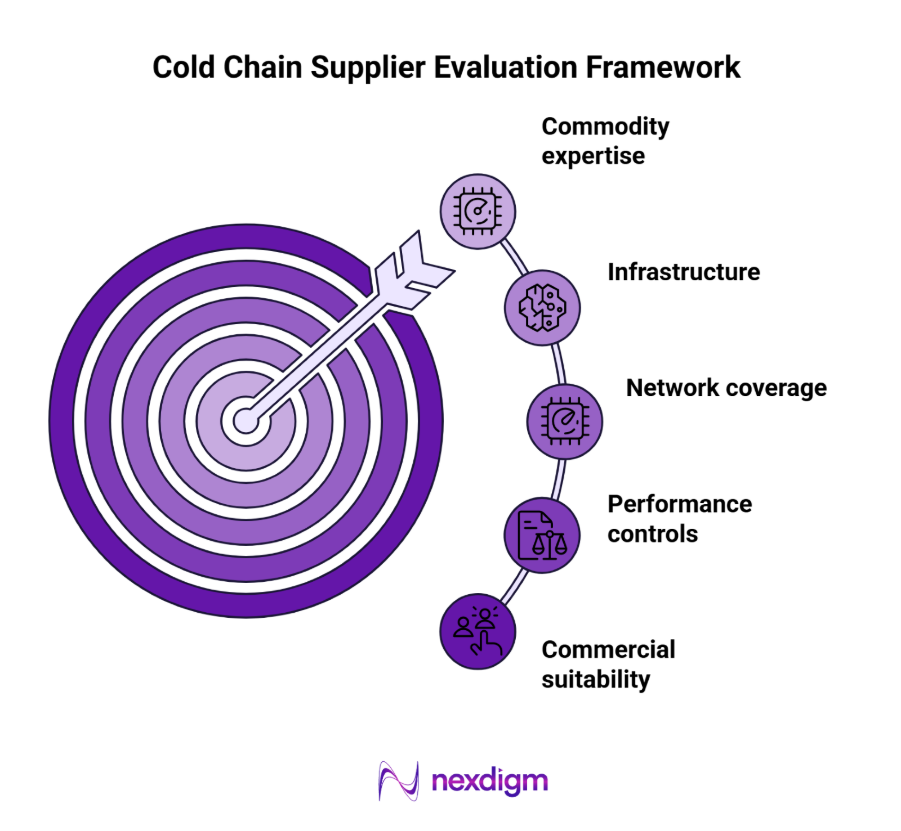
- Commodity expertise: Experience with the relevant crops and handling requirements.
- Infrastructure: Pre-cooling, packhouses, cold storage and refrigerated transport.
- Network coverage: Farm-gate access, regional hubs, routes and destination reach.
- Performance controls: Temperature monitoring, traceability, service levels and incident response.
- Commercial suitability: Cost structure, scalability, insurance and contractual accountability.
Nexdigm’s Case Study: Benchmarking Agricultural Cold Chain Providers
Nexdigm evaluated 33 cold chain providers across 6 agricultural corridors, assessing storage infrastructure, reefer capacity, temperature monitoring and service coverage. The study identified 8 potential partners and highlighted 4 routes requiring stronger refrigerated connectivity.
To take the next step, simply visit our Request a Consultation page and share your requirements with us.
Harsh Mittal
+91-8422857704