

Commercial vehicles are essential to transportation, distribution, construction, manufacturing and logistics operations. Businesses depend on trucks, light commercial vehicles, buses and specialised vehicles to support daily operations and move goods across domestic and regional markets.
Selecting a commercial vehicle supplier, however, involves more than comparing purchase prices and technical specifications. Vehicle suitability, maintenance support, spare parts availability, delivery timelines and lifecycle operating costs all influence the long-term value of a procurement decision.
For organisations managing large fleets, a structured supplier assessment can help identify manufacturers and dealers capable of meeting both immediate and future transportation requirements.
Why Commercial Vehicle Supplier Evaluation Matters
Commercial vehicle procurement involves significant capital expenditure and long-term operational commitments. A vehicle’s purchase price represents only one component of its overall cost.
Maintenance, fuel consumption, replacement parts, downtime, warranty coverage and resale value can influence the total cost of ownership over the vehicle’s operating life.
Supplier selection should therefore consider four major dimensions:
- Product range: Availability of vehicle categories, payload capacities, engine configurations and specialised applications.
- Maintenance support: Workshop coverage, authorised service centres, spare parts availability and warranty arrangements.
- Delivery capacity: Production availability, order fulfilment timelines and the ability to accommodate bulk procurement.
- Strategic fit: Alignment with fleet requirements, operating conditions, technology preferences and long-term replacement plans.
A supplier with a competitive purchase price may not provide the strongest long-term value if maintenance support is limited or spare parts take considerable time to obtain.
Comparing Product Range and Vehicle Capabilities
Commercial vehicle suppliers offer products across several categories, each designed for different operational requirements.
- Light commercial vehicles: Commonly used for urban distribution, smaller deliveries and last-mile transportation.
- Medium commercial vehicles: Suitable for regional distribution, industrial transportation and intermediate-load applications.
- Heavy commercial vehicles: Used for long-haul freight, construction materials, bulk transportation and other high-capacity applications.
- Specialised commercial vehicles: Include refrigerated vehicles, tankers, tipper trucks, refuse collection vehicles and other purpose-built configurations.
Procurement teams should compare vehicles against actual operating requirements rather than relying exclusively on manufacturer specifications.
Important evaluation parameters include:
- Payload and gross vehicle weight ratings.
- Fuel efficiency and operating range.
- Engine performance and suitability for operating conditions.
- Safety features and regulatory compliance.
- Availability of specialised configurations.
- Compatibility with fleet management and telematics systems.
The assessment should also consider the availability of alternative powertrains, including electric commercial vehicles, where they align with operational requirements and charging infrastructure.
Evaluating Maintenance Support and Delivery Capacity
After-sales support is a major factor in commercial fleet procurement because vehicle downtime can directly affect transportation schedules and operating costs.
Supplier assessments should examine the geographical distribution of authorised workshops, service response times, technician availability and spare parts inventory.
Key maintenance indicators include:
- Preventive maintenance availability.
- Average repair turnaround time.
- Spare parts fulfilment timelines.
- Warranty coverage and exclusions.
- Breakdown response arrangements.
- Vehicle service history and maintenance documentation.
Delivery capacity should be assessed separately from the manufacturer’s overall production capacity.
Procurement teams should establish whether suppliers can fulfil bulk orders within agreed timelines, accommodate different vehicle configurations and provide consistent delivery schedules across multiple locations.
Businesses purchasing vehicles for fleet expansion should also examine production lead times, dealer inventory, delivery coordination and registration support.
Assessing Total Cost of Ownership and Strategic Fit
A commercial vehicle’s financial value should be evaluated across its expected operating life.
Total cost of ownership typically includes:
- Initial vehicle purchase price.
- Fuel or energy consumption.
- Scheduled maintenance expenses.
- Repairs and replacement parts.
- Insurance and registration costs.
- Downtime and productivity losses.
- Residual value at the end of the ownership period.
Supplier comparisons should use consistent assumptions around annual distance travelled, operating hours, load conditions and vehicle lifespan.
Strategic fit is equally important. A supplier should be able to support future fleet requirements, technology upgrades and changes in transportation operations.
For organisations operating across multiple regions, the manufacturer’s service network and dealer coverage may be as important as the vehicle itself.
Commercial Fleet Supplier Analysis Framework
A structured commercial fleet supplier analysis exercise can help organisations evaluate manufacturers and dealers against operational and financial requirements.
The assessment should follow six stages:
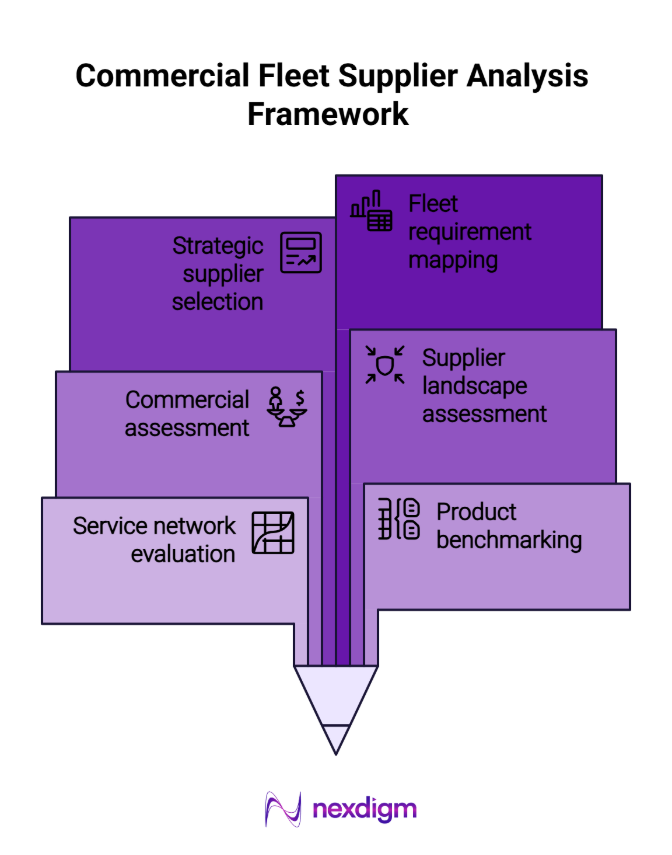
- Fleet requirement mapping: Identify vehicle categories, payload requirements, operating conditions and expected fleet size.
- Supplier landscape assessment: Map manufacturers, authorised dealers and specialised vehicle suppliers.
- Product benchmarking: Compare technical specifications, safety features, vehicle configurations and performance.
- Service network evaluation: Assess workshop coverage, spare parts availability, warranty terms and repair support.
- Commercial assessment: Compare acquisition costs, maintenance expenses, financing arrangements and lifecycle costs.
- Strategic supplier selection: Rank providers based on product suitability, delivery capacity, after-sales support and long-term value.
Nexdigm can support organisations through commercial vehicle market research, supplier mapping, product benchmarking and procurement assessments. These exercises help fleet operators understand supplier capabilities, compare commercial propositions and identify manufacturers aligned with their operational requirements.
Nexdigm’s Case Study
Nexdigm evaluated 10 commercial vehicle suppliers across 4 vehicle categories, comparing product specifications, service networks, spare parts availability and acquisition costs. The assessment shortlisted 3 suppliers, identified a 13% variation in total ownership costs and helped the client establish standardised vehicle procurement and maintenance benchmarks.
To take the next step, simply visit our Request a Consultation page and share your requirements with us.
Harsh Mittal
+91-8422857704