

Commercial vehicles are the backbone of economic activity, supporting logistics, construction, manufacturing, retail distribution, and public transportation. As economies adapt to changing trade patterns, e-commerce expansion, sustainability goals, and technological advancements, the commercial vehicle sector is experiencing a significant transformation. This raises an important industry question: Where is commercial vehicle demand growing, and what factors are driving this momentum?
A comprehensive Commercial vehicle market assessment indicates that demand growth is increasingly influenced by three key forces: fleet renewal requirements, freight activity expansion, and the ongoing transition toward alternative powertrains. Together, these factors are reshaping both purchasing decisions and long-term investment priorities across the commercial mobility ecosystem.
Nexdigm believes that understanding the interaction between these demand drivers is essential for manufacturers, fleet operators, suppliers, investors, and policymakers seeking to capitalize on emerging market opportunities.
Where Is Commercial Vehicle Demand Growing?
Commercial vehicle demand is growing most strongly in segments and regions characterized by:
- Rising freight and logistics activity
- Expanding e-commerce networks
- Aging vehicle fleets requiring replacement
- Infrastructure and construction investments
- Regulatory support for cleaner transportation
- Fleet modernization initiatives
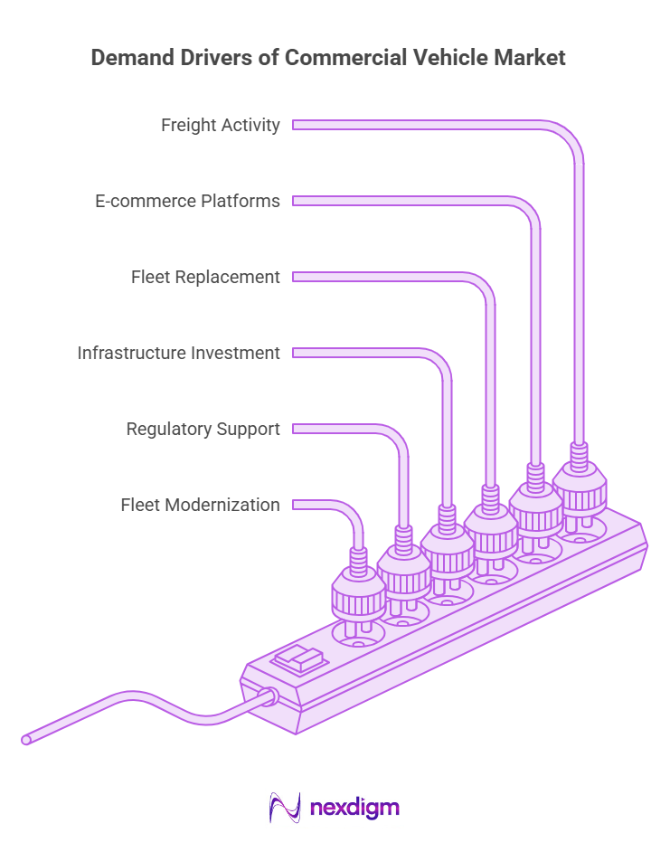
Rather than being driven by a single factor, demand growth is emerging from a combination of operational requirements, economic expansion, and technology transitions.
A forward-looking Commercial vehicle market analysis reveals that markets experiencing strong freight movement and fleet replacement cycles are likely to generate the greatest opportunities over the coming years.
Fleet Renewal: The First Growth Engine
One of the strongest drivers of commercial vehicle demand is fleet renewal. Many operators are managing vehicles that were purchased several years ago and are now facing challenges related to:
- Rising maintenance costs
- Reduced fuel efficiency
- Regulatory compliance requirements
- Reliability concerns
- Increasing operating expenses
As vehicles age, replacing them often becomes more economical than maintaining them.
Why Fleet Renewal Is Accelerating
- Higher Operating Cost Pressure: Fleet managers are prioritizing cost optimization and fuel efficiency.
- Compliance Requirements: New emissions and safety regulations are encouraging vehicle upgrades.
- Technology Advancements: Modern vehicles offer telematics, connectivity, predictive maintenance, and improved fleet management capabilities.
- Uptime Optimization: Newer vehicles reduce downtime and improve operational productivity.
Fleet replacement is therefore becoming a strategic investment rather than a routine procurement exercise.
Nexdigm’s Suggestion
At Nexdigm, market evaluations suggest that fleet renewal should be viewed through a long-term value lens rather than an asset replacement perspective. Organizations should assess:
- Lifecycle Cost Benefits: New vehicles often generate measurable savings through efficiency improvements.
- Asset Utilization Rates: Optimized fleet deployment can improve return on investment.
- Financing Structures: Innovative financing solutions are enabling faster fleet modernization.
- Digital Fleet Management: Technology integration is creating additional value beyond vehicle performance.
A well-structured Commercial vehicle market assessment increasingly places fleet modernization at the center of growth forecasting.
Freight Activity: A Critical Demand Indicator
Commercial vehicle demand remains closely linked to freight movement. As supply chains evolve and consumer expectations continue to rise, freight transportation requirements are expanding across multiple sectors.
Key Growth Drivers
- E-commerce Expansion: Last-mile delivery networks continue to require larger and more efficient vehicle fleets.
- Manufacturing Activity: Industrial growth increases demand for transportation and logistics services.
- Regional Trade Expansion: Cross-border and domestic trade flows create additional freight volumes.
- Infrastructure Development: Construction projects generate demand for heavy-duty and specialized commercial vehicles.
Growing freight activity translates directly into higher vehicle utilization rates and increased purchasing demand.
Nexdigm’s Suggestion
From a Nexdigm standpoint, freight data serves as one of the strongest leading indicators of commercial vehicle demand. Businesses should continuously monitor:
- Logistics Network Expansion: Emerging logistics hubs often signal future vehicle demand.
- Warehousing Growth: Increased warehouse capacity typically drives transportation requirements.
- Sector-Specific Freight Patterns: Retail, manufacturing, agriculture, and construction sectors influence demand differently.
- Last-Mile Delivery Trends: Urban distribution requirements are driving demand for light and medium commercial vehicles.
Organizations that align market strategies with freight growth patterns are better positioned to capture emerging opportunities.
Powertrain Transition: A New Chapter in Commercial Mobility
Commercial vehicle purchasing decisions are no longer based solely on payload and performance. Fleet operators are increasingly evaluating powertrain options as sustainability and operating economics gain importance. The market is witnessing growing interest in:
- Diesel efficiency improvements
- Hybrid commercial vehicles
- Battery electric trucks and vans
- Alternative fuels
- Hydrogen-powered commercial transportation
The pace of adoption varies by application, but the transition is clearly underway.
Nexdigm’s Suggestion
At Nexdigm, commercial mobility assessments indicate that powertrain transitions are increasingly driven by economics rather than environmental considerations alone.
Fleet operators are evaluating:
- Total Cost of Ownership (TCO): Operating economics remain a primary purchase criterion.
- Fuel Cost Volatility: Alternative powertrains can help reduce exposure to fuel price fluctuations.
- Vehicle Duty Cycles: Different applications require different propulsion solutions.
- Infrastructure Availability: Charging and fueling infrastructure readiness significantly influences adoption rates.
A detailed Commercial vehicle market assessment demonstrates that fleet operators are adopting technologies that best align with operational realities rather than pursuing electrification for its own sake.
Market Segments Showing Strong Demand Potential
Demand growth is not uniform across the commercial vehicle sector. Several segments are demonstrating particularly strong momentum.
Light Commercial Vehicles (LCVs)
Growth is being supported by:
- E-commerce delivery services
- Urban logistics
- Retail distribution networks
- Small business expansion
Medium-Duty Trucks
Demand is increasing due to regional freight transportation and industrial activity.
Heavy-Duty Vehicles
Construction, mining, infrastructure projects, and long-haul logistics continue to support growth.
Electric Commercial Fleets
Urban delivery operations are increasingly adopting electric vehicles where charging infrastructure is available.
Nexdigm’s Suggestion
Nexdigm recommends that organizations avoid viewing the commercial vehicle market as a single homogeneous category. Instead, businesses should focus on:
- High-Growth Use Cases: Identify sectors experiencing structural expansion.
- Regional Demand Variations: Different markets demonstrate distinct purchasing behaviors.
- Fleet Buyer Requirements: Commercial customers increasingly seek customized mobility solutions.
- Technology Adoption Readiness: Electrification opportunities differ significantly by fleet type.
A segmented approach allows organizations to allocate resources more effectively and maximize return on investment.
Emerging Opportunities Across the Commercial Vehicle Ecosystem
Beyond vehicle manufacturing, significant opportunities are emerging across supporting industries. These opportunities support growth and investment decisions. Some major emerging opportunities across the commercial vehicle market are:
- Fleet Analytics Platforms: Data-driven fleet management solutions are becoming critical.
- Connected Vehicle Technologies: Real-time monitoring improves efficiency and maintenance planning.
- Charging and Fueling Infrastructure: Powertrain diversification creates new infrastructure requirements.
- Fleet Financing Solutions: Flexible financing models support fleet modernization efforts.
- Aftermarket Services: Maintenance, telematics, and lifecycle support remain important value drivers.
These adjacent opportunities further strengthen the outlook identified through a comprehensive Commercial vehicle market assessment.
Nexdigm’s Case
Nexdigm supported an automotive player in assessing commercial-vehicle demand as July 2026 retail volumes rose 24% YoY, while LCV sales increased 27.6%. The study linked fleet renewal, freight activity, and powertrain shifts, sharpening market priorities and identifying scalable growth opportunities.
To take the next step, simply visit our Request a Consultation page and share your requirements with us.
Harsh Mittal
+91-8422857704