

Demand for trucks and buses reflects the movement of goods, infrastructure spending, fleet replacement cycles and public transport investment. Yet a growing vehicle market does not automatically translate into an attractive export opportunity. Import dependence, local production, operating requirements and competitive pricing all influence which manufacturers can win business.
A useful trade assessment examines individual vehicle segments and the trade relationships connecting major production and consumption markets.
Distinguish Truck And Bus Demand
Heavy trucks, medium-duty trucks, light commercial vehicles, and buses serve different purchasing needs. Freight operators may prioritise payload, fuel efficiency, uptime, and maintenance costs. Municipal authorities and public transport operators may focus on passenger capacity, accessibility, lifecycle costs and emissions performance.
These differences affect demand forecasts, and the types of vehicles countries import. Infrastructure development can support demand for construction and freight vehicles, while urbanisation and public transport investment may create opportunities for city buses and intercity coaches.
Track Imports, Exports And Production
Commercial vehicle trade analysis should track imports and exports by vehicle category, trading partner and year. Trade values reveal market size, while unit volumes can help distinguish changes in prices or product mix from changes in physical demand.
Three comparisons are especially useful. Import data can identify markets reliant on foreign vehicles. Export data reveals which manufacturing countries are expanding their reach. Production figures help establish whether domestic manufacturers serve local demand or operate as export-oriented production hubs.
These indicators should be considered alongside vehicle registrations, fleet replacement cycles, and procurement announcements. A country may import specialised heavy trucks while producing large volumes of lighter commercial vehicles domestically.
Understand Competitive Conditions
Competition is shaped by more than the number of manufacturers operating in a market. Product suitability, dealer coverage, spare-parts availability, financing and after-sales support can influence purchasing decisions over a vehicle’s operating life.
Electric commercial vehicles add another consideration. Buyers must evaluate charging or depot infrastructure, vehicle range, payload implications, and total cost of ownership. Adoption may progress differently for buses operating on predictable urban routes and long-haul trucks covering greater distances.
Exporters should also examine tariffs, homologation requirements, local assembly arrangements, and public procurement rules. These factors determine whether a vehicle can compete on price and compliance as well as technical performance.
A Commercial Vehicle Market Framework
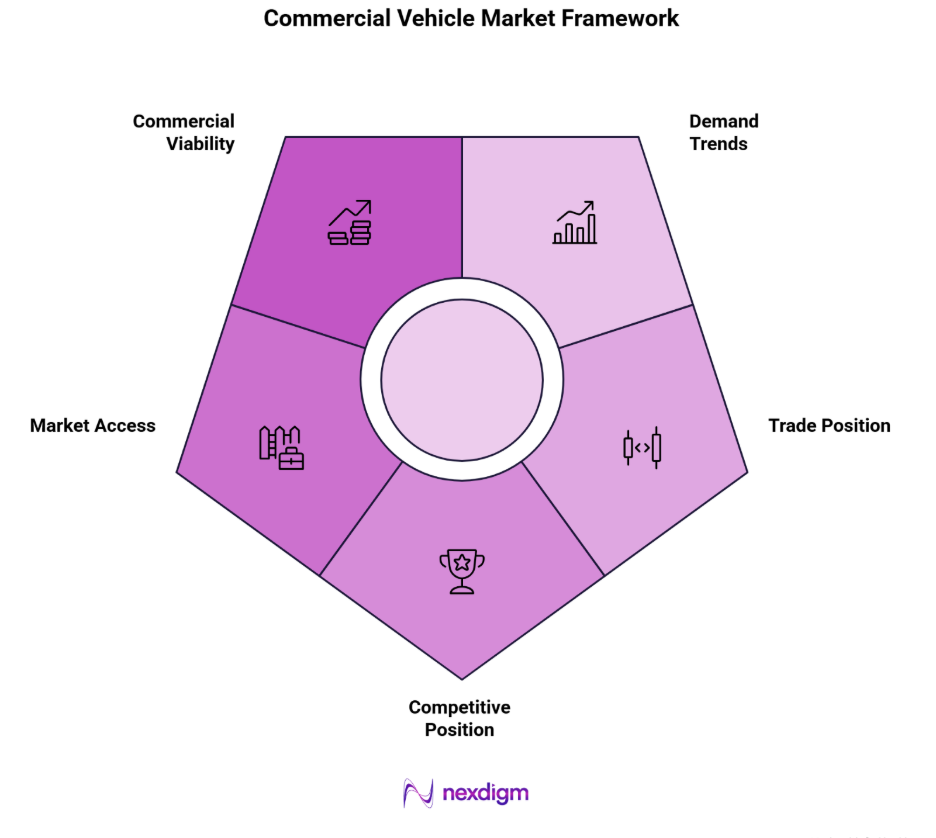
- Demand Trends: Compare registrations, fleet age, replacement cycles, infrastructure projects and procurement plans to identify vehicle categories with sustained purchasing potential.
- Trade Position: Track import volumes, export destinations and domestic production to determine whether a market depends on foreign supply or serves as a regional manufacturing base.
- Competitive Position: Examine leading manufacturers, product availability, pricing, dealer coverage and service networks to identify market gaps and barriers to entry.
- Market Access: Review tariffs, certification requirements, local-content rules and procurement conditions that could affect vehicle eligibility, launch timelines and landed costs.
- Commercial Viability: Estimate achievable sales volumes alongside distribution, financing, spare parts and maintenance costs to determine whether the opportunity can support a sustainable market presence.
A high import volume alone does not guarantee an attractive opportunity. Demand consistency, competitive intensity, and the ability to support vehicles after delivery are equally important.
Turn Trade Data Into Commercial Priorities
Commercial vehicle research is most useful when trade flows are connected to fleet demand, production capacity, and buyer requirements. This approach helps manufacturers identify target markets, assess export routes, and determine where distributor partnerships or local production could improve competitiveness.
Nexdigm’s Case Study
A manufacturer comparing two export destinations finds that one has higher truck imports but strong domestic competition. The other has a smaller market, yet its bus fleet is ageing, and public procurement plans indicate replacement demand. Segment-level analysis helps the manufacturer prioritise the opportunity that better matches its product range and distribution capabilities.
To take the next step, simply visit our Request a Consultation page and share your requirements with us.
Harsh Mittal
+91-8422857704