

Commodity chemical distribution is fundamentally a scale and efficiency business. Large-volume customers, freight economics, storage infrastructure, supplier relationships, inventory cycles, and product availability can determine whether a distributor can compete profitably. Unlike highly specialized chemicals, purchasing decisions for many commodity products are strongly influenced by delivered cost, reliability, specification compliance, and supply continuity.
India’s chemical ecosystem provides significant distribution potential. Chemicals and petrochemicals excluding pharmaceuticals and fertilizers accounted for approximately ₹6.32 lakh crore of imports in FY2024–25, while domestic petrochemical production reached 42.16 million tonnes against installed capacity of 52.29 million tonnes in FY2023–24. These flows create opportunities for distributors that can connect producers and importers with geographically dispersed industrial customers.
For manufacturers, distributors, importers, and investors assessing expansion, commodity chemical distribution entry strategy can help identify priority markets, map bulk customers, evaluate storage requirements, understand trade flows, and design commercially sustainable distribution networks.
Bulk Demand Determines Where Distribution Should Be Built
Commodity chemicals are consumed across plastics, textiles, construction, automotive, agriculture, packaging, pharmaceuticals, paints, coatings, and industrial manufacturing. Demand is therefore closely connected to the location of downstream production.
A distributor entering a new market needs to understand not just total consumption but customer concentration, shipment volumes, buying frequency, product requirements, and purchasing routes. High-volume industrial clusters can create attractive distribution economics when several customers can be served efficiently through shared infrastructure.
Storage and Logistics Can Change the Commercial Equation
For bulk chemicals, distribution economics extend well beyond the purchase price. Storage capacity, tank farms, handling systems, transportation distance, safety requirements, inventory turnover, and working capital can significantly influence delivered cost.
A centralized facility may work when customers are concentrated, while regional storage can become more attractive when demand is geographically dispersed. The optimal model depends on product velocity, shipment size, customer density, infrastructure, and service requirements.
Nexdigm’s Data-led Approach to Commodity Chemical Distribution Planning
While demand, storage, and logistics shape the economics of commodity chemical distribution, successful market expansion requires a structured understanding of how these factors interact across the value chain. Customer concentration, trade flows, inventory requirements, supplier access, and distribution infrastructure must be evaluated together to develop a commercially sustainable network.
Combining market intelligence, commodity chemical distribution entry strategy and distribution-network expertise, Nexdigm helps manufacturers, importers, distributors, and investors identify attractive market opportunities and develop commodity chemical distribution strategies aligned with operational and commercial realities.
Why Commodity Chemical Distribution Planning Matters
Efficient distribution in commodity chemical markets requires balancing customer demand, logistics economics, storage infrastructure, and supply availability to support profitable growth. This takes place through:
- Demand Concentration Analysis: Identifying industrial clusters, bulk customers, and high-consumption regions to improve market coverage and distribution efficiency.
- Network and Logistics Optimization: Evaluating storage, transportation, inventory, and trade-flow dynamics to reduce costs and support reliable product availability.
A structured commodity chemical distribution planning approach helps businesses develop scalable, cost-efficient distribution networks aligned with market demand and long-term commercial objectives.
Nexdigm’s Commodity Chemical Distribution Entry Assessment
Nexdigm’s commodity chemical distribution entry strategy assessment evaluates distribution opportunities through a structured framework that considers demand concentration, trade flows, infrastructure availability, and network economics. This is done through:
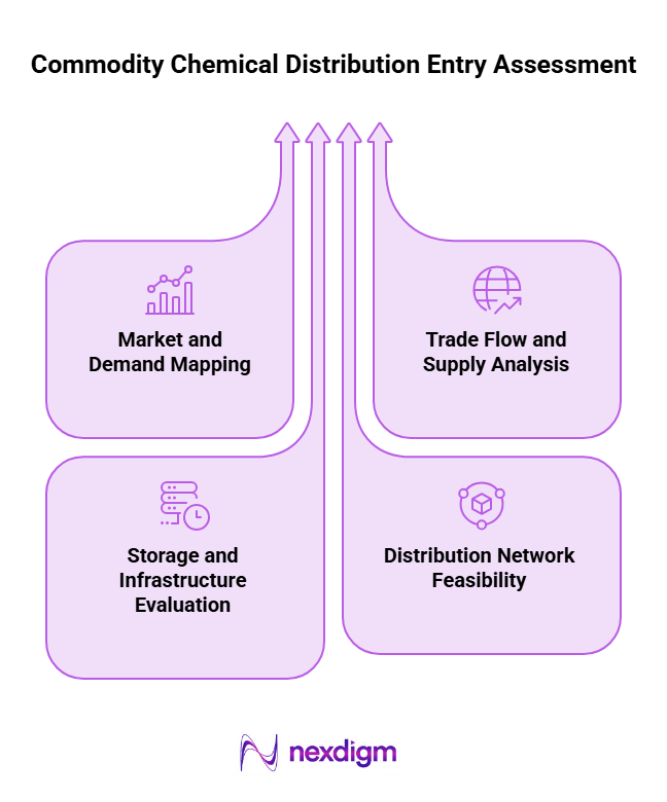
- Market and Demand Mapping: Identifying high-consumption regions, industrial clusters, bulk customers, end-use industries, and demand concentrations that can support efficient distribution operations.
- Trade Flow and Supply Analysis: Assessing domestic production, import dependencies, sourcing patterns, supplier locations, and product movement across key markets.
- Storage and Infrastructure Evaluation: Analyzing warehousing, tank-farm capacity, handling infrastructure, transportation connectivity, and operational requirements needed to serve target markets.
- Distribution Network Feasibility: Evaluating distribution models, market coverage, inventory positioning, logistics costs, and service-level expectations to determine the optimal network structure.
These assessment dimensions help businesses identify where commodity chemical distribution opportunities are strongest and how distribution networks can be designed for operational efficiency, market reach, and long-term commercial viability.
Benefits of Nexdigm’s Commodity Chemical Distribution Entry Assessment
Nexdigm’s assessment helps businesses move beyond demand estimates by evaluating the commercial, operational, and network factors that influence distribution success. It helps businesses with:
- Improved Market Prioritization: Identify the most attractive regions, industrial clusters, and customer segments based on demand concentration, accessibility, and growth potential.
- Optimized Distribution Economics: Assess logistics costs, storage requirements, inventory positioning, and trade flows to improve profitability and operational efficiency.
- Stronger Network Design: Develop distribution structures that align supply sources, infrastructure, and customer demand while supporting scalable growth.
- Reduced Expansion Risk: Evaluate competitive intensity, market-entry barriers, and operational challenges before committing capital and resources.
The assessment benefits enable businesses to make informed distribution decisions, improve market coverage, and build commercially sustainable commodity chemical distribution networks.
Nexdigm’s Case
Nexdigm supported a European specialty chemicals company evaluating entry into India. The engagement screened 60+ distributors, shortlisted 12 potential partners, assessed compliance readiness across 8 regulatory parameters, and evaluated market coverage across 15 priority cities. The structured partner-identification process helped the company reduce expected entry-execution risk by 30%, providing a stronger basis for distributor selection and market-entry planning.
To take the next step, simply visit our Request a Consultation page and share your requirements with us.
Harsh Mittal
+91-8422857704