

Commodity chemicals are unforgiving markets. Products may have established demand and broad industrial applications, yet producers can struggle to earn acceptable returns when competing suppliers have larger plants, cheaper feedstock or better access to customers. A new facility that looks viable at an attractive selling price may become unprofitable after a fall in prices or a rise in energy costs.
The entry decision depends on the cost position the plant can sustain across a market cycle, not just whether current demand appears strong.
Start With the Supply-Demand Balance
India’s production of selected major chemicals and petrochemicals increased from 45.64 million tonnes in FY2015–16 to 58.62 million tonnes in FY2024–25, according to the Department of Chemicals and Petrochemicals. The sector contributed 8.1% of manufacturing gross value added in FY2023–24, as highlighted in the Economic Survey 2025–26.
These figures show the importance of chemicals to India’s manufacturing base. They do not, however, reveal whether a particular commodity is undersupplied. The Department’s Chemical and Petrochemical Statistics at a Glance 2025 provides product-level information on production, installed capacity and foreign trade, which is more relevant for evaluating individual products.
For a proposed entrant, the first task is to reconcile apparent demand with actual supply. Imports may be rising because domestic capacity is insufficient, but they may also reflect lower overseas prices, different product grades or long-term supply agreements. Similarly, high installed capacity does not guarantee abundant market supply if plants operate below capacity or face feedstock constraints.
The Cost Position Matters More Than the Headline Market Size
Commodity producers generally have limited room to differentiate products that buyers regard as interchangeable. Their economics depend heavily on feedstock, energy, plant scale, process efficiency, logistics and operating reliability.
A cost assessment should compare the proposed facility with both domestic producers and imported supply. It should include:
- Feedstock price and security of supply
- Energy, water, utilities and waste-treatment costs
- Conversion costs, yield losses and maintenance
- Freight, storage, handling and customer delivery
- Financing, working capital and plant utilisation
Location can alter the outcome. A plant near a refinery, port, industrial cluster or reliable raw-material source may enjoy lower logistics costs or better supply security. A remote facility can face a disadvantage even if land and labour are cheaper.
Minimum economic scale is equally important. If a project needs high utilisation to reach break-even, the investor must establish whether customer demand can absorb that output without forcing the plant to discount heavily.
Trade Flows Reveal Opportunity, Not Guaranteed Profit
NITI Aayog’s 2026 chemicals industry analysis identifies persistent production-consumption gaps in parts of petrochemicals and inorganic chemicals, linked partly to limitations in feedstock and mineral availability. This creates a rationale for evaluating import substitution, but each product requires separate investigation.
A useful trade analysis asks four questions:
- What is being imported? Confirm the precise product and grade using the relevant HS code.
- Who supplies it? Examine supplier-country concentration, pricing patterns and potential exposure to freight or geopolitical disruption.
- Why are buyers importing? Determine whether the reason is price, quality, scale, technology or a shortage of domestic capacity.
- Can a new plant compete? Compare its fully loaded cost with delivered import prices under different market conditions.
The keyword commodity chemicals market entry feasibility reports fits this decision process because a credible assessment must connect trade evidence to production economics, capacity and demand. Import volumes alone cannot establish a project’s commercial case.
Commodity Chemical Entry: The Investment Tests
Before committing capital, investors should resolve three uncertainties: whether demand is durable, whether the facility can operate competitively and whether the project can withstand a weaker price cycle. Sensitivity analysis should test changes in feedstock prices, selling prices, utilisation, commissioning time and financing costs.
Commodity Chemicals Market Entry Feasibility Framework
The Commodity Chemicals Entry Feasibility Framework provides a structured basis for evaluating a proposed plant.
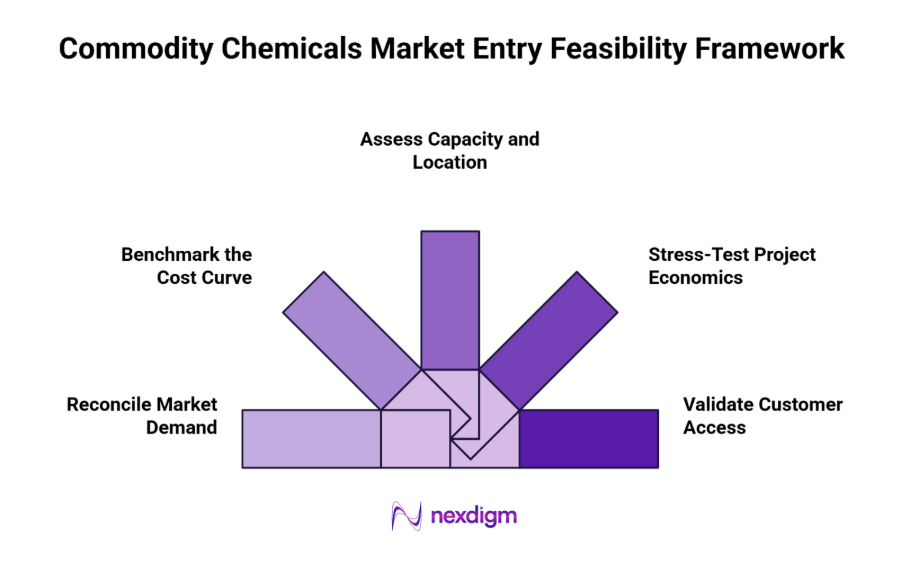
- Reconcile Market Demand: Analyse consumption, domestic production, imports, exports and demand by end-use sector.
- Benchmark the Cost Curve: Compare feedstock, utilities, conversion costs, logistics and scale against competing suppliers.
- Assess Capacity and Location: Review existing and announced capacity, utilisation, infrastructure and raw-material access.
- Stress-Test Project Economics: Model break-even utilisation, margin sensitivity, working capital and downside price scenarios.
- Validate Customer Access: Confirm product specifications, buyer requirements, achievable volumes and potential supply agreements.
Nexdigm Case Study
Nexdigm assessed 11 commodity chemical candidates using import trends, domestic capacity, feedstock availability and cost benchmarking. Three advanced to detailed financial modelling. One remained commercially attractive under lower-price scenarios, while two required stronger feedstock arrangements and customer commitments before further investment.
To take the next step, simply visit our Request a Consultation page and share your requirements with us.
Harsh Mittal
+91-8422857704