

A large chemical import bill can look like an obvious manufacturing opportunity. It often isn’t. Some products are imported because domestic capacity has not kept pace with demand. Others remain import-dependent because local feedstocks are expensive, production technology is unavailable, or overseas suppliers can land the product at a lower cost even after freight and duties.
That distinction matters when evaluating commodity chemicals. The opportunity is rarely import volume by itself. It is the combination of persistent external dependence, expanding domestic consumption and a credible path to competitive local supply.
India’s chemical industry illustrates the scale of the opportunity. The Department of Chemicals and Petrochemicals covers more than 80,000 commercial products across basic chemicals, petrochemicals, speciality chemicals and downstream applications. The government has also identified reducing import dependence and strengthening domestic production as important sector priorities.
Import Dependence Needs To Be Explained
Trade data identifies import volumes, but evaluating investment viability requires uncovering the underlying structural drivers:
- Underlying Drivers of Import Reliance: High import volumes may stem from domestic capacity shortfalls, but they often reflect uncompetitive feedstock access, sub-scale facilities, inferior product grades/purity, or lower foreign production costs.
- Persistent vs. Cyclical Demand: Sustained import growth aligned with rising domestic consumption indicates an attractive market, whereas short-term spikes often reflect temporary disruptions.
- Supplier Concentration: A consolidated foreign supplier base incentivizes domestic buyers to support a local alternative to mitigate supply-chain vulnerability, even at a slight price premium.
- Inland Logistics Arbitrage: Aggregated national import statistics mask regional deficits. Port-landed imports incur high inland freight charges, allowing local producers situated near consuming industrial clusters to compete via delivered cost, rapid replenishment, and lower inventory holding requirements.
Follow The Chemical into Its End Markets
Commodity chemical demand is derived demand, tied entirely to downstream consuming industries like packaging, textiles, construction, and manufacturing.
High import volumes can mask weak long-term viability if end-use markets are stagnant, while moderate imports become highly attractive when diversified downstream sectors expand simultaneously.
Market assessments must therefore evaluate demand by tracing the chemical through its major consuming industries rather than treating top-line import volumes as the total addressable market.
Local Production Has to Beat The Delivered Cost
Import substitution sounds straightforward until the economics are modelled.
A domestic producer has to compete against the full landed cost of imported material, not simply the export price. Feedstock, electricity, fuel, labour, financing, plant utilisation, freight, port handling, duties and working capital can all influence the result.
Scale is particularly important for commodity chemicals. A plant operating well below its efficient utilisation level can have a cost disadvantage that becomes difficult to overcome through pricing. This makes the size of the addressable market critical. There has to be enough recurring demand to support an economically viable facility.
Location can change the equation as well. Access to ports, pipelines, natural gas, power and established chemical clusters can materially influence production economics. Proximity to customers can be just as important where inland freight forms a meaningful part of the delivered cost.
A market therefore becomes interesting when local production can compete across a reasonable range of commodity prices rather than only during periods when imports become unusually expensive.
Nexdigm Investment Gap Assessment Framework
A Nexdigm assessment would typically move from trade data into the underlying economics of supply.
The analysis would examine:
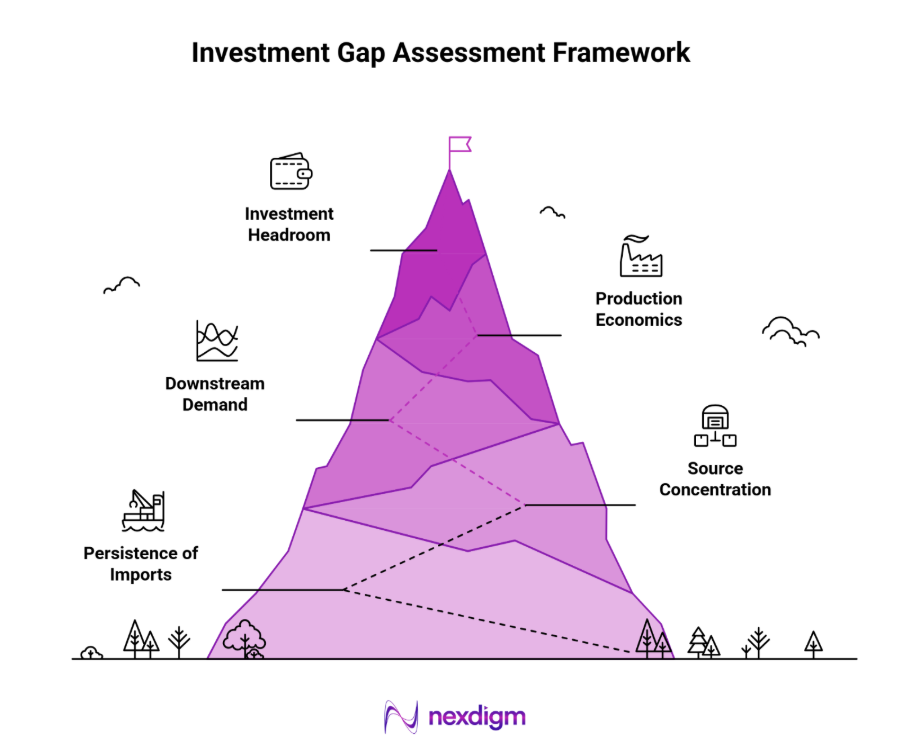
- Persistence of imports: Whether external dependence has remained consistent over several years and whether volumes are growing alongside domestic consumption.
- Source concentration: Which countries and producers supply the market and whether customers face meaningful dependence on a limited number of suppliers.
- Downstream demand: Which industries consume the chemical, how quickly those industries are expanding and whether demand is geographically concentrated.
- Production economics: Feedstock, energy, technology, plant scale, utilisation, logistics and other costs that determine whether a domestic producer can compete with imports.
- Investment headroom: Whether the addressable market is large enough to support new capacity after accounting for existing producers, announced projects and potential competitive responses.
This exercise can lead to very different conclusions. In one market, the answer may be a large integrated plant. In another, a smaller regional facility could make more sense because customers are concentrated in a particular industrial cluster. Some products may favour downstream conversion rather than primary chemical production, while others may remain better served through imports.
Import Substitution Can Become an Export Platform
A production facility designed around a growing domestic market may eventually serve neighbouring countries if its cost position and logistics network are competitive. This matters for India because its chemical industry already has a substantial export base. The Ministry of Commerce reported chemical exports of approximately US$64 billion in 2024–25.
That creates a second test for potential investments.
Can the proposed facility remain competitive if domestic prices weaken?
Can excess production be sold into regional markets?
Does the location provide access to ports and trade corridors that make exports practical?
An investment that works only because domestic imports are temporarily expensive is considerably less attractive than one with multiple routes to market.
Nexdigm Case: Screening an Import-Substitution Opportunity
A Nexdigm assessment screened 42 commodity chemicals using import persistence, downstream demand, supplier concentration, feedstock access and delivered-cost competitiveness. Eleven showed structural supply gaps, but only four remained attractive after production economics were tested. One shortlisted product supported approximately 180,000 tonnes of potential annual domestic substitution, with additional export potential from the proposed production location.
To take the next step, simply visit our Request a Consultation page and share your requirements with us.
Harsh Mittal
+91-8422857704