
Commodity farming can look straightforward on paper. A crop has an established price, recognised buyers and a defined production cycle. The economics of entering that market are considerably more complicated.
Crop profitability depends on yield, input costs, land economics, irrigation, labour, post-harvest handling, transportation and the price ultimately realised by the producer. These variables can also change significantly between crops and regions.
The government’s 2026–27 Rabi MSP data illustrates the difference. Wheat has an MSP of ₹2,585 per quintal against a reported cost of production of ₹1,239, while mustard has an MSP of ₹6,200 against a cost of ₹3,210. Lentil has an MSP of ₹7,000 against a reported cost of ₹3,705.
The numbers provide a benchmark. They do not, on their own, establish whether entering a commodity-farming market is commercially viable.
What Actually Determines Crop-Level Profitability?
The first assessment needs to move beyond the headline crop price. A commodity with an attractive selling price can still produce weak returns if yields are inconsistent, inputs are expensive or the crop requires costly irrigation and labour.
For a prospective entrant, the underlying economics can be examined through several variables:
- Yield potential: Expected output under the production conditions of the target geography.
- Input intensity: Seed, fertiliser, crop-protection products, irrigation, machinery and labour requirements.
- Land economics: Land availability, rental or acquisition costs, holding size and cropping intensity.
- Realised price: Expected selling price after accounting for procurement access, quality requirements and market conditions.
- Post-harvest costs: Storage, handling, transportation, financing and potential losses before sale.
These variables should be modelled together rather than treated as independent cost lines. A crop with higher gross revenue may still generate weaker returns if its production and market-access costs are substantially higher.
MSP Provides a Benchmark, not a Guaranteed Return
The government’s MSP system provides an important reference point for several crops. For 2026–27, the reported margin over cost is 109% for wheat, 93% for mustard, 89% for lentil, 59% for gram and 50% for safflower.
The government also reported procurement of 310 lakh tonnes of Rabi crops during RMS 2025–26, valued at ₹79,267 crore at MSP.
However, the existence of an MSP does not mean every producer will realise that price under every production and market condition. Procurement access, crop eligibility, location, quality and the presence of alternative buyers can all influence actual price realisation.
For an entrant, the relevant question is therefore not simply whether a crop has an attractive MSP. It is whether the production model can consistently generate acceptable returns at the prices realistically available to the business.
Land and Inputs Can Change the Economics by Region
India’s average operational holding was 1.08 hectares in the 2015–16 Agriculture Census. The scale and fragmentation of agricultural holdings can have significant implications for businesses considering direct cultivation, contract farming or sourcing-led models.
Land suitability also extends beyond acreage. Soil conditions, water availability, cropping patterns and the possibility of multiple cropping can influence both yield and production costs.
Input economics can vary in the same way. Seed, fertiliser, crop-protection products, machinery and labour may have different costs and levels of availability across regions.
A crop that appears commercially attractive at a national level can therefore produce a very different return profile in a specific geography.
Buyer Access Determines Whether Production Economics Hold
Agricultural output ultimately has to reach a buyer. Traders, processors, exporters, government procurement agencies and organised buyers can have different requirements around quality, volume, timing and pricing.
India’s agricultural exports reached US$52.55 billion in FY2025–26, demonstrating the scale of demand available across international agricultural markets.
That opportunity cannot simply be applied to every commodity. Export markets may impose specific quality standards, processing requirements, documentation, logistics arrangements and volume expectations.
Buyer concentration can also affect negotiating power. A production region with several competing buyers may provide a different commercial environment from one where farmers or producers depend heavily on a limited number of purchasers.
For companies considering commodity farming market entry services, the assessment therefore needs to connect what can be produced profitably with who can buy it, at what price and under what conditions.
Nexdigm’s Commodity Market Assessment Approach
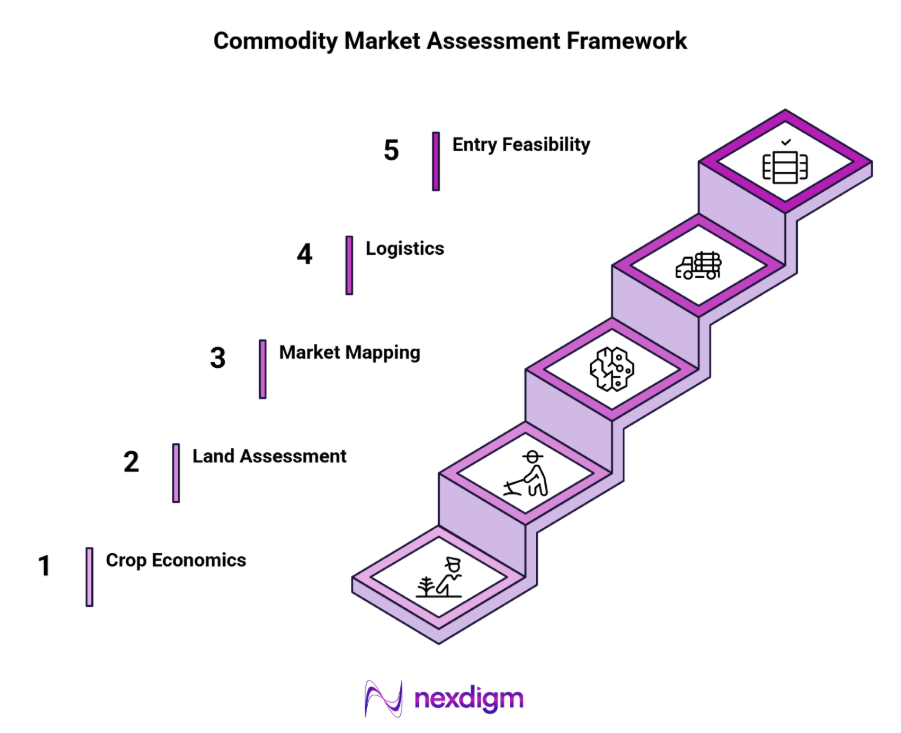
Nexdigm can assess commodity opportunities by connecting production economics with land suitability, input costs and downstream market access.
- Crop Economics and Scenario Modelling
Model yields, prices, production costs and margins under different assumptions to determine how resilient the business case is. - Land and Input Assessment
Examine land availability, soil and water conditions, input costs, labour and machinery requirements across potential production locations. - Market and Buyer Mapping
Identify processors, traders, procurement centres, exporters and organised buyers, including their quality, volume and sourcing requirements. - Logistics and Price Realisation
Incorporate transportation, storage, handling and market-access costs to estimate the economics that can be achieved. - Entry Feasibility and Prioritisation
Compare crops and geographies under base-case and downside scenarios to identify opportunities that warrant deeper investment consideration.
Nexdigm’s Case Study: Testing Crop Economics Before Entry
An agribusiness evaluated five commodity crops across yield potential, input costs, land suitability, buyer access and logistics. Scenario analysis tested a 10% increase in input costs and 15% decline in realised prices, narrowing the opportunity to two crops that maintained positive margins under both downside conditions.
Nexdigm can support companies with crop economics, geographic assessment, supply-chain analysis, competitive research and market-entry feasibility modelling to evaluate commodity opportunities before investment.
To take the next step, simply visit our Request a Consultation page and share your requirements with us.
Harsh Mittal
+91-8422857704