

Commodity farming businesses operate within markets shaped by weather disruption, currency movements, trade policies, input inflation, and shifting global demand. Commodity farming pricing analysis consulting helps producers, traders, processors, and investors evaluate cost structures, benchmark market prices, assess margin exposure, and model alternative commercial scenarios.
With Pricing Analysis, businesses can establish responsive price corridors, improve contract decisions, manage volatility, and protect profitability. This evidence-led approach supports stronger planning, and sustainable growth across grains, oilseeds, fibers, sugar, and other globally traded agricultural commodities in uncertain market conditions today.
In 2026, the FAO Food Price Index remained 2.2% above its year-earlier level, while the World Bank projected overall commodity prices to rise 16% during 2026, reinforcing the value of timely pricing analysis, scenario planning, and risk-adjusted decisions globally.
Dynamic Pricing Analysis Strategies for Global Farming Commodities
Dynamic pricing analysis enables commodity farming businesses to respond to market volatility using timely data, scenario modelling, and adaptive price decisions that protect margins, competitiveness, and long-term commercial resilience globally. Key elements in focus during Pricing Analysis process are:
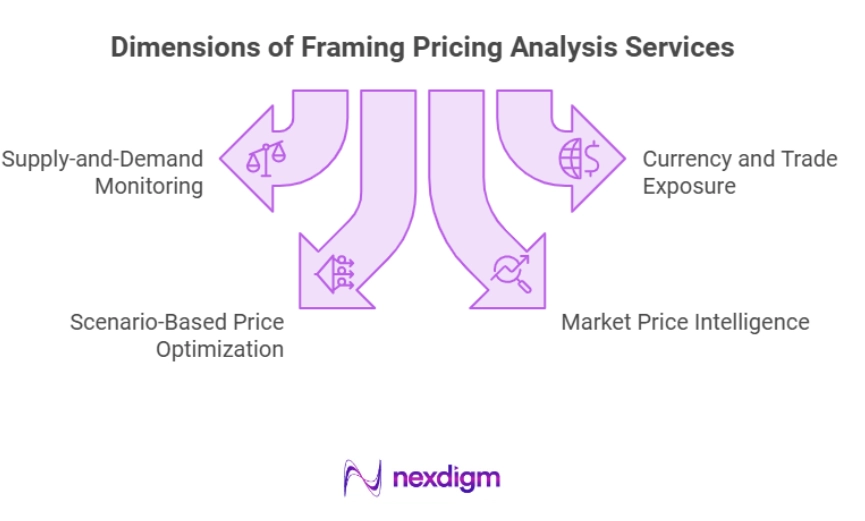
- Supply-and-Demand Monitoring: Analyzes crop production, inventories, consumption patterns, export demand, and seasonal availability to anticipate market imbalances and guide responsive commodity pricing decisions across priority regions.
- Currency and Trade Exposure: Measures exchange-rate movements, tariffs, duties, freight costs, and trade restrictions to assess landed-price competitiveness and manage international pricing risk across commodity markets effectively.
- Scenario-Based Price Optimization: Tests baseline, upside, and downside pricing scenarios against cost, demand, currency, and supply changes to establish resilient price corridors and improve decision-making under uncertainty.
- Market Price Intelligence: Tracks commodity exchanges, regional benchmarks, competitor movements, and historical trends to identify price signals, emerging risks, and timely commercial opportunities across global agricultural markets.
Nexdigm’s End-to-End Pricing Support for Farming Businesses
Nexdigm’s end-to-end Pricing Analysis support helps agricultural businesses manage volatility, protect margins, and improve global market decisions. With strategic approach combined with commodity farming pricing analysis consulting, agricultural commodity price benchmarking, dynamic pricing strategy, cost and margin analysis, market volatility assessment, scenario-based pricing, and commodity price forecasting, it helps businesses to establish resilient price corridors and strengthen commercial performance across globally traded agricultural markets.
Nexdigm’s Pricing Analysis Architecture for Farming Commodities
Nexdigm’s dynamic pricing architecture helps farming businesses respond to commodity volatility by integrating market intelligence, cost visibility, scenario modelling, and governance to protect margins and strengthen global commercial decisions consistently. Key steps of the pricing analysis architecture are:
- Volatility Signal Identification: Identify critical price drivers across weather, crop output, inventories, currencies, trade policies, and global demand to determine where immediate pricing attention is required.
- Exposure and Sensitivity Mapping: Measure how commodity, input, freight, storage, and currency movements affect revenue and margins, highlighting the products, markets, and contracts carrying the greatest exposure.
- Price Corridor Construction: Establish minimum, target, and maximum price thresholds using costs, benchmarks, demand conditions, and risk tolerances to guide commercially disciplined pricing decisions.
- Contract and Channel Alignment: Translate recommended price corridors into indexed contracts, spot prices, regional structures, and customer terms that reflect channel economics and changing market conditions.
- Performance Review and Recalibration: Track realized prices, margins, volumes, forecast accuracy, and market movements, enabling timely updates to assumptions, pricing triggers, and commercial recommendations.
Nexdigm’s Case
Nexdigm supported an agricultural commodities business managing pricing across three volatile markets. Through benchmark tracking, exposure mapping, contract redesign, and price-corridor governance, the engagement improved price realization by 14%, reduced margin leakage, accelerated pricing approvals by 22%, and increased forecast accuracy by 12% across priority commodities and regions.
To take the next step, simply visit our Request a Consultation page and share your requirements with us.
Harsh Mittal
+91-8422857704