

Businesses are continuously looking for ways to gain a competitive edge. While industry reports, marketing campaigns, and company announcements provide valuable insights, one missed source of intelligence is import-export trade data. Through Competitor Import Export Analysis, organizations can identify and analyze critical information about a competitor’s market expansion plans, sourcing strategies, product portfolio, and business priorities.
Understanding how and where competitors move goods across the countries can reveal patterns that help businesses make informed strategic decisions. From identifying emerging markets to tracking product demand and supply chain shifts, trade intelligence serves as a powerful tool for enhancing competitor behavior.
Why Competitor Import-Export Analysis Matter
Trade data serves as real-world information for business activity. Unlike sponsored content or public statements, import-export records often indicate actual commercial transactions, providing a more accurate knowledge of an industry. Through Competitor Import Export Analysis, businesses can:
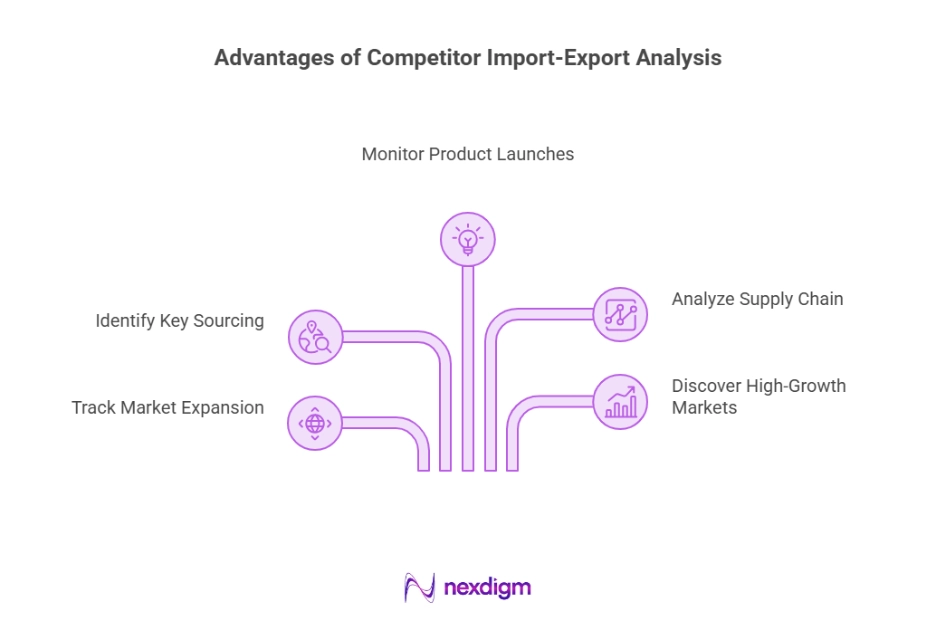
- Track competitor market expansion strategies: Identify new countries and regions competitors are targeting through increasing export or import activities.
- Identify key sourcing countries and suppliers: Discover key sourcing countries and suppliers’ competitors rely on for products or raw materials.
- Monitor product launches and portfolio diversification: Detect new product introductions and portfolio expansion through changing trade patterns.
- Analyze supply chain dependencies: Understand competitor dependencies, risks, and sourcing concentration across regions and suppliers.
- Discover high-growth markets and customer segments: Identify high-demand markets and emerging customer segments based on competitor trade trends.
Companies that leverage trade intelligence gain actionable insights that can improve market positioning and enhance their growth.
Identifying High Potential Markets Through Import-Export Data
One of the most valuable aspects of import-export data is its ability to identify target markets.
For example, if a competitor’s exports increase over several quarters, it may indicate strategic expansion in the specific region. Similarly, rising shipment volumes within the markets could signal increased demand for the product. Importance of each target destination are:
Export Destinations
Import-export data provides valuable insights into where competitors are selling their products and how their market presence is evolving. By tracking export destinations, businesses can understand which regions competitors are prioritizing and where demand is increasing. Analyzing export destinations helps businesses identify:
- New geographic markets being targeted
- Regions experiencing growing demand
- Strategic partnerships and distribution networks
- Market entry patterns
An increase in exports to a specific country may indicate that the competitor has identified new opportunities for expansion.
Import Destinations
Import data reveals where competitors source raw materials, components, and finished goods. This information can help determine:
- Supplier relationships
- Manufacturing locations
- Cost optimization strategies
- Supply chain diversification efforts
Understanding sourcing location allows businesses to benchmark their own strategies and identify alternative supplier options for resource allocation.
Understanding Competitor Product Portfolio Through Trade Data
Trade Data offers valuable insights into a competitor’s product portfolio, helping businesses understand what products are being traded, how offerings are evolving, and which product categories are gaining traction in the market. Trade records often contain detailed product descriptions and codes, providing visibility to the types of products being imported or exported. This information can help businesses:
Product Expansion Signals
Changes in import activity can provide early indications of product portfolio expansion. By monitoring new product categories, shipment patterns, and trade volumes of the competitors, businesses can identify:
- Product innovation initiatives
- Capacity expansion
- New manufacturing investment
- Diversification into adjacent categories
Through effective Competitor Import Export Analysis, organizations can identify these signals before product launches become public.
Tracking Product Demand
Export volume trends can reveal which product categories are experiencing stronger demand. These indicators include:
- Rising shipment frequency
- Increasing container volumes
- Growth in export value
- Expansion into multiple destination countries
These patterns help businesses detect market demand shifts and evaluate growth opportunities.
Strategic Applications of Competitor Import-Export Data
Competitor import-export analysis seems to be of great value when businesses transform raw trade data into actionable intelligence. By combining trade insights with market research and competitive analysis, organizations can make informed decisions that drive growth and strengthen their market position. Businesses can leverage competitor trade data to:
- Market Expansion Planning: Identify attractive markets based on competitor activity, export destinations, and regional demand trends.
- Product Development: Monitor competitor imports and exports to uncover emerging products, innovation trends, and portfolio expansion strategies.
- Procurement Optimization: Analyze sourcing patterns to identify reliable, cost-effective suppliers and reduce supply chain risks.
- Competitive Benchmarking: Compare trade volumes, market presence, sourcing strategies, and product diversification against industry competitors.
- Strategic Decision-Making: Support investment, partnership, market entry, and expansion decisions with real-world trade intelligence.
Organizations must combine trade data interpretation, competitive intelligence, market assessment, risk analysis, and strategic planning to gain meaningful insights from complex datasets. When integrated effectively, these capabilities enable businesses to identify opportunities, mitigate risks, and develop sustainable growth strategies.
Nexdigm’s Approach to Trade Intelligence for Business Growth
At Nexdigm, the experts help organizations with market research and business advisory support. With Competitor Import Export Analysis, this can help businesses to understand market dynamics, identify growth opportunities, and strengthen competitive positioning.
Nexdigm’s capabilities core strategies of Trade Intelligence include:
- Competitor trade activity assessment
- Import-export trend analysis
- Market entry and expansion research
- Supply chain intelligence and risk evaluation
- Product positioning insights
- Strategic advisory for global growth initiatives
By combining data-driven analysis with deep industry expertise, Nexdigm enables businesses to make confident decisions in an increasingly competitive global marketplace.
Why Partner with Nexdigm?
Nexdigm combines market intelligence, industry expertise, and data-driven analysis to help businesses identify complex global markets effectively. By delivering actionable insights and strategic recommendations, Nexdigm enables organizations to identify opportunities, mitigate risks, and make informed business decisions that support sustainable growth.
Nexdigm’s Case
Nexdigm supported a multinational manufacturer in analyzing competitors’ import–export activity across trade corridors and product categories. Using trade intelligence, supplier mapping, and market trend analysis, the engagement identified high-growth markets, improved product portfolio decisions by 16%, accelerated expansion planning by 21%, and increased competitive visibility within eight months.
To take the next step, simply visit our Request a Consultation page and share your requirements with us.
Harsh Mittal
+91-8422857704