

Construction chemical demand is often discussed as a function of construction activity. That is only the starting point.
The more useful question is what type of construction is taking place, what technical conditions the project creates, and which chemical formulations are required to meet them. Infrastructure modernization, industrial manufacturing expansion, urban redevelopment, and asset-longevity requirements are creating different demand pools across geographies and applications.
India, the Middle East, and Southeast Asia, for example, are seeing demand associated with major infrastructure programs, including concrete admixtures, structural repair materials, grouts, and waterproofing systems. North America and Western Europe have a different demand profile, with semiconductor fabs, EV battery facilities, and data centers creating requirements for specialized flooring, containment, and high-performance construction materials.
For producers, the commercial opportunity therefore lies in mapping project pipelines to formulation requirements rather than treating construction spending as a standalone demand indicator.
Three Demand Vectors Are Reshaping the Market
- Large-scale infrastructure development: Projects such as high-speed rail, metro systems, tunnels, and ports require specialized criteria including workability retention, early strength, waterproofing, corrosion resistance, and structural repair.
- Advanced industrial construction: Facilities like semiconductor fabs and EV battery gigafactories demand controlled environments and specialized flooring with static-dissipation properties, chemical resistance, thermal shock resistance, and heavy automated-vehicle tolerance.
- Infrastructure decarbonization and asset longevity: Longer design lifespans and lower-carbon methods alter the necessary chemistry to maintain performance in complex concrete mixes.
These three vectors create very different addressable markets, even when they fall under the broad label of construction chemicals.
From Project Pipeline to Chemical Requirement
A demand analysis becomes commercially useful when project activity is translated into specific chemical requirements.
- High-speed rail and underground systems can require polycarboxylate ether superplasticizers, shotcrete accelerators, and spray-applied waterproofing systems. Their value depends on characteristics such as workability retention, early compressive strength, and resistance to hydrostatic water.
- Semiconductor and EV manufacturing facilities generate demand for conductive or electrostatic-dissipative epoxy and polyurethane flooring, as well as chemically resistant containment systems.
- Coastal infrastructure and marine structures create requirements for penetrating sealers, corrosion inhibitors, and epoxy grouts designed to address chloride exposure and deterioration.
- Urban renovation creates another demand pool, particularly for high-performance adhesives and elastic sealants capable of handling movement while meeting low-VOC requirements.
This mapping matters because the same project value can support very different chemical revenue depending on specification intensity and chemical consumption per project.
Where Formulation Demand Is Becoming More Specialized
Structural trends create formulation challenges, such as low-carbon concrete where substituting Portland cement with slag, fly ash, or LC3 increases viscosity and water demand while delaying setting. Customized hyper-branched PCEs address these issues.
Specialized opportunities also exist in industrial cleanrooms, which require resilient resinous flooring, and tunnel construction, which uses TBM chemicals, sealants, and waterproofing for underground conditions.
These niche segments offer manufacturers higher value capture than broader construction markets due to their technical complexity and criticality.
Nexdigm’s Project-to-Product Demand Map
A robust construction chemicals demand analysis services approach can connect four levels of evidence.
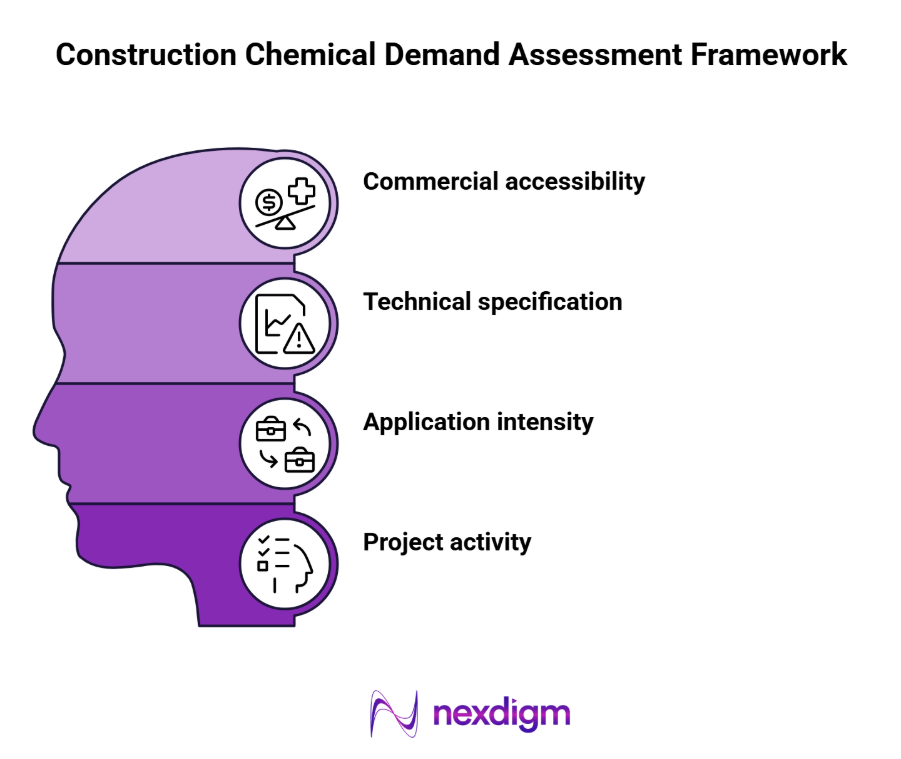
- Project activity
Identify where infrastructure, industrial facilities, transportation systems, and renovation projects are being developed. The objective is to establish the addressable project pool. - Application intensity
Estimate how much chemical intervention each project category requires. A tunnel, semiconductor fab, commercial building, and residential development will have materially different chemical intensity. - Technical specification
Translate each application into performance requirements such as curing speed, workability, waterproofing, conductivity, chemical resistance, adhesion, or movement capability. - Commercial accessibility
Assess procurement structures, specification ownership, distributor networks, contractor influence, qualification requirements, and competitive intensity. A technically attractive application is less useful if suppliers have limited access to the decision process.
The result is a market map that identifies not simply where construction is growing, but where project activity is translating into commercially accessible chemical demand.
Nexdigm Case: Infrastructure Chemical Demand Mapping
A chemical producer assessed 5 construction segments across 4 regions. Nexdigm mapped 640 projects, 31 technical specifications, and 5 application categories, identifying a $118 million addressable demand pool concentrated in infrastructure and industrial projects.
To take the next step, simply visit our Request a Consultation page and share your requirements with us.
Harsh Mittal
+91-8422857704