

Construction chemicals are often sold into a project long before the finished building is occupied. Waterproofing, concrete admixtures, tile adhesives, sealants and repair compounds may be specified by engineers, recommended by contractors or selected by applicators. A manufacturer entering the market must understand who influences the product choice, how specifications are set and what convinces a buyer to change suppliers.
The commercial opportunity is shaped by construction activity, but also by product performance, technical support, distribution and the cost of failure on site.
Not Every Construction Chemical Follows the Same Demand Cycle
India’s chemicals industry supplies products to construction, infrastructure and real estate, alongside agriculture, pharmaceuticals and manufacturing. NITI Aayog’s 2026 chemicals industry profile estimates that specialty chemicals accounted for around US$37 billion of India’s domestic chemicals market in FY2025. Construction chemicals form part of this category, alongside paints and coatings, surfactants, additives and other application-specific products.
The size of the broader specialty chemicals market should not be treated as the addressable market for construction chemicals. Demand needs to be calculated by product category and end use.
Four categories offer different entry considerations:
- Concrete admixtures: Demand follows ready-mix concrete, infrastructure construction and projects requiring controlled setting, workability or durability. Technical compatibility and performance consistency are essential.
- Waterproofing systems: Applications span roofs, basements, bathrooms, water-retaining structures and infrastructure. Product selection often depends on site conditions, applicator capability and the consequences of failure.
- Tile adhesives and grouts: Demand is linked to tile installation, renovation, housing and commercial construction. Distribution reach, installer familiarity and ease of application can influence adoption.
- Repair mortars, sealants and protective systems: These products serve maintenance, rehabilitation and specialised building requirements. Technical specification, substrate compatibility and durability can matter more than the lowest initial price.
A new entrant should avoid launching a broad catalogue before establishing which applications offer sufficient volume, achievable margins and an accessible customer base.
Where Project Demand Becomes a Sales Opportunity
Construction spending does not translate automatically into chemical sales. A project may specify a particular product brand, require approved-vendor status or rely on contractors who have established relationships with suppliers. Product substitution can require technical approval, sample testing or assurance that performance will remain consistent.
The route to market therefore varies by category. A tile adhesive producer may rely on dealers, distributors, installers and retail visibility. A waterproofing supplier may need trained applicators and project-level technical support. Concrete admixtures can require close relationships with ready-mix concrete producers, contractors and site engineers.
For each category, market research should examine:
- Project pipeline: Residential, commercial, industrial and infrastructure projects relevant to the product.
- Specification and approval: Who chooses the chemical, which standards apply and how suppliers qualify.
- Channel economics: Distributor margins, contractor incentives, applicator training and the cost of technical service.
- Performance and liability: Testing requirements, failure risks, warranties and the consequences of poor application.
- Repeat demand: Replenishment patterns, maintenance cycles, recurring project requirements and customer retention.
These parameters help distinguish a category with large theoretical demand from one a new manufacturer can realistically serve.
Product Economics and Competitive Positioning
Construction chemicals can face pressure from established brands, regional manufacturers and lower-priced alternatives. The relevant comparison is not just price per kilogram or litre. Buyers may also consider coverage, dosage, labour requirements, application time, durability and the cost of rework.
A higher-priced product may be commercially viable if it reduces material consumption or improves service life. Such claims must be supported by credible testing and demonstrated under conditions relevant to the customer. For a new entrant, product consistency, clear application guidance and reliable supply can be as important as formulation.
A construction chemicals feasibility study for market entry should combine project-level demand estimates with product economics, competitive benchmarking, customer interviews and distribution assessment. It should also consider manufacturing location, shelf life, packaging, storage, applicable quality standards and technical support requirements.
Construction Chemicals Market Entry Framework
The Construction Chemicals Market Entry Framework provides a practical route from category screening to investment.
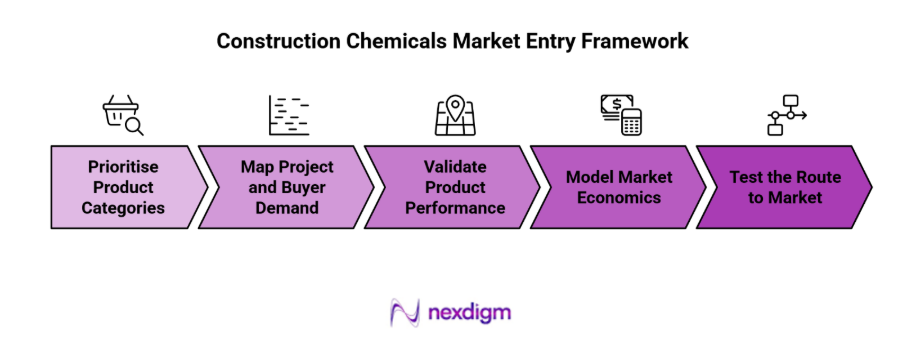
- Prioritise Product Categories: Compare concrete admixtures, waterproofing, adhesives, sealants and repair products by application demand and competitive intensity.
- Map Project and Buyer Demand: Identify relevant projects, specifications, contractors, distributors, applicators and purchasing decision-makers.
- Validate Product Performance: Establish required standards, application conditions, testing needs and technical differentiation.
- Model Market Economics: Assess manufacturing cost, distribution margins, service costs, achievable pricing and capacity utilisation.
- Test the Route to Market: Secure buyer feedback, trial opportunities, channel partnerships and realistic repeat-order assumptions.
Nexdigm Case Study
Nexdigm assessed five construction chemical categories for a prospective manufacturer, comparing project demand, product qualification, channel structure and margin potential. Waterproofing systems and concrete admixtures advanced to detailed validation. The entry plan prioritised contractor and ready-mix concrete relationships, with production investment linked to trial acceptance and initial customer commitments.
To take the next step, simply visit our Request a Consultation page and share your requirements with us.
Harsh Mittal
+91-8422857704