

Construction activity creates a broad demand base for chemicals, but not every category scales at the same rate. Concrete admixtures move with concrete volumes, waterproofing follows the complexity and longevity requirements of structures, repair materials benefit from aging assets, and industrial flooring is increasingly linked to specialized facilities such as warehouses, data centers and cleanrooms.
The commercial opportunity therefore depends on identifying which construction chemical categories can convert rising construction activity into repeatable product demand.
India provides a useful example. The country’s construction chemicals market generated approximately $5.63 billion in 2024 and is projected to reach $8.61 billion by 2030, representing a 7.6% CAGR. Admixtures accounted for 51.18% of 2024 revenue, while coatings are projected to be the fastest-growing product segment.
Scale Depends On What The Chemical Is Attached To
The first distinction is between chemicals whose demand rises almost automatically with construction volumes and products whose growth depends on a specific technical requirement.
Concrete admixtures are closely linked to cement and ready-mix concrete consumption. Polycarboxylate ether, or PCE, superplasticizers can support lower water-to-cement ratios while maintaining workability, making them increasingly relevant as concrete producers seek performance and lower clinker intensity.
Construction additives are already heavily concentrated in concrete-related applications. Nexdign estimates that chemical additives accounted for around 47% of the construction additives market in 2025, with demand supported by high-performance concrete and infrastructure projects.
Waterproofing operates differently. Demand depends less on tonnes of concrete and more on the number and complexity of structures exposed to water ingress, underground construction, basements, tunnels and infrastructure deterioration.
This distinction creates different scaling models.
Four Categories Reveal Four Different Growth Mechanisms
A useful way to examine the market is to ask what causes incremental chemical consumption.
- Volume-linked categories
Concrete admixtures benefit directly from growth in ready-mix concrete, infrastructure and high-rise construction. Their addressable market can expand quickly when construction volumes rise. - Performance-linked categories
Waterproofing systems, repair materials and structural grouts benefit when construction standards become more demanding. The customer is paying for durability, protection and reduced lifecycle risk. - Facility-linked categories
Industrial flooring follows the development of warehouses, manufacturing facilities, pharmaceutical plants, semiconductor fabs and data centers. Its demand is tied to the specifications of the facility rather than simply the number of buildings. - Technology-transition categories
Adhesives, sealants and advanced coatings can gain share as construction moves toward prefabrication, modular systems, energy-efficient buildings and new materials.
The supplied sector research similarly identifies admixtures, waterproofing, structural rehabilitation, industrial flooring, sealants and adhesives as distinct scaling opportunities with different margin and demand characteristics.
Nexdigm’s Construction Chemicals Opportunity Test
A construction chemicals market feasibility assessment should therefore examine the opportunity through a set of commercial gates rather than applying one market CAGR to every category.
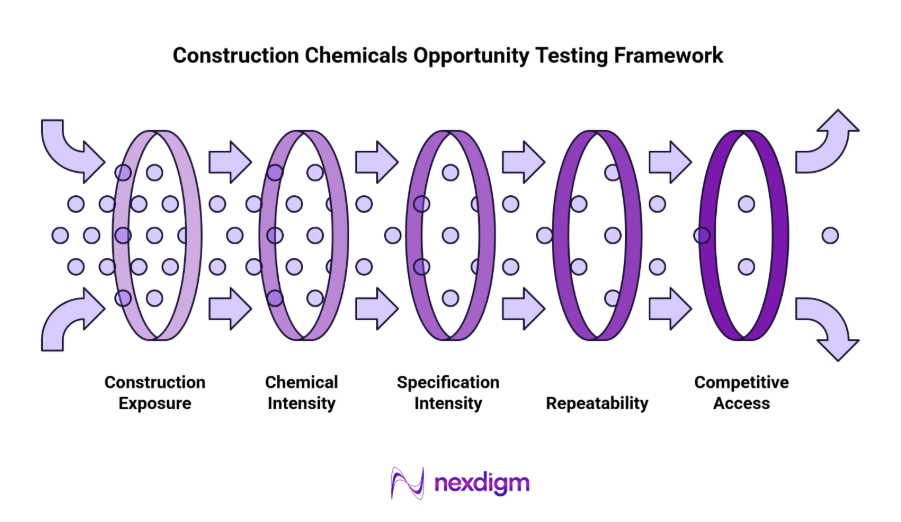
- Gate 1: Construction exposure
Measure residential, commercial, industrial and infrastructure activity across the target geography. Identify which construction segments are actually expanding. - Gate 2: Chemical intensity
Estimate how much chemical product is required per square meter, cubic meter of concrete, facility or project. This converts construction forecasts into chemical demand. - Gate 3: Specification intensity
Determine whether the category is being driven by mandatory standards, project specifications, performance requirements or simple material consumption. - Gate 4: Repeatability
Assess whether demand is recurring across projects or concentrated in occasional large developments. Admixtures can create recurring supply relationships with ready-mix producers, while specialized systems may depend on project pipelines. - Gate 5: Competitive access
Map approved suppliers, specification consultants, contractors, ready-mix producers and distributors. Construction chemicals are often specified before procurement, making technical relationships commercially important.
Why Infrastructure Creates Differentiated Demand
Infrastructure projects can generate particularly attractive demand because project failure has high economic consequences.
Underground transportation, tunnels, bridges, water treatment facilities and coastal infrastructure require materials that withstand moisture, corrosion, vibration and long operating lives. Waterproofing and repair systems can therefore command stronger value propositions than standard construction materials.
Asia Pacific remains a major demand centre for construction additives, accounting for approximately 44% of global revenue in 2025. India is also identified as a high-growth market, supported by urbanization and infrastructure investment.
The opportunity is not uniform, however. A market dominated by low-cost commodity admixtures presents a different commercial case from a market where waterproofing, structural repair or industrial flooring specifications are becoming more sophisticated.
Nexdigm Case: Construction Chemical Portfolio
A construction chemicals producer with $96M revenue assessed 5 categories across 4 Indian regions. Nexdigm mapped 640 projects and 31 specifications, identifying waterproofing and admixtures as priority pools worth $118M in five-year demand.
To take the next step, simply visit our Request a Consultation page and share your requirements with us.
Harsh Mittal
+91-8422857704