

Construction chemicals are often discussed as one market, but the commercial logic varies sharply by application. Concrete admixtures depend heavily on construction volume and concrete intensity. Waterproofing follows both new construction and the growing need to protect ageing structures. Repair products benefit from renovation and infrastructure maintenance. Flooring is more closely tied to industrial, commercial and specialised facilities where performance requirements can support higher-value products.
That makes opportunity assessment less about finding the fastest-growing construction market and more about identifying where a specific application is underserved.
India provides a broad demand base. Construction activity remained strong through FY26, supported by infrastructure investment, housing and industrial development. The Economic Survey 2025-26 reported 7.4% growth in the construction sector during H1 FY26. Cement production was also estimated at 491.4 million tonnes in FY26, providing an indication of the scale of underlying concrete-intensive activity.
Yet construction volume does not translate evenly across chemical categories. The opportunity depends on where technical requirements, project growth and existing supply gaps intersect.
Four Markets, Four Different Opportunity Structures
The commercial logic differs sharply across core construction chemical segments. Admixture demand tracks overall concrete consumption, differentiated primarily by mix performance and durability requirements.
Waterproofing spans a wide asset base driven by weather resilience and groundwater protection, while repair chemicals generate steady, counter-cyclical revenue linked to the maintenance of existing structures.
Conversely, industrial flooring relies on specialized, high-value applications tailored to demanding operating environments like pharma and logistics.
Lumping these segments together obscures the distinct growth and margin drivers behind each category.
Where The Market Gap Actually Appears
A market gap does not necessarily mean that a product is unavailable. It can also mean that existing suppliers do not adequately serve a particular application, geography or customer group.
A regional construction market may have several waterproofing brands but limited availability of systems suitable for large infrastructure projects. An industrial cluster may have plenty of general flooring providers but few suppliers capable of handling pharmaceutical or high-cleanliness environments. A fast-growing city may have strong admixture distribution but insufficient technical support for increasingly complex concrete specifications.
The gap can therefore be created by product capability, distribution, application expertise or service.
For construction chemicals opportunity assessment consulting, this distinction is important. A market should not be considered attractive simply because competitors are absent. An absence of competitors may indicate limited demand rather than an opportunity. The stronger signal is a meaningful customer requirement that existing suppliers are not addressing effectively.
Project Type Determines Which Gap Matters
A single geography yields varied construction chemical opportunities depending on asset type and project lifecycle:
- Infrastructure: Sustained demand for concrete admixtures, grouts, repair compounds, and waterproofing.
- Residential: High volume across waterproofing, tile adhesives, sealants, and concrete products.
- Industrial: Higher-value, specialized demand for flooring, protective coatings, and anchoring systems.
- Lifecycle demand: Beyond initial construction, India’s expanding asset base ensures recurring, long-term revenue through maintenance, rehabilitation, and operating-condition upgrades.
A Nexdigm Framework For Finding The Market Gap
A useful opportunity assessment should move beyond market size and determine exactly where an underserved demand pocket exists.
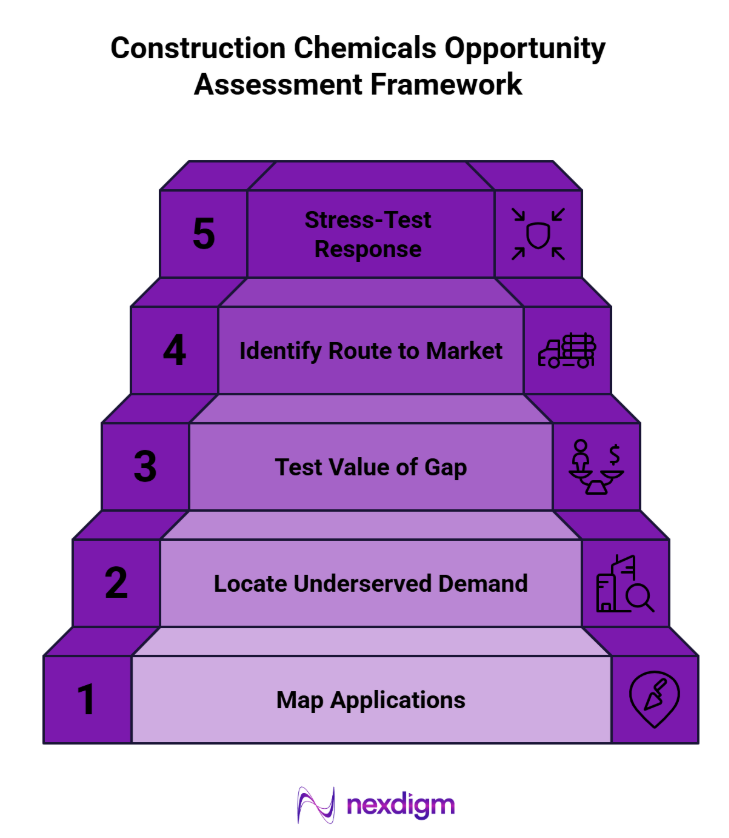
- Map the application pool
Break construction activity into the applications that consume chemical products. Estimate demand separately for admixtures, waterproofing, repair, flooring and other relevant categories instead of applying one construction-growth rate across the market. - Locate underserved demand
Compare customer requirements with the products, technical capabilities and distribution coverage currently available. Look for applications where customers face limited choice, inconsistent supply or inadequate technical support. - Test the value of the gap
Estimate whether the unmet requirement represents enough recurring demand to support a commercial proposition. High technical complexity can create attractive margins, but only if there is sufficient project density and customer willingness to pay. - Identify the route to market
Determine who influences product selection and who actually purchases it. Architects, consultants, contractors, applicators, developers and industrial facility owners can each play different roles. The strongest product-market opportunity is of limited value if access to the specification or purchasing process is difficult. - Stress-test competitive response
Assess how existing suppliers could respond if the opportunity becomes visible. A market gap is more defensible when it depends on technical capability, application expertise, customer relationships or distribution infrastructure that competitors cannot quickly replicate.
This framework helps distinguish a genuine market opening from a temporary supply shortage. It also allows opportunities to be ranked by both market size and quality of demand.
The Highest-Value Gap May Not Be The Largest One
Construction chemicals tend to become more attractive as technical requirements become more specific.
A standard admixture market can generate considerable volume but may face intense price competition. A specialised repair system for infrastructure or a chemical-resistant flooring system for a pharmaceutical facility may have a much smaller addressable market but stronger margins and fewer qualified suppliers.
The opportunity therefore needs to be judged on more than tonnes sold or square metres covered. Product complexity, specification influence, replacement frequency and customer switching costs can materially change the economics.
This is particularly relevant for companies considering expansion beyond their existing construction chemical portfolio. A supplier with established contractor relationships may have an advantage in adjacent waterproofing or repair categories. A manufacturer with formulation capabilities may find a stronger opening in specialised flooring or performance admixtures than in commoditised products.
Nexdigm Case: Prioritising Construction Chemical Gaps
A Nexdigm assessment screened 36 application-market combinations across eight Indian construction clusters, combining project pipelines, competitor coverage, customer interviews and pricing data. Nine showed meaningful supply gaps, but four met the required demand and margin thresholds. Specialised industrial flooring and infrastructure repair emerged as the strongest expansion opportunities, with a combined estimated addressable market of approximately INR 620 crore.
To take the next step, simply visit our Request a Consultation page and share your requirements with us.
Harsh Mittal
+91-8422857704