

Construction equipment demand is often treated as a proxy for construction activity. In practice, the relationship is more complicated. Excavators, loaders, cranes, graders, compactors, haul trucks, and other machines are purchased when physical projects require them, when mining output expands, when rental fleets need additional capacity, or when older equipment becomes uneconomic to maintain.
The latest Indian data illustrates the importance of looking beneath headline market growth. India’s construction equipment sales reached 106,933 units in 2025, down 6% from 114,330 units in 2024. Off-Highway Research forecasts a 5% recovery to 112,210 units in 2026, followed by 116,285 units in 2027 and 122,610 units in 2028.
The decline therefore does not necessarily indicate a collapsing demand base. Part of it reflected purchase timing around new emissions and safety requirements.
Infrastructure Creates Equipment Demand Through Project Execution
Infrastructure investment becomes relevant to equipment manufacturers when projects move from allocation to physical execution.
A road-building programme can create demand for excavators, graders, compactors, crushers, and asphalt equipment. Metro construction requires different combinations of cranes, tunnelling systems, concrete equipment, and material-handling machinery.
The size of announced infrastructure spending is therefore less useful than the value of projects entering construction, their execution schedules, and their equipment intensity.
For manufacturers, this creates a project-to-equipment conversion exercise. The market opportunity is the equipment requirement generated by actual project activity rather than the entire value of the infrastructure pipeline.
Mining Runs on a Different Cycle
Mining equipment demand follows production requirements and commodity economics.
A new mine can require large fleets of haul trucks, loaders, drills, excavators, and support equipment. Existing mines generate replacement demand as machines accumulate operating hours and maintenance costs increase.
The mineral outlook is particularly relevant in 2026. The IEA reports that demand for key energy minerals continued to expand strongly in 2025, with energy technologies accounting for approximately 75% of demand growth.
That does not mean every mining-equipment category will grow equally. Equipment demand depends on which minerals are being developed, where mines are located, mine depth, production targets, operating conditions, and fleet requirements.
Real Estate Demand Is More Sensitive to Financing
Construction equipment used in real estate tends to have a different demand cycle from equipment serving public infrastructure or mining.
Residential and commercial projects can be delayed when financing costs rise, property sales weaken, or developers face liquidity constraints. Contractors and rental companies can respond by extending fleet lives or renting equipment rather than purchasing new units.
This makes equipment ownership structure important.
A market with high rental penetration may show strong equipment utilization without producing equivalent new-equipment sales. Conversely, a market dominated by direct ownership may convert construction activity into new machinery purchases more quickly.
Replacement Demand Can Be as Important as New Construction
A machine does not need a new project to become a sales opportunity.
Fleet age, utilization, maintenance costs, fuel efficiency, emissions requirements, and resale values all influence replacement decisions.
India’s 2025 decline demonstrates the effect clearly. Off-Highway Research attributes part of the drop to pre-buying ahead of CEV Stage-V emissions and safety requirements in 2024. Customers and manufacturers accelerated purchases before the regulatory change, creating a weaker comparison base for 2025.
The forecast recovery to 112,210 units in 2026 and 116,285 units in 2027 suggests that timing effects need to be separated from structural demand.
For manufacturers, this distinction can change production planning, inventory levels, distributor strategy, and financing requirements.
Equipment Demand Is Becoming More Application-Specific
The same construction market can produce different opportunities across equipment classes.
High-rise development can favour lifting equipment. Road and infrastructure projects increase demand for earthmoving and compaction machinery. Mining requires high-capacity equipment with different uptime and durability specifications.
The opportunity therefore needs to be mapped from project activity to equipment class and then to individual product specifications.
This is where construction equipment market research services can move beyond market sizing into demand forecasting.
Nexdigm’s Construction Equipment Demand Mapping Framework
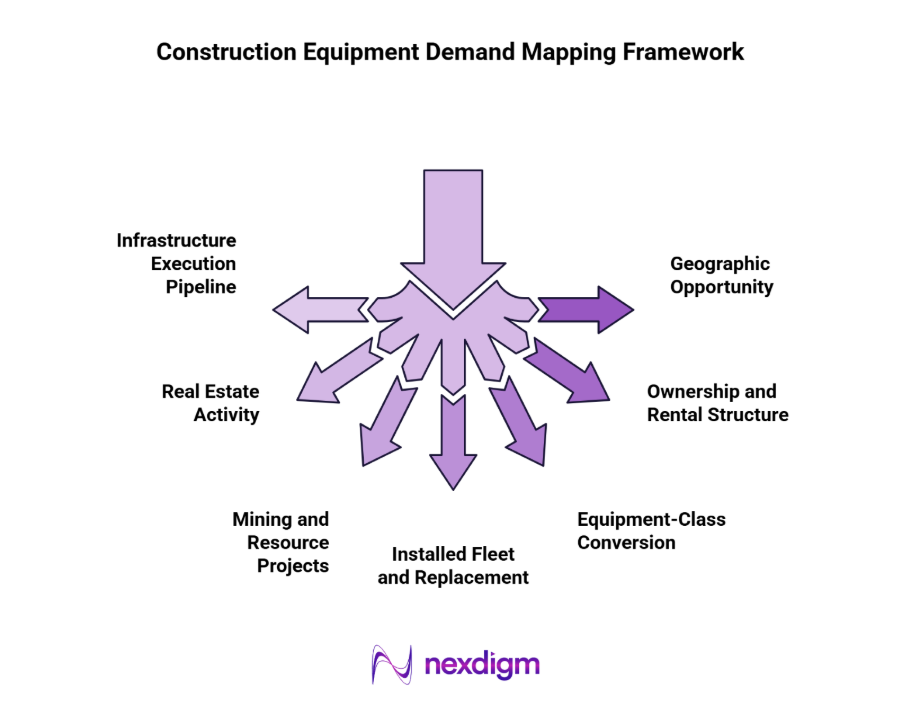
- Infrastructure Execution Pipeline
Track roads, railways, airports, ports, utilities, urban infrastructure, and project execution schedules. - Real Estate Activity
Assess housing starts, commercial construction, industrial development, financing conditions, and contractor activity. - Mining and Resource Projects
Map mine openings, expansions, production targets, commodity economics, and fleet requirements. - Installed Fleet and Replacement
Measure equipment population, age, utilization, maintenance expenditure, emissions compliance, and replacement timing. - Equipment-Class Conversion
Translate project and mining activity into demand for excavators, loaders, cranes, graders, haul trucks, compactors, and specialised machinery. - Ownership and Rental Structure
Assess direct ownership, rental penetration, financing availability, used-equipment markets, and fleet replacement behaviour. - Geographic Opportunity
Prioritize regions according to project intensity, fleet replacement, equipment utilization, competition, and achievable sales.
Case Study: Construction Equipment Market Research Services
India sold 106,933 construction machines in 2025, down 6% from 2024. With 2026 sales forecast at 112,210 units and 2028 at 122,610, manufacturers can distinguish cyclical pre-buying effects from the underlying recovery.
To take the next step, simply visit our Request a Consultation page and share your requirements with us.
Harsh Mittal
+91-8422857704