

Construction markets are shaped by infrastructure spending, housing demand, commercial development, financing conditions and the availability of materials and labour. For contractors, equipment manufacturers, material suppliers and investors, understanding these factors is essential to identifying where demand is building and where project economics are becoming less attractive.
A reliable assessment must distinguish announced investment from projects that are funded, approved and progressing towards execution.
Track Project Demand And Investment
Construction demand varies considerably across residential buildings, commercial real estate, industrial facilities, transport infrastructure, energy projects and public works. Each segment has different procurement cycles, material requirements and exposure to financing costs.
The World Bank’s Private Participation in Infrastructure database reported that investment in infrastructure projects with private participation in low- and middle-income countries reached US$100.7 billion in 2024, a 16% increase from 2023. The database covers projects across energy, transport, telecommunications and water and sanitation, offering a useful view of infrastructure investment activity.
However, infrastructure investment is not equivalent to total construction output. Project announcements, financing commitments, contract awards and completed construction should be tracked separately.
Businesses should monitor:
- Project Pipeline: Identify announced, approved, financed and awarded projects.
- Sector Demand: Separate residential, commercial, industrial and infrastructure activity.
- Funding Conditions: Assess public budgets, private investment, credit availability and interest rates.
- Project Timing: Track tender dates, construction starts, delays and completion schedules.
- Regional Concentration: Identify locations where multiple projects may compete for the same resources.
This helps companies estimate when demand is likely to translate into orders.
Evaluate Capacity And Cost Pressures
Strong project demand can create opportunities, but it can also strain the supply of construction materials, skilled labour, equipment and specialist contractors.
Companies should assess cement, steel, aggregates, electrical equipment and other critical inputs alongside transport costs, supplier lead times and local production capacity. Import dependence can expose projects to currency movements, tariffs and shipping disruptions.
Construction output data can help distinguish a growing market from one experiencing temporary fluctuations. Eurostat’s 2025 construction statistics showed differing performance between building construction and civil engineering across the European Union, illustrating why broad industry averages can conceal important segment-level differences.
Understand Competition And Market Access
construction industry analysis should connect project demand with the capabilities and capacity of firms competing for the work.
Competitor assessments can examine contract awards, project portfolios, geographic coverage, specialist expertise, equipment availability and financial capacity. For material suppliers, trade data can reveal which countries are supplying a market and whether import dependence is changing.
The analysis should also consider qualification requirements, local-content rules, permitting processes and payment conditions. A market may have an extensive project pipeline but remain difficult to enter if contracts require established local relationships or significant financial guarantees.
For contractors, bid prices alone do not determine competitiveness. Delivery record, technical capability, access to subcontractors and the ability to manage cost escalation can influence both contract awards and profitability.
Turn Market Intelligence Into Project Priorities
Businesses should compare potential markets using both demand and execution risk. A large project pipeline may be less attractive if projects are repeatedly delayed or if suppliers face severe payment uncertainty.
Scenario analysis can test how higher material costs, slower approvals or reduced financing availability affect expected returns. Companies can also identify where partnerships, local sourcing or phased investment would reduce entry barriers.
The Construction Market Assessment Framework
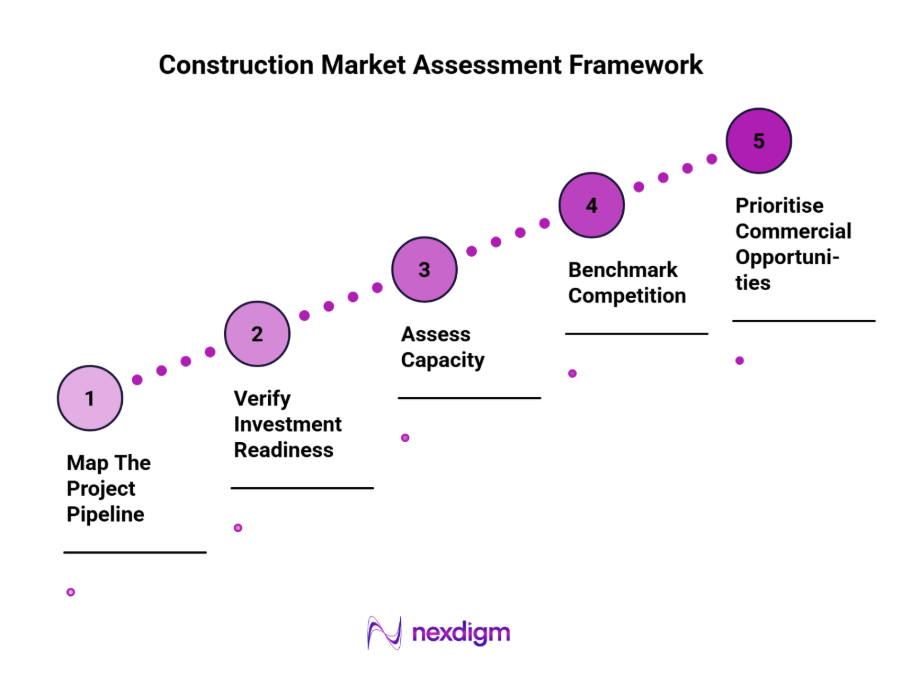
- Map The Project Pipeline: Identify projects by sector, location, stage and expected timing.
- Verify Investment Readiness: Separate announced projects from funded and awarded contracts.
- Assess Capacity: Evaluate material availability, labour, equipment and contractor coverage.
- Benchmark Competition: Review contract awards, competitor capabilities and market access requirements.
- Prioritise Commercial Opportunities: Compare expected demand, margins, execution risk and payment conditions.
Case Study: Selecting A Regional Construction Market
A building materials supplier compares three regional markets using project pipelines, infrastructure investment, import dependence and competitor coverage. One market has numerous announcements but limited confirmed funding. Another has fewer projects, but several funded infrastructure contracts and established distribution channels, making it the preferred entry point.
Construction intelligence is most useful when it connects investment signals with project readiness, supply capacity and competitive conditions. This enables companies to target markets where demand is more likely to become executable work rather than relying on announced spending alone.
To take the next step, simply visit our Request a Consultation page and share your requirements with us.
Harsh Mittal
+91-8422857704