

A construction market can look attractive on paper and still be difficult to enter. Project pipelines may be extensive, but funding can be uncertain, established contractors may control major tenders, and shortages of labour or materials can erode expected margins.
A sound market assessment needs to connect four questions: what will be built, who will fund it, which companies can deliver it and whether the available capacity can support additional work.
First, Establish What the Pipeline Contains
Project databases should be segmented by construction type, geography, project value, funding source and development stage. A housing programme has different commercial implications from a port expansion or a new industrial facility.
The World Bank’s Private Participation in Infrastructure database tracks projects involving private participation across sectors such as energy, transport and water. It can help identify investment activity and compare infrastructure markets, although it does not represent the full construction pipeline or all publicly funded projects.
A practical pipeline should distinguish between announced proposals without confirmed funding, projects that have secured financing or formal approval, tenders and contract awards, projects under construction, and completed projects with future maintenance requirements.
This classification prevents businesses from counting the same opportunity repeatedly as it moves through successive stages.
Investment Is Only One Side of the Equation
Construction demand is influenced by public expenditure, private capital, interest rates, property-market conditions and the cost of financing. Changes in any of these can alter project timing.
The FIEC Statistical Report 2026 estimated that EU construction investment declined by 2.1% in real terms in 2025, with a moderate recovery forecast for 2026. Civil engineering performed more strongly than several building segments, supported by investment in transport, energy and water infrastructure.
The implication is not that civil engineering is always the best market. Rather, demand must be assessed at segment level. Contractors specialising in residential development may face different conditions from companies supplying power infrastructure or industrial construction.
Competition And Capacity Determine Accessibility
A market with many projects may also have intense competition. Assess contractors’ experience, tender participation, project portfolios, geographic reach, specialist equipment and financial capacity. For suppliers, examine which companies have framework agreements or established relationships with major developers and public authorities.
Then test delivery capacity. Skilled labour, subcontractor availability, equipment, materials and permitting can all restrict how much work can be undertaken at once. Where demand outpaces capacity, prices may rise, but so can execution risk and project delays.
Construction market analysis should therefore go beyond estimating market size. It should connect the project pipeline to the companies competing for work and the resources required to deliver it.
Market Entry Scorecard
Assess each candidate market against five practical considerations:
- Project Certainty: Are funding, approvals, tender schedules and start dates confirmed?
- Demand Quality: Does the market offer a sustained mix of projects, recurring requirements and commercially viable contract sizes?
- Competitive Pressure: How established are incumbent contractors, and how difficult will it be to secure contracts or local relationships?
- Delivery Capacity: Are skilled labour, materials, equipment and subcontractors available when projects require them?
- Commercial Risk: Are payment conditions, cost escalation, regulation and contractual obligations manageable?
Use these considerations to compare markets, but do not let an overall score conceal a critical weakness. Strong demand cannot compensate for an inability to meet qualification requirements or a serious risk of non-payment.
Nexdigm’s Construction Market Prioritisation Framework
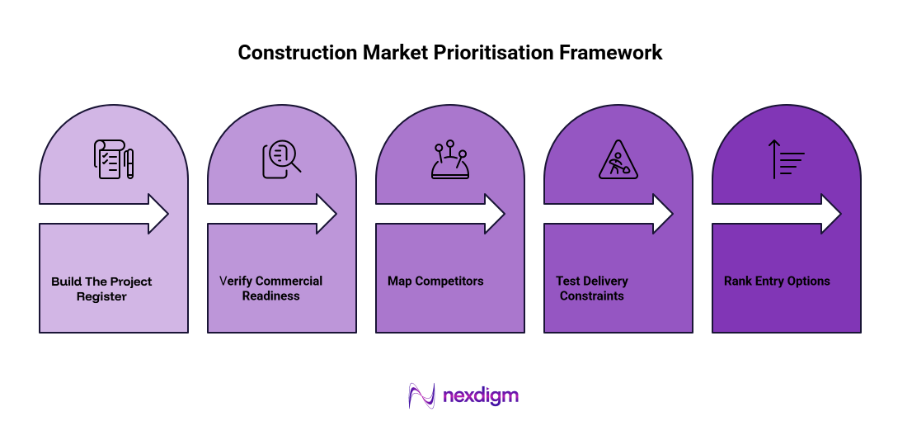
- Build The Project Register: Compile projects by location, sector, value and stage.
- Verify Commercial Readiness: Check funding, approvals, tender timing and procurement status.
- Map Competitors: Assess incumbent capabilities and likely tender participation.
- Test Delivery Constraints: Review labour, equipment, material and subcontractor availability.
- Rank Entry Options: Compare revenue potential with margins, risk and required investment.
From Pipeline Size to Executable Demand
The best construction markets are not necessarily those with the largest project announcements. They are those where demand is funded, opportunities are accessible and delivery capacity is sufficient to support profitable execution.
Nexdigm’s Case Study: Reordering A Market Pipeline
A specialist contractor compares two markets with similar announced project values. Further checks show that one has repeated funding delays and concentrated incumbent competition, while the other has awarded contracts and a wider pool of subcontractors. The contractor prioritises the second market for near-term business development.
To take the next step, simply visit our Request a Consultation page and share your requirements with us.
Harsh Mittal
+91-8422857704