

The global consumer electronics market continues to expand in value, even as mature categories experience slower unit growth. Pure-play consumer electronics revenue is projected at approximately $1.03 trillion in 2026, while the broader global Tech & Durables market is expected to reach roughly $1.4 trillion, growing 5.1% year over year. For a new electronics brand, however, market size alone says little about commercial viability.
The relevant question is whether a specific product can find enough customers at a viable price, reach them through profitable channels, and establish differentiation against incumbents. This requires a closer assessment of demand, customer segments, pricing, channel economics, competitive intensity, and entry investment.
Where Is the Actual Demand?
Market sizing becomes more useful when customers are segmented by purchasing behaviour, including price sensitivity, replacement cycles, preferred channels, geography, brand loyalty, and willingness to switch.
Premium and price-sensitive consumers can have very different priorities, while regional conditions can also influence product demand. Replacement cycles determine whether a category offers recurring volume or mainly installed-base demand.
The addressable opportunity should therefore be built around identifiable customer cohorts rather than an assumed share of total category revenue. A category growing at more than 6% annually may appear attractive, but the opportunity can narrow significantly once demand is segmented by price tier, geography, and replacement frequency.
Can the Product Support Its Price?
Pricing has become more difficult as component costs increase. DRAM and NAND pricing has risen by more than 300% year over year, with memory components potentially increasing from a historical 12%–15% share of hardware BOM to 28%–35%. This creates particular pressure on entry-level products, where manufacturers have limited room to absorb cost increases.
A consumer electronics market feasibility study should therefore test price elasticity alongside BOM structure, competitor pricing, financing options, trade-in economics, and channel discounts. A product that appears competitive at factory cost can become commercially unattractive once distribution margins, marketplace fees, logistics, warranty provisions, and promotional spending are included.
Which Route to Market Protects Margin?
Distribution can determine whether a viable product remains commercially viable after reaching the customer. Multi-tier physical distribution can consume 25%–35% of retail price through distributor and dealer margins while creating additional inventory and receivables exposure.
Digital marketplaces provide scale but introduce platform fees, sponsored-placement costs, and dependence on third-party algorithms. D2C provides greater control over pricing and customer data, although customer acquisition and fulfilment costs can rise rapidly.
A new brand therefore needs to model the economics of each channel before committing to a route-to-market strategy. D2C may establish early demand, marketplaces can extend reach, and selected physical retail partnerships can support product demonstration and local credibility.
Where Can a New Brand Find Competitive White Space?
Competitive concentration should be assessed at category and subcategory level. Premium smartphones and smart televisions, for example, can have CR4 concentration above 75%, creating significant barriers through established ecosystems, distribution relationships, and consumer loyalty.
More fragmented categories can offer greater room for differentiation, particularly where consumers have identifiable functional frustrations. Durability, repairability, battery performance, privacy, localized processing, and specialized form factors can create opportunities where established brands have concentrated primarily on mainstream specifications.
The assessment should also distinguish genuine unmet demand from features consumers are unwilling to pay for. A product advantage becomes commercially meaningful when it can improve conversion, support a price premium, increase retention, or reduce acquisition costs.
Nexdigm Brand Entry Framework: Six Tests for Commercial Viability
Nexdigm can evaluate a new electronics proposition through six decision areas:
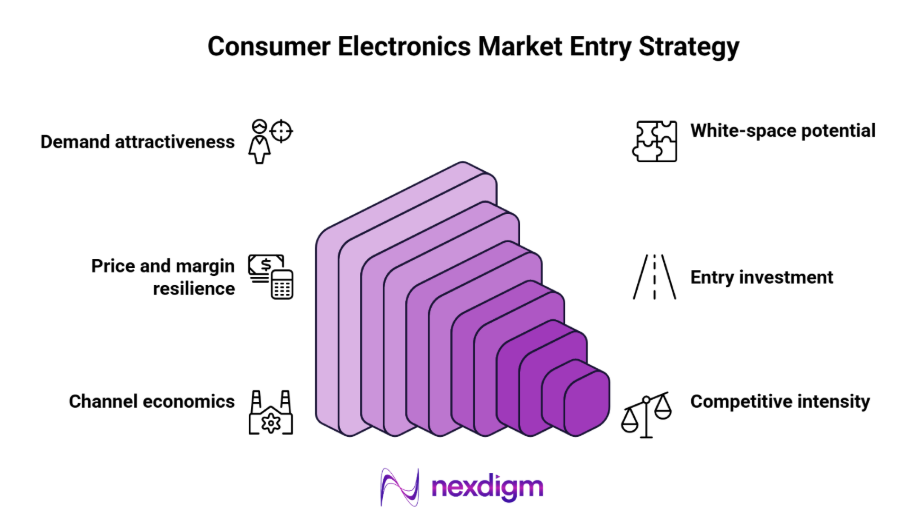
- Demand attractiveness: Size addressable customer cohorts, replacement demand, and segment growth.
- White-space potential: Benchmark competing products, features, positioning, and unmet customer needs.
- Price and margin resilience: Model BOM, ASP, elasticity, discounts, and contribution margins.
- Channel economics: Compare D2C, marketplace, distributor, dealer, and retail economics.
- Competitive intensity: Assess CR4 concentration, incumbent advantages, and switching barriers.
- Entry investment: Evaluate tooling, MOQ, inventory requirements, working capital, and time to scale.
The resulting assessment can identify which segments warrant entry, which pricing positions are defensible, and where the proposed business model requires adjustment.
Nexdigm Case: Validating a New Electronics Brand
Nexdigm assessed a new consumer electronics brand across 12 competitors, five price bands, and three distribution channels. The analysis identified a 17% pricing opportunity in an underserved segment, reduced projected customer acquisition cost by 23%, and prioritized two launch channels expected to improve first-year margins by 14%.
To take the next step, simply visit our Request a Consultation page and share your requirements with us.
Harsh Mittal
+91-8422857704