

Consumer credit growth is becoming increasingly uneven. Borrowing demand continues to expand, but the quality and economics of that demand vary sharply by borrower income, geography, product type, and credit history. High-income households generally retain stronger debt-servicing capacity, while younger, non-prime, and lower-income borrowers face greater pressure from revolving balances and unsecured obligations.
Aggregate credit growth is therefore a weak indicator of market opportunity. Lenders need to identify borrower segments where demand can expand without creating disproportionate default, servicing, or regulatory risk.
Consumer Credit Is Moving Beyond Traditional Prime Borrowers
In emerging markets such as India, retail credit has expanded faster than industrial borrowing, with non-housing retail credit playing a major role. Unsecured personal loans, credit cards, and consumer durable financing have widened access to credit, particularly among new-to-credit and younger borrowers.
The expansion has also attracted greater regulatory attention. The Reserve Bank of India increased risk weights on unsecured consumer credit by 25 percentage points, reflecting concerns around rapid origination and the capital requirements associated with higher-risk portfolios.
For lenders, the opportunity is consequently less about maximizing loan volumes and more about understanding which borrower cohorts can support sustainable balances.
Affordability Is Reshaping Product Demand
Higher borrowing costs have altered how consumers use credit. Large secured purchases can become harder to finance when monthly debt obligations rise, while smaller unsecured facilities can remain attractive for short-term liquidity needs.
Different products address different forms of household demand:
- Credit cards support recurring consumption, rewards, and short-term cash-flow gaps.
- Personal loans are commonly used for debt consolidation, medical expenses, and major life events.
- Consumer durable finance supports purchases such as electronics, appliances, and smartphones.
- Auto and two-wheeler loans address mobility and income-generating transportation.
- Gold loans provide collateral-backed liquidity where borrowers have limited access to conventional formal credit.
The commercial opportunity depends on whether the product’s repayment structure matches the borrower’s cash-flow profile. A rapidly growing product can still produce weak economics if affordability is stretched or refinancing becomes necessary to maintain repayments.
Geography Can Reveal the Next Credit Pools
Credit penetration differs significantly between metropolitan and smaller markets.
Tier-1 cities tend to have deeper access to banks, NBFCs, cards, and digital lenders. Competition for established borrowers can therefore increase acquisition costs while limiting room for differentiated pricing.
In Tier-2 and Tier-3 markets rising disposable incomes, increasing digital adoption, and demand for household goods and mobility can create new borrowing requirements, while traditional branch-based lending remains less pervasive.
These markets require granular assessment.
Informal income, property ownership, agricultural assets, gold holdings, and banking transaction histories can all affect how lenders evaluate repayment capacity.
Risk Is Becoming a Market-Selection Variable
Expanding into new borrower populations also changes portfolio risk. New-to-credit customers may lack established bureau histories, while borrowers with several recent loans can carry hidden leverage that is difficult to identify through a single lending relationship.
Multi-lending is particularly important. Borrowers accessing several digital credit lines may appear manageable within individual portfolios while carrying substantially higher aggregate obligations. Early delinquency across 30-, 60-, and 90-day buckets can consequently reveal deterioration before headline portfolio performance changes materially.
Borrower segmentation therefore needs to incorporate employment stability, bureau behavior, existing obligations, collateral, regional penetration, and repayment history together.
A Consumer lending market assessment connects borrower demand with affordability, product suitability, credit behavior, and regional penetration.
Nexdigm’s Consumer Credit Opportunity Framework
Nexdigm evaluates consumer lending opportunities by connecting demand potential with portfolio sustainability. The assessment examines borrower segments, product requirements, affordability, competitive intensity, and the risk characteristics associated with each market.
Key analytical dimensions include:
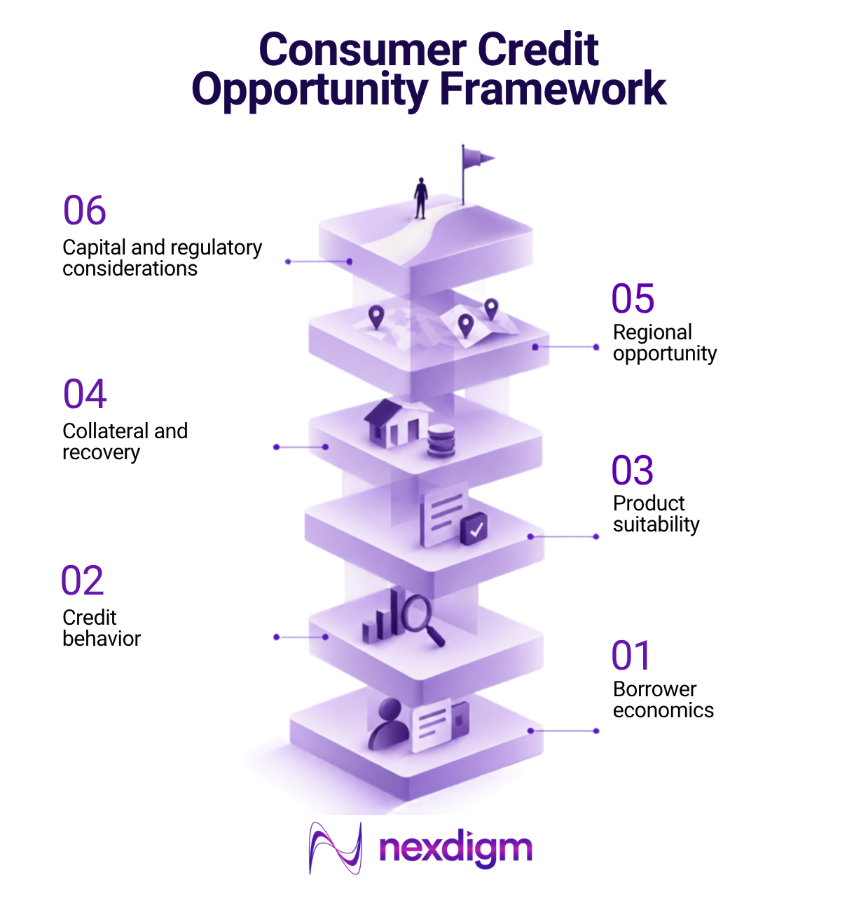
- Borrower economics: income stability, monthly obligations, disposable cash flow, and employment profile.
- Credit behavior: bureau history, recent inquiries, active loans, and delinquency trajectories.
- Product suitability: whether unsecured, secured, revolving, or asset-backed credit matches the underlying borrowing need.
- Collateral and recovery: asset liquidity, loan-to-value considerations, and recovery conditions for secured products.
- Regional opportunity: credit penetration, household economics, competitive presence, and underserved borrower pools.
- Capital and regulatory considerations: how borrower risk and product structure affect portfolio economics.
The result is a segment-level view of where incremental lending can generate attractive returns without relying solely on aggressive origination.
How Nexdigm Identifies Credit Segments with Attractive Risk-Adjusted Demand
Nexdigm ranks borrower and product combinations according to demand, affordability, risk, competitive intensity, and regulatory constraints. This can distinguish saturated urban unsecured lending from opportunities such as secured mobility finance, consumer durable lending, gold-backed credit, and payroll-linked lending.
A lender evaluating 12 consumer-credit segments found that three Tier-2/3 asset-finance categories accounted for 42% of modelled incremental demand, while high-risk unsecured cohorts required materially higher capital allocation.
Nexdigm used borrower affordability, bureau behavior, collateral, and regional penetration to prioritize scalable segments.
The assessment gives lenders a clearer basis for deciding where to expand, which products to emphasize, and which borrower cohorts require tighter underwriting or reduced exposure.
To take the next step, simply visit our Request a Consultation page and share your requirements with us.
Harsh Mittal
+91-8422857704
[email protected]