

As consumer credit demand expands across emerging and mature markets, lenders require pricing models that balance portfolio growth, profitability, and risk. Effective consumer lending pricing strategy analysis combines borrower segmentation, credit risk assessment, market benchmarking, competitor pricing, and regulatory considerations to optimize lending decisions.
Financial institutions can refine interest rates, fees, and promotional offers while improving customer acquisition, portfolio quality, and lifetime value using Strategic Pricing Analysis. A data-driven pricing strategy enables sustainable growth, stronger margins, and better customer retention in an increasingly competitive lending environment.
Recent TransUnion data shows U.S. personal-loan originations reached a record 7.6 million in Q4 2025, increasing 21.7% year over year, while outstanding balances rose to $277 billion by Q1 2026. These trends reinforce the need for disciplined, pricing analysis as consumer credit demand expands.
How Pricing Analysis Strengthens Consumer Lending Performance
Pricing analysis helps lenders align borrower risk, market demand, funding costs, and profitability, enabling competitive loan offers, stronger portfolio quality, sustainable margins, and responsible consumer credit growth across customer segments. Key steps for the following are:
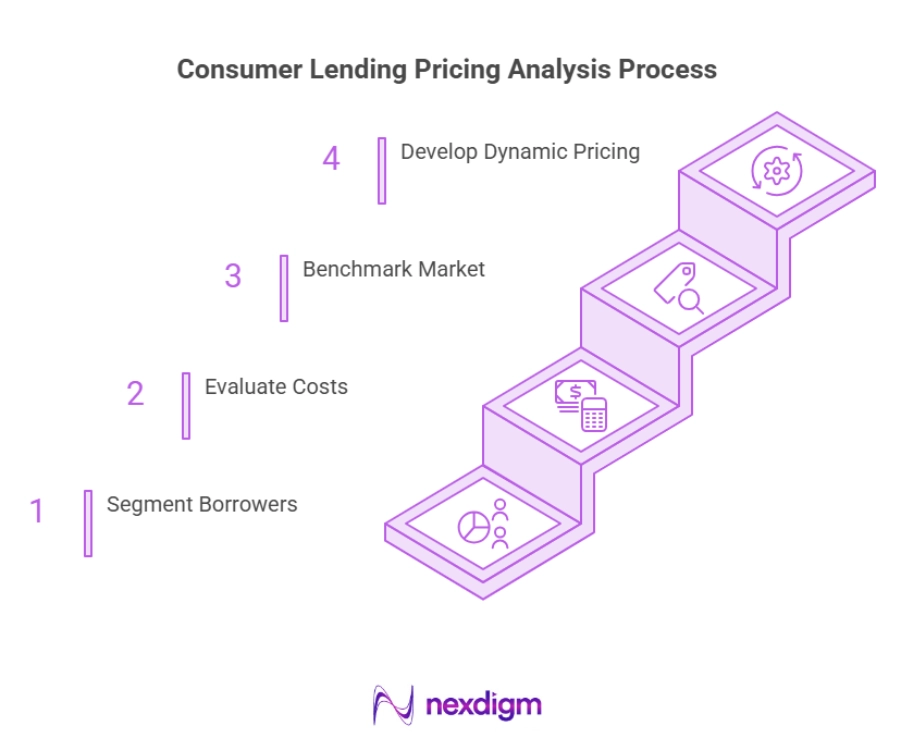
- Segment Borrowers and Assessing Risk: Analyze credit scores, repayment history, income stability, and borrowing behaviour to create differentiated pricing that reflects borrower risk and long-term portfolio performance.
- Evaluate Cost and Profitability Drivers: Assess funding costs, operating expenses, expected credit losses, and capital requirements to establish sustainable interest rates that protect margins while remaining competitive.
- Benchmark Market Pricing: Compare loan rates, fees, tenures, promotional offers, and competitor strategies to identify pricing opportunities and position lending products effectively across target customer segments.
- Develop Dynamic Risk-Based Pricing: Design flexible pricing models that adjust interest rates and loan terms based on borrower profiles, market conditions, demand trends, and evolving credit risk indicators.
Nexdigm’s Strategic Support for Consumer Credit Pricing Analysis
Nexdigm supports lenders with market benchmarking, borrower segmentation, cost assessment, and risk-based pricing models that improve credit decisions and portfolio returns. Its consumer credit pricing analysis, loan pricing strategy, pricing analysis services, and lending profitability consulting help institutions optimize rates, fees, and offers while balancing customer acquisition, regulatory expectations, credit risk, competitive positioning, sustainable margins, and long-term portfolio growth.
Nexdigm’s Consumer Lending Pricing Analysis Framework
Nexdigm’s framework combines credit risk, customer value, market intelligence, and portfolio economics to design lending prices that strengthen competitiveness, profitability, responsible growth, and long-term borrower relationships across consumer finance markets. Some major framework models used by Nexdigm’s experts are:
- Vintage Performance Model: Compares loan cohorts by origination period, pricing band, borrower segment, and channel to identify emerging delinquency, margin, conversion, and repayment performance trends early.
- Affordability and Capacity Model: Evaluates income, expenses, existing obligations, disposable surplus, and repayment capacity to structure responsible interest rates, loan amounts, and tenures for individual borrowers appropriately.
- Conversion Optimization Model: Analyzes application completion, approval, acceptance, and disbursement patterns across pricing variations to identify offers that improve customer conversion without weakening portfolio economics or quality.
- Macroeconomic Scenario Model: Tests pricing performance under changing interest rates, inflation, unemployment, liquidity, and credit conditions to strengthen portfolio resilience and support forward-looking lending decisions effectively.
Nexdigm’s Case
Nexdigm helped a consumer finance provider redesign its lending pricing strategy using real-time market benchmarks, borrower segmentation, and risk-based pricing analytics. Within nine months, loan conversion rates increased 18%, net interest margins improved 10%, delinquency rates declined and customer acquisition costs reduced.
To take the next step, simply visit our Request a Consultation page and share your requirements with us.
Harsh Mittal
+91-8422857704