

Consumer purchase decisions are becoming more deliberate, fragmented, and omnichannel. In 2026, research from Impact and Cardlytics found that average order value increased 1.9% while shopping-trip frequency declined 1.6% over a two-year period, while click volumes rose 2% year-on-year but conversion rates fell 6%.
In India, a 2026 A&M–CII study found that 64% of shoppers complete purchases across two or more channels, while 83% rely on reviews before buying. These shifts show why retailers need to understand not only what consumers buy, but what triggers choice, increases basket size, and moves customers toward conversion.
Product Choice Is Shaped by More Than Price
Consumers evaluate products through a combination of price, quality, reviews, convenience, availability, brand reputation, promotions, and personal relevance. These factors can carry different weight across categories and customer segments. Understanding their relative importance helps retailers refine propositions, assortment, pricing, and communication rather than assuming that a single purchase driver applies across the market.
Basket Size and Conversion Follow Different Signals
A customer may show strong interest without completing a purchase, while another may enter a store or platform intending to buy one item and leave with several. Basket expansion can be influenced by recommendations, promotions, convenience, complementary products, and minimum-order thresholds.
- Basket Expansion: Cross-selling, bundling, promotions, assortment, and convenience can encourage customers to add complementary products to their purchases.
- Conversion Drivers: Price, trust, reviews, availability, delivery, product information, and checkout experience can influence whether consideration becomes an actual purchase.
Nexdigm’s Approach to Consumer Purchase Behavior Intelligence
Nexdigm combines consumer research, retail market intelligence, category analysis, competitive intelligence, pricing assessment, and channel research to understand the factors shaping purchase behaviour. Our consumer purchase behavior retail analysis can examine:
- Purchase Drivers: Evaluate price, quality, brand perception, reviews, promotions, convenience, availability, product features, and other factors influencing product choice.
- Consumer Journey: Map how consumers move from awareness and discovery to comparison, purchase, basket building, and post-purchase behaviour across online and offline channels.
- Basket and Conversion Signals: Analyze basket composition, purchase frequency, complementary purchases, conversion barriers, cart abandonment, and repeat behaviour to identify opportunities for growth.
Why Consumer Purchase Behaviour Needs Structured Analysis
Purchase behaviour can vary significantly by category, customer segment, geography, channel, price point, and purchase occasion. A factor that drives conversion for everyday groceries may have limited influence on a high-consideration electronics purchase.
A structured approach therefore helps separate purchase triggers from barriers, distinguish planned from impulse purchases, and understand how consumers move between online and offline touchpoints before completing a transaction.
Nexdigm’s Consumer Intelligence Assessment
Nexdigm’s assessment moves beyond identifying what consumers purchase to understand why they purchase, what influences their decisions, and where businesses can intervene to improve commercial outcomes. The assessment can combine quantitative and qualitative inputs to evaluate consumer segments through:
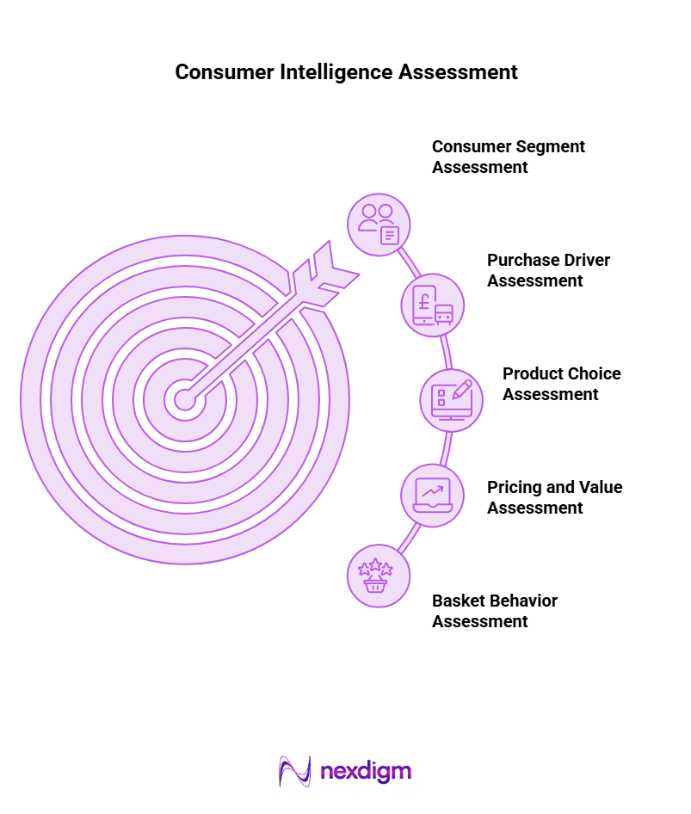
- Consumer Segment Assessment: Nexdigm identifies differences in purchase behaviour across demographic, socioeconomic, behavioural, geographic, and need-based segments.
- Purchase Driver Assessment: The analysis determines the relative importance of price, quality, brand, convenience, reviews, promotions, availability, and product features in influencing purchase decisions.
- Product Choice Assessment: Nexdigm compares product attributes, formats, features, brands, and price points to understand what drives selection within specific categories.
- Pricing and Value Assessment: The analysis evaluates price sensitivity, promotional response, competitor pricing, willingness to pay, and perceived value across customer segments.
- Basket Behaviour Assessment: Nexdigm examines basket size, complementary purchases, cross-selling patterns, purchase frequency, and product combinations to identify opportunities for increasing transaction value.
The assessment ultimately connects consumer motivations with measurable commercial outcomes, helping businesses determine which behavioural insights require strategic action.
How Nexdigm’s Consumer Intelligence Assessment Creates Competitive Advantage
A deeper understanding of consumer behaviour can give businesses an advantage by helping them respond to customer needs more precisely than competitors through:
- Sharper Product Positioning: Nexdigm can identify the product attributes and benefits that matter most to specific customer groups, helping businesses develop differentiated propositions rather than competing primarily on price.
- More Effective Pricing: Understanding willingness to pay, price sensitivity, promotional response, and competitor alternatives can help businesses establish more relevant pricing and value strategies.
- Stronger Customer Targeting: Segment-level behavioural insights allow businesses to prioritize customers based on needs, purchase motivations, value potential, and channel behaviour, supporting more focused marketing and commercial investment.
- Higher Conversion Potential: Identifying friction throughout the customer journey can help businesses improve product information, availability, checkout, fulfilment, payment, and overall customer experience.
Overall, Nexdigm’s consumer intelligence assessment helps businesses turn behavioural evidence into product, pricing, customer, channel, and experience strategies, creating opportunities to compete through greater relevance rather than relying solely on discounts or increased promotional spending.
Nexdigm’s Case
Nexdigm surveyed 4,500 UAE consumers to understand product preferences and shopping behaviour. The research found 72% preferred mobile shopping, while insights-led product placement and e-commerce optimization contributed to an 18% improvement in client conversion rates. The engagement helped translate consumer behaviour into measurable improvements in retail targeting and conversion.
To take the next step, simply visit our Request a Consultation page and share your requirements with us.
Harsh Mittal
+91-8422857704