

Contract logistics strategies are gaining relevance as businesses increasingly outsource supply chain activities to improve flexibility, efficiency, and market responsiveness. As part of a market entry strategy, contract logistics allows companies to access warehousing, transportation, inventory management, fulfilment, and distribution capabilities without building full-scale infrastructure from the start.
A well-defined Contract logistics market entry strategy helps businesses reduce operational complexity, control costs, and scale faster in new regions. By working with specialised logistics partners, companies can strengthen service reliability, improve delivery performance, and adapt to changing demand while focusing on core growth priorities across domestic and cross-border markets.
The global contract logistics market was valued at about USD 345.9 billion in 2025 and is projected to reach USD 641 billion by 2033, growing at a CAGR of 8.1%. Asia Pacific accounted for 34.5% of the market in 2025, reflecting strong demand for outsourced warehousing, transportation, fulfilment, and integrated supply chain solutions.
Strengthening Distribution Readiness in New Markets Through Outsourced Logistics Models
Outsourced logistics models strengthen distribution readiness by providing access to warehousing, transport, fulfilment, and delivery networks, helping businesses enter new markets faster with lower infrastructure investment:
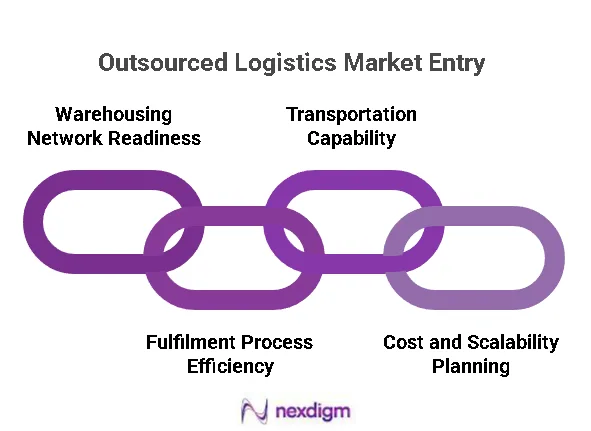
-
Warehousing Network Readiness
Assesses storage capacity, warehouse locations, and fulfilment infrastructure needed to support faster distribution in new markets.
-
Transportation Capability
Reviews transport availability, delivery routes, carrier networks, and last-mile access to ensure reliable market coverage.
-
Fulfilment Process Efficiency
Evaluates order processing, picking, packing, dispatch, and returns capabilities for smooth outsourced logistics operations.
-
Cost and Scalability Planning
Compares outsourcing costs, volume flexibility, and expansion capacity to support phased market entry without heavy investment.
Nexdigm’s Advisory on Distribution Network Planning for Market Entry
Nexdigm can advise businesses on designing efficient distribution networks for new market entry by assessing demand centres, warehouse locations, transport routes, partner capabilities, costs, and service levels. This helps create scalable logistics structures that improve delivery reach, reduce risks, and support phased regional expansion.
Nexdigm Logistics Partner Assessment for Outsourced Supply Chain Operations
Nexdigm can evaluate logistics partners on service capability, network coverage, cost structure, technology systems, compliance standards, scalability, and performance reliability to support efficient outsourced supply chain operations.
-
Partner Capability Assessment
Reviews warehousing, transportation, fulfilment, inventory handling, and delivery capabilities to determine partner readiness for outsourced operations.
-
Network Coverage Review
Evaluates geographic reach, hub locations, last-mile access, and route strength to support market entry and regional distribution.
-
Technology and Reporting Systems
Assesses tracking tools, warehouse systems, reporting dashboards, and integration capability for better supply chain visibility.
-
Service Model Evaluation
Compares pricing structures, service terms, scalability options, and contractual flexibility to manage outsourcing costs effectively.
Nexdigm’s case:
Nexdigm helped a consumer products company assess logistics partners for outsourced supply chain operations across three target markets. By reviewing service capability, network coverage, technology systems, compliance standards, and cost models, Nexdigm helped the company shortlist two suitable partners, reduce projected logistics costs by 13–16%, improve delivery coverage by 32%, and accelerate market entry readiness by nearly 25%.
To take the next step, simply visit our Request a Consultation page and share your requirements with us.
Harsh Mittal
+91-8422857704